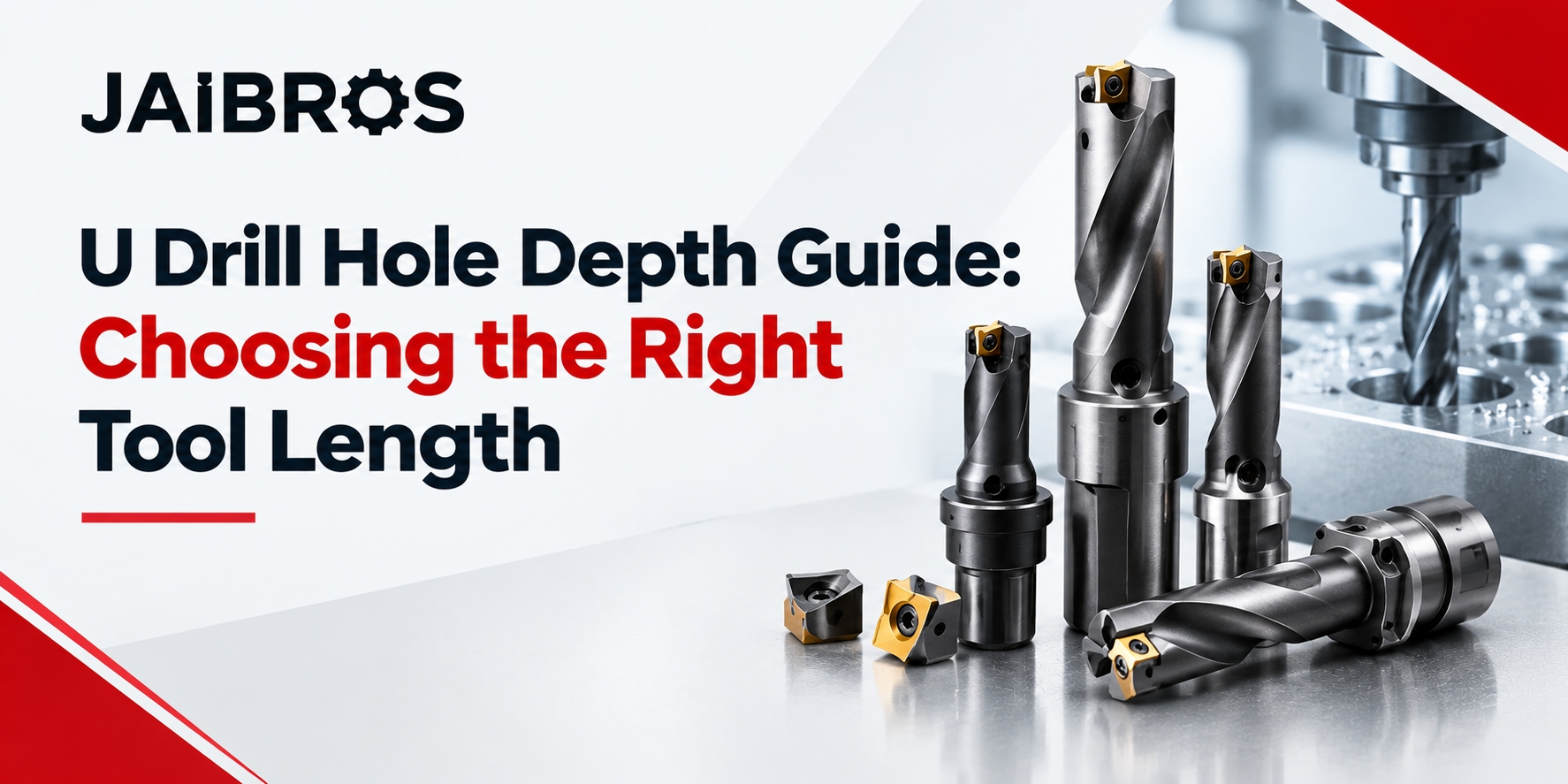
Drilling a deep hole sounds easy until chips jam in the flute, an insert breaks, or the hole ends up shorter than the drawing asks. The first step to avoiding these problems is choosing a u drill with the correct length. This guide explains depth ratios, how to read sizing data, and simple rules for matching tool length to your job. You will save time, tools, and material.
What Is an Indexable Drill and Why Does Length Matter?
An indexable drill, often called a U-type drill, has a steel body with replaceable carbide inserts at the tip. When an edge wears, you change the insert instead of regrinding or replacing the whole tool.
Length matters because the flute is the only path for chips to leave the hole. If the flute is too short, the tool cannot reach the full depth. If the tool is too long, it flexes, vibrates, and loses accuracy. The goal is always the shortest drill that still completes the hole.
Understanding the Depth Ratio (xD)
Drill length is described as a multiple of diameter, known as the L/D ratio. Common ratios are 2xD, 3xD, 4xD, and 5xD. Longer types, up to 7xD or 8xD, are made for special jobs. The ratio tells you the approximate maximum hole depth.
Here is a quick example for a 20 mm diameter drill:
Depth Ratio | Approximate Maximum Depth |
2xD | 40 mm |
3xD | 60 mm |
4xD | 80 mm |
5xD | 100 mm |
These values are approximate, because exact flute length differs between tool makers.
Using a U Drill Size Chart
A u drill size chart lists the diameter range, flute length, overall length, shank diameter, and matching insert code. To use it correctly, follow these steps:
Measure the finished hole depth.
Add a small allowance for breakout on through holes.
Find the row for your hole diameter.
Pick the lowest ratio whose flute length covers the total depth.
Check that the shank fits your holder.
Always confirm dimensions in the maker’s catalogue, because charts are not identical across manufacturers.
Choosing the Right Diameter
The u drill size you select sets the hole diameter, and the finished hole is often slightly oversize. Typical tolerance falls in the IT12 to IT13 range. This is fine for bolt clearance holes, pre-drilling before tapping, and rough bores.
When you need a close-fit hole, drill first and then finish with a boring bar or reamer. Leave enough stock in the hole for that finishing tool to cut cleanly.
Matching the Insert to the Material
Every u drill insert has a grade and geometry designed for certain materials. Most tools use two inserts. A central insert works near the axis at low cutting speed, and a peripheral insert does the work at the outer edge at high speed. Because their jobs differ, their grades are often different.
Choose grades for steel, stainless steel, cast iron, or aluminium as listed by the maker. Replace worn inserts early, and clean the pocket before fitting a new one.
Practical Tips for Deep Holes
Use the shortest drill that reaches the required depth.
Provide strong through-tool coolant to push chips out.
Keep the holder short and check spindle runout.
Reduce feed when entering or leaving uneven, curved, or angled surfaces.
Start with the maker’s recommended speed and feed, then adjust by chip shape and sound.
For holes beyond 5xD, follow the maker’s advice on reduced feed or peck cycles.
Common Mistakes to Avoid
Many failures come from simple errors:
Choosing a longer drill than needed reduces stiffness.
Weak coolant pressure packs chips into the flute.
Using a worn holder adds runout.
Ignoring insert wear leads to damaged pockets.
Expecting tight tolerance from a roughing tool causes rejected parts.
Checking these five points before each job prevents most problems.
Conclusion
Choosing the right drill length is about balance. Measure the depth, apply the depth ratio, read the chart carefully, and pick the shortest tool that completes the hole with good chip flow. Pair it with the correct insert grade and enough coolant, and you will get faster cycles and longer tool life.
If you are looking for reliable drills, inserts, and other CNC tooling in one place, Jaibros is a good place to start. You can browse the indexable drill collection to compare sizes and lengths from several trusted brands before you choose.
Frequently Asked Questions
1. What is the standard depth of a U drill?
Standard depth is described by the length-to-diameter ratio, most commonly 2xD to 5xD. A 3xD tool drills roughly three times its diameter, so a 25 mm drill reaches about 75 mm. Longer 6xD to 8xD versions exist, but they need lower feed, strong coolant flow, and a very rigid machine setup for accurate holes.
2. How do I calculate the drill length I need?
Measure the finished hole depth, then add a small allowance for the drill tip and breakout on through holes. Divide the total by the drill diameter to get the ratio you need. Round up to the next standard ratio, such as 3xD or 4xD. Finally, confirm that the flute length in the catalogue is equal to or greater than that depth.
3. Can an indexable drill make precise holes?
It makes good holes quickly, but not the tightest ones. Tolerance is usually in the IT12 to IT13 range, and the hole can run slightly oversize. For close-fit holes, drill with this tool first, then finish with a boring bar or reamer. This keeps the finishing tool from taking heavy cuts and improves its life.
4. Why is coolant important for deep holes?
In deeper holes, chips have a long path to escape. Without strong coolant flow, chips pack into the flutes, raise heat, and can break the insert or the drill body. Through-tool coolant flushes chips out and cools the cutting edge. Check the pressure and flow recommended by the tool maker, and keep coolant holes clean.
5. When should I replace the insert?
Replace or index the insert when you see visible flank wear, chipping, rising noise, burrs at the hole exit, or a drop in hole size accuracy. Do not wait for failure, because a broken insert can damage the drill pocket. Clean the pocket before fitting a new insert and tighten the screw to the recommended torque.