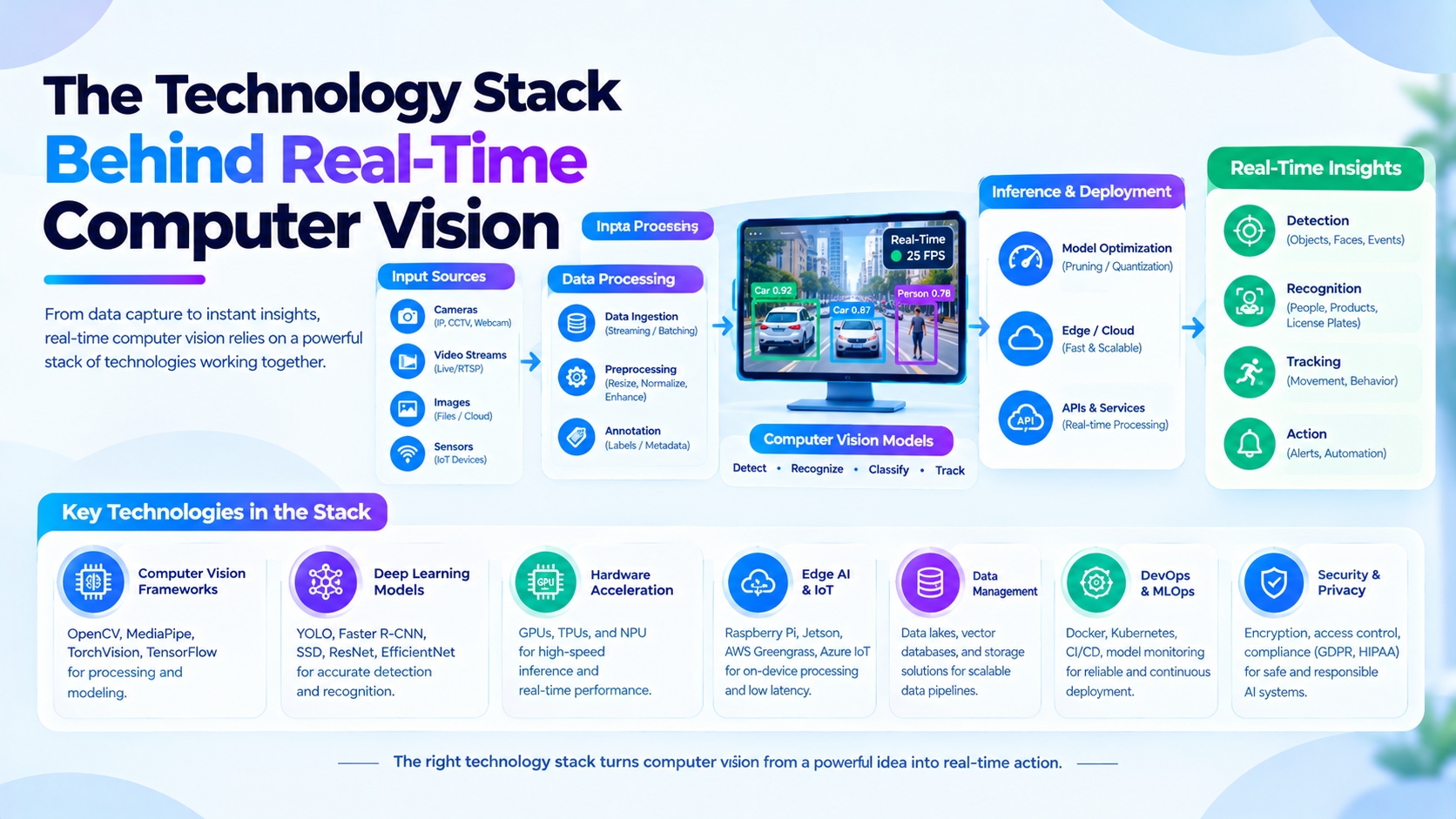
Real-time computer vision is an important tool in any business that needs to watch, observe, measure something, or take action in a fraction of a second. Of course, every application has its own unique requirements and specifics. But what all of them have in common is that it is not enough to grab a great camera and train a neural network — one needs to build an end-to-end technology stack that would bring together image acquisition, preprocessing tools, the actual AI, and the productionization layer.
In this article, we will discuss building a real-time computer vision system.
Camera Hardware and Image Acquisition
The first step in any computer vision system is, unsurprisingly, a camera. Different modes of operation and various environments require specific hardware. It is essential to ensure that your frame rate, resolution, and other parameters will be compatible with your further steps.
We recommend taking a closer look at your options and understanding what parameters affect which part of your system. For example, some depth cameras could be integrated into the system, providing more data about the objects in the scene.
Preprocessing and Computer Vision Libraries
The output of your camera and the input of your neural network might not be directly compatible, which requires additional preprocessing steps. They are essential for most computer vision applications and can often make or break your pipeline.
These steps are usually not very resource-intensive, so you can afford to use some high-level tools. The most popular one is OpenCV, which includes a variety of useful functions. You can perform standard image transformations and operations like motion estimation, edge detection, and others. Teams leveraging AI app development services often rely on such libraries as a foundation for building efficient preprocessing pipelines. But if you want to make your application real-time capable, you might need to optimize some of the steps.
AI Models: Detection, Segmentation, Pose Estimation, Object Classification
The neural network part of the system is usually its most important part. There are dozens of different computer vision tasks, so it is challenging to find a single model that would be universally useful. Some common examples are object detection, segmentation, pose estimation, and image classification. This is where strong Computer Vision development practices — including model selection, architecture tuning, and post-processing design — determine the overall quality of the system.
You can use any of the existing neural networks, but you might want to consider your options carefully. Depending on your specific case, you might need to sacrifice some inference time for better precision. Some models are designed to work with lower-resolution images, for example.
You should also consider additional post-processing steps that would be required once the model finishes its work. Usually, the output of a neural network should be further classified or visualized to actually produce useful results.
GPU Acceleration and Edge Devices
Processing full-resolution images is computationally heavy, and doing it in real-time might be impossible on some platforms. That is why many modern applications try to leverage the power of GPUs.
There are several ways to do that — for example, if you are using CUDA-compatible devices, you can use the CUDA framework to accelerate your processes. The most promising applications currently are the ones where the whole pipeline is optimized to use specific hardware features. For example, NVIDIA TensorRT is a great inference optimization tool for such applications. Providers of AI development services often optimize these hardware-aware pipelines as part of end-to-end deployment engagements. Another example is Edge AI and edge devices in general — sometimes an application would benefit from processing the data right on the hardware that is producing it, instead of sending it to a remote server.
Video Streaming and Real-Time Inference
A video application is generally quite complex, which means that you need an appropriate number of optimizations. First of all, a computer vision model should be able to process each frame in real time.
Then, you need to integrate a video streaming library that would be able to read the input frames. The application will probably need to do some processing on the frames — for example, resize them or perform some other transformations. After your model produces the output, another set of operations will follow, and the results should eventually be visualized.
The most common protocol used to stream videos in applications is RTSP (Real-Time Streaming Protocol). There is also GStreamer, a cross-platform multimedia framework that allows you to build custom pipelines and perform required operations.
Note that when working with RTSP and similar protocols, you need to consider other requirements of the system. For example, if you are receiving videos via RTSP, you might want to have a few frames buffer. You can use GStreamer to pipeline your video stream and add any additional operations needed. Processing every single frame that comes from a camera might not be necessary — depending on the application, you can process only some of the frames or sample them.
Software Architecture and Integration
Most applications are not standalone — they need to communicate with other applications or update some information about the system state. Note that you can use Python in combination with C++ to achieve the desired result.
The most important tools for your application to interact with the outside world are APIs, and you should use appropriate message brokers. You can use them to send and receive information from various parts of your system. For example, your computer vision application might need to send and receive information from video streaming sources, databases, and other computer vision applications to update the overall state of the system.
A simple example would be a Quality inspection application. This type of application needs to integrate with several important parts of the larger system. The computer vision system detects an issue, the application stores the relevant information in a database, and a separate automation application removes the defective product from the belt.
Overall, such an application is much easier to design and maintain with a modular architecture. Teams working with artificial intelligence development services commonly apply this modular approach to keep individual components independently testable, scalable, and maintainable across long-running deployments.
Monitoring, Security, and Deployment Considerations
When deploying such a system, you need to consider both system-level and model-level metrics. They should also be closely monitored during the lifetime of the application. Some of the examples of system-level metrics are latency and frame rate. The metrics related to the model could be its accuracy, the load on the GPU, and other factors.
As for monitoring, there are multiple ways to observe and analyze your application. But even if you have chosen a particular approach (for example, Prometheus), you should still consider specific problems that could occur in your systems. For example, if the lighting in your working environment changes too often, your model might become too inaccurate.
Make sure to implement appropriate security measures. For instance, you might want to restrict access to the application, keep your database and video recordings secure, and store the data on appropriate servers.