Every fall, thousands of northerners head for warmer weather. Most of them want the same thing waiting for them in Florida, Arizona, Texas, or the Carolinas: their own car, parked and ready.
You have three ways to get it there. You can drive it yourself, which means days on the road and a flight home or back. You can tow it, which means a trailer and a long haul. Or you can use snowbird car transport, where a professional carrier moves the car while you fly south and arrive rested.
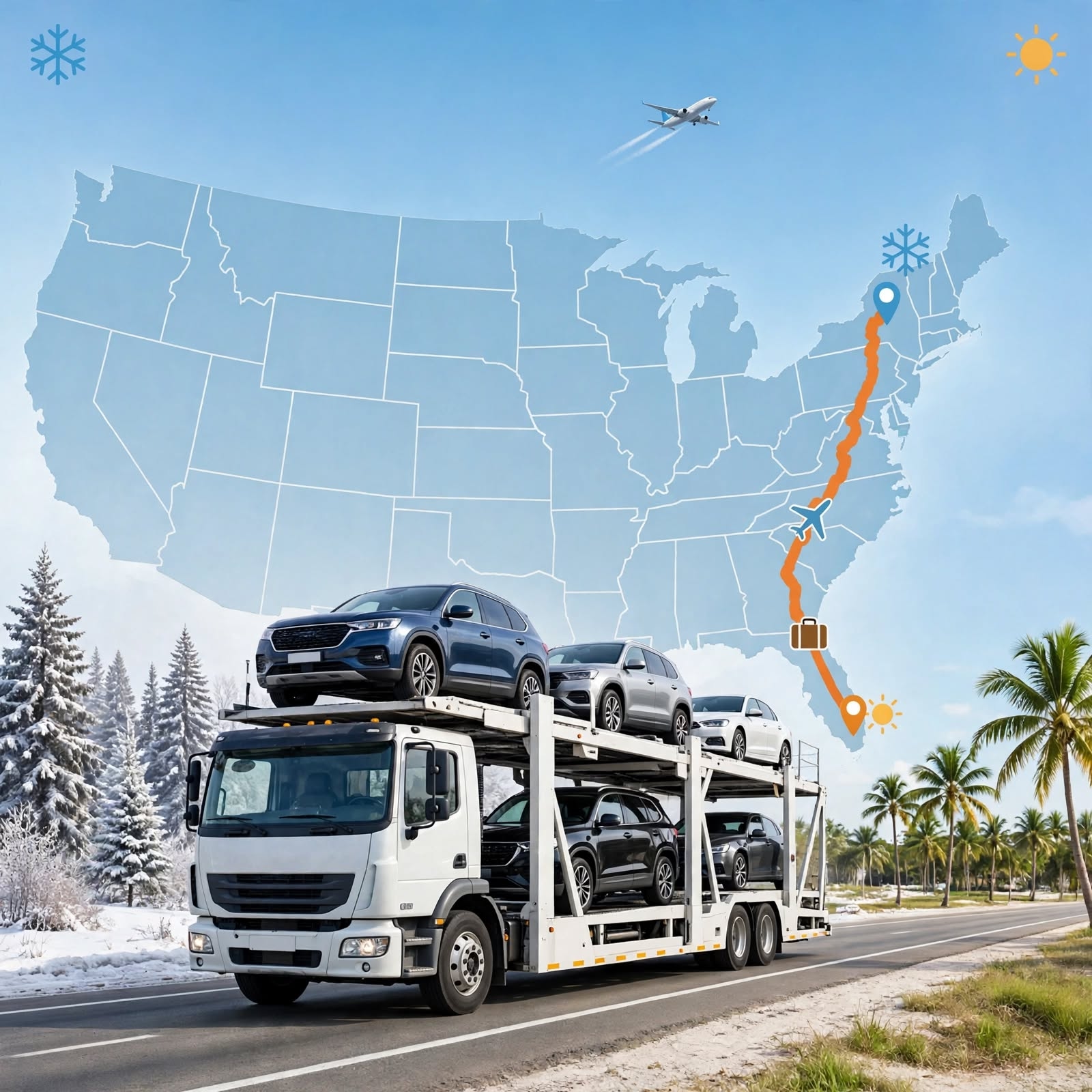
This guide covers the part most articles skip: timing, pickup logistics, and the gated-community problem that surprises people every season. Rapid Auto Shipping helps customers move vehicles locally and between states, including seasonal moves in both directions.
Snowbird Season Has Two Waves, Not One
Snowbird shipping is a migration with a departure rush and a return rush. Sources describe the peaks a little differently, but the pattern is consistent:
Southbound (fall): The southbound surge runs from October through December, and another guide notes the rush usually starts in late October and peaks in November.
Northbound (spring): The return trip builds from late winter. One guide says the northbound return peaks from February through April, while a carrier's booking data shows it triples between February and April and stays heavy into June.
Why the sources differ: They measure different things, such as booking dates, pickup dates, or specific routes. Use the overlap. Fall departures cluster in October and November, spring returns cluster from March through May, and Easter week is often busy.
Where the traffic goes. Florida takes the largest share, though California, Texas, and Arizona also receive many snowbird cars. The heaviest lanes link the Northeast and Midwest to Florida and Arizona.
A Seasonal Booking Calendar You Can Copy
When you want to move | When to start | Why |
Southbound, October or November | Late August to September | Peak demand starts in October |
Southbound, December | Early to mid fall | Demand eases, but schedules still fill |
Northbound, March or April | February | The return wave builds early |
Northbound, May | March or April | Traffic stays heavy into late spring |
One carrier calendar puts it bluntly: book Florida and Arizona deliveries by late September, and booking after October 15 risks delays. For the return, it says book in February for a March or April return.
A note if you're reading this in late fall: you're already in or near peak southbound season. Don't wait. Request your quote now, offer flexible pickup dates, and ask about the first available carrier on your lane.
A smart habit: Set two calendar reminders. Another guide suggests creating a reminder in September to book your southbound trip and one in February to book your northbound return. Booking both legs at once can also simplify planning.
Why One Direction Can Be Easier Than the Other
Carriers go where the loads are. In the fall, trucks fill up heading south, and they often run emptier heading north. In spring, it reverses. As one guide explains, carriers price by demand: in autumn southbound is contested and northbound runs with empty slots, and in spring it reverses.
What this means for you:
Flexibility helps. A wider pickup window gives dispatchers more room to match your car with a truck.
Travel plans can be staggered. If you can ship before the main rush or just after it, you have more carriers to choose from.
Your direction matters. Ask about availability on your specific lane instead of assuming.
The Gated Community Problem & How to Solve It
Retirement communities, condo complexes, and age-restricted developments are common snowbird destinations. They are also tricky for big trucks.
A car hauler is long, wide, and heavy, around 75 feet in length.
Many communities restrict commercial trucks, have low gates, narrow roads, tight turns, or low-hanging trees.
Some require advance notice, a gate code, or a visitor pass.
Fixes that work:
Ask your HOA or property manager whether commercial trucks may enter and during what hours.
Offer a meeting point. A large parking lot, shopping center, or wide road near the community entrance is usually easy for a driver.
Authorize a trusted person to meet the driver if you can't be there. Give them your carrier's contact details.
Share gate codes and access rules with the dispatcher before the pickup date.
Prepare for drop-off the same way. Delivery faces the same access issues in reverse.
Telling the dispatcher about restrictions upfront avoids missed pickups and rescheduling.
Choosing Open or Enclosed for a Seasonal Move
Open transport is the standard choice for everyday cars and SUVs. It's widely available and works for most snowbirds.
Enclosed transport is worth considering for classic, luxury, or high-value cars, especially if the car travels through winter storms and road salt.
If you own a convertible or a collector car you can't replace, ask about enclosed options early. Space is limited, and demand rises in season.
What a Smooth Snowbird Shipment Looks Like
Step 1: Plan the dates. Pick a pickup window, not just a day, and share your flight dates.
Step 2: Get a written quote. Make sure it lists the equipment type, pickup and delivery windows, insurance, and cancellation terms.
Step 3: Check your carrier. Confirm the USDOT and MC numbers in the FMCSA's public records and ask for a certificate of insurance.
Step 4: Prep the car.
Wash it so existing marks are easy to see.
Photograph every side, the interior, and the odometer.
Remove personal items and valuables, including toll tags and garage remotes.
Keep fuel about a quarter tank.
Make sure the battery and tires are in good shape.
Disable alarms or explain how to turn them off.
Step 5: Hand off the keys. Review the inspection report with the driver and keep a copy.
Step 6: Fly south. Keep your phone on for dispatch updates.
Step 7: Inspect at delivery. Compare the car with your photos, note any new damage on the paperwork, and sign only when you're satisfied.
Step 8: Re-register or renew as needed. If you stay in the state long term, check local inspection and registration rules.
Common Snowbird Mistakes
Booking too late. The most common mistake, and the hardest to fix in peak weeks.
Rigid dates. A tight window narrows your carrier options.
Forgetting gated-community rules. A missed gate code can mean a failed pickup.
Leaving belongings in the car. Carrier insurance generally doesn't cover personal items.
Skipping the inspection report. Without it, claims are harder to prove.
Choosing only on a low number. Unusually low offers often change after you commit. Compare written terms, not just the headline.
Why Snowbirds Choose Rapid Auto Shipping
Seasonal planning. We help you time your pickup around the fall and spring waves.
Flexible scheduling. Share your window, and we work around your travel plans.
Clear, written quotes. You know what's included before you commit.
Open and enclosed options for everyday cars and prized vehicles.
Real communication from booking to delivery.
Ready to fly south and let someone else handle the driving? Request your free, no-obligation snowbird car transport quote from Rapid Auto Shipping today. Tell us your pickup city, your winter address, your car, and your dates, and we'll build a plan around your season.
FAQs
1. What is snowbird car transport?
It's a seasonal vehicle shipping service for people who spend winter in a warmer state, typically Florida, Arizona, Texas, or the Carolinas, and return north in spring. A carrier moves your car so you don't have to drive it.
2. When should snowbirds book car shipping?
Book 4 to 6 weeks before your target date when you can, and earlier for October and November departures. For the spring return, start in February.
3. When is snowbird season for car shipping?
Southbound demand rises from October through December, and northbound demand builds from late winter and stays heavy through spring. Peak weeks vary by route.
4. Is it better to ship my car or drive it south?
Shipping saves days on the road, fuel, hotel stays, wear on the car, and the return flight logistics. Driving gives you your car on the way, but costs time and effort.
5. Can the truck deliver inside my gated community?
Sometimes, but many communities restrict large trucks. Check with your HOA, and be ready to meet the driver at a nearby lot if needed.
6. Do I need to be there for pickup and delivery?
You or an authorized person should be present to inspect the car and sign the paperwork. Choose someone you trust who is reachable by phone.
7. Can I ship my car both ways?
Yes. Many snowbirds book both legs together or set reminders for each season so the process becomes routine.
8. Is it cheaper to ship in one direction than the other?
Demand differs by season. In the fall, southbound is usually busier than northbound, and in spring it reverses. Ask for options on both legs.
9. Can I leave personal items in my car?
Generally no. Carrier insurance usually doesn't cover them. Remove valuables and loose items before pickup.
10. What if I need my car by a specific date?
Share your deadline when you book and ask what the carrier can commit to in writing. Because drivers have daily limits, very tight timelines can be risky.