
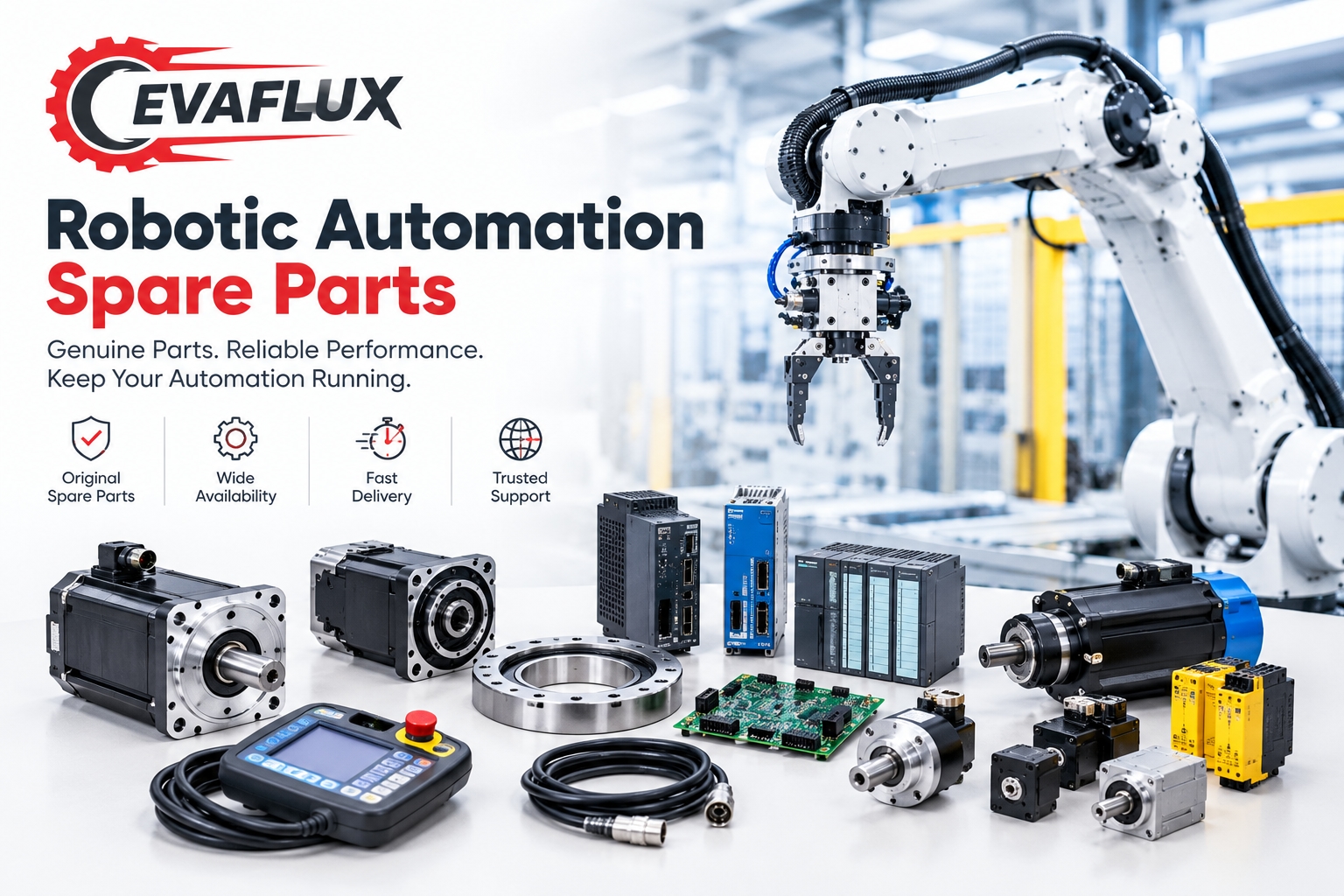
Precision Matters: Choosing Robotic Automation Spare Parts for Accurate Motion
Accuracy is the reason many manufacturers adopt robots in the first place. Whether the task is placing a small electronic component or positioning a weld seam, the result depends on how precisely each axis moves. Over time, wear and part substitution can erode that precision. This article explains which components drive accuracy and how to select replacements that preserve it.
Understanding Precision in Robots
Two terms are often confused. Accuracy is how close the robot gets to a commanded position. Repeatability is how consistently it returns to the same position. Most industrial robots specify repeatability, commonly between ±0.02 mm and ±0.1 mm depending on size and type. Spare parts affect both. A component with looser tolerances can add error that no controller setting can fully compensate.
Selecting Robotic automation spare parts with proper tolerances helps keep the robot within its original performance envelope.
The Components That Shape Accuracy
Encoders. They report their position to the controller. Higher resolution (for example 20 to 24 bit absolute) improves positioning, and good signal quality reduces noise-induced errors.
Reducers. Harmonic drives and cycloidal or planetary gearboxes provide high torque in compact form. Backlash, torsional stiffness and lost motion directly affect precision. Precision units often specify backlash at or below one arc-minute.
Servo motors and drives. Smooth torque, low cogging and well-tuned current loops help avoid vibration and overshoot.
Couplings and bearings. Even small play or misalignment shows up at the tool tip, especially on long arms.
Linear guides and ball screws. In gantry and Cartesian systems, preload and straightness determine accuracy.
Sensors and vision components. Calibration quality, lens condition and lighting influence guided positioning.
Technical Specifications to Compare
Resolution and absolute accuracy of encoders
Backlash and torsional stiffness of reducers
Rated and peak torque, inertia and speed
Repeatability of grippers and positioners
Thermal expansion behaviour and temperature range
Communication protocol and update rate, which affect control quality
These numbers should match, or exceed, those of the part being replaced. Where an upgrade is planned, verify that the controller and firmware can use the improved capability.
Preserving Precision During Replacement
Replacement is where precision is most often lost. Follow these principles:
Use matching or better specifications. Do not substitute a lower-resolution encoder or higher-backlash gearbox.
Respect assembly procedures. Torque, alignment and preload values matter.
Keep the environment clean. Contamination in a reducer or encoder can cause early wear.
Re-calibrate. After replacing an encoder, motor or reducer, perform zero-point and mastering procedures.
Verify. Run a test program that measures repeatability before returning to production.
Quality Robotic automation spare parts only deliver their full value when installed and calibrated correctly.
Thermal and Environmental Effects
Temperature changes cause expansion in metal structures and changes in lubricant viscosity. A robot that is accurate at the start of a shift may shift slightly as it warms. Spare parts designed for stable thermal behaviour and proper cooling reduce this effect. Dust and moisture can also affect optical encoders and sensors, so sealing and cable shielding are important in harsh settings.
Typical Use Cases
Electronics assembly: placement of small components requires tight repeatability and low vibration.
Precision machining and tending: loading parts into fixtures with narrow tolerances.
Dispensing and gluing: consistent path accuracy affects product quality.
Inspection and measurement: robots carrying cameras or probes need stable, repeatable positioning.
Laboratory and pharmaceutical automation: precise handling of small containers and samples.
UAE Applicability
Industrial and logistics operations in the UAE increasingly use automation for quality and throughput. High ambient temperatures, strong air-conditioning gradients and dust can influence the thermal and mechanical stability of precision systems. Spare parts with good sealing, stable materials and verified specifications support consistent accuracy in these conditions. Having reliable access to compatible replacements also shortens the time a precision cell remains out of service, which helps maintain output and quality targets.
Quick Selection Guide
Need | Focus on |
Tighter positioning | Encoder resolution, reducer backlash |
Smooth motion | Motor and drive quality, tuning |
Stable long-term accuracy | Thermal behaviour, bearing quality |
Fast replacement | Compatibility, documentation, availability |
When in doubt, consult the robot manufacturer's service manual, then compare against available Robotic automation spare parts that meet the same specification.
Frequently Asked Questions
What is the difference between accuracy and repeatability?
Accuracy is closeness to the target position; repeatability is consistency when returning to the same point.
Will a higher-resolution encoder always improve precision?
Only if the controller supports it and the mechanical chain (reducer, couplings) is good enough to benefit.
How can I tell if a reducer is causing accuracy loss?
Look for increased backlash, noise, vibration or lost motion when reversing direction.
Is calibration always required after replacing a part?
For motors, encoders and reducers, yes. Calibration keeps the position reference correct.
Do environmental conditions really affect precision?
Yes. Temperature, dust and humidity can influence sensors, lubricants and mechanical stability.