
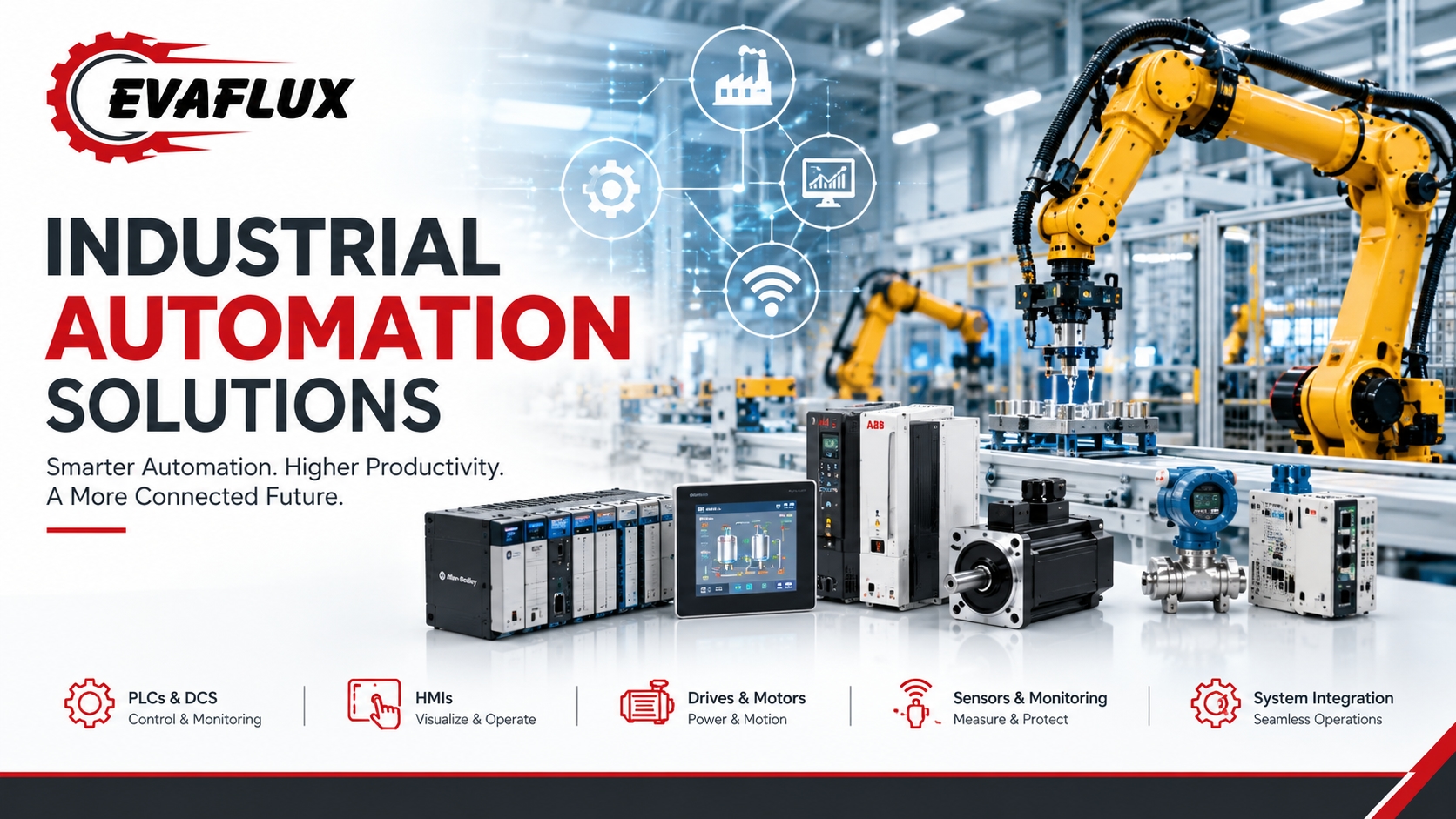
PLCs, HMIs and Control Panel Components: The Backbone of Scalable Control
If sensors are the senses and drives are the muscles, the controller is the brain. Programmable logic controllers (PLCs), operator interfaces and panel components form the core of any automated system. This article outlines the specifications, reliability and applications of the controls category at Evaflux.
Category Overview
Compact and modular PLCs
Remote I/O and distributed I/O modules
HMI touchscreens and industrial panel PCs
Industrial Ethernet switches and gateways
Power supplies, relays, contactors and circuit protection
Terminal blocks, pushbuttons, pilot lights and enclosures
Technical Specifications
Typical features include the following. Model details differ.
CPU performance: scan times from under 1 ms per 1,000 instructions on higher-end units
Memory: from tens of kilobytes to several megabytes of program and data memory
I/O capacity: from 16 points on compact units to thousands via expansion and remote racks
I/O types: 24 VDC digital, relay and transistor outputs, analog 4–20 mA/0–10 V, RTD and thermocouple inputs
Programming: IEC 61131-3 languages, including ladder, function block and structured text
Networks: Ethernet, PROFINET, EtherNet/IP, Modbus TCP, OPC UA
HMI displays: 4.3" to 21" touchscreens, with IP65 front faces
Power supplies: 24 VDC output, 1–40 A, with DIN-rail mounting and high efficiency
Reliability for Round-the-Clock Operation
Controllers are designed for uninterrupted duty. Fanless designs, solid-state memory and battery-free retention remove common failure points. Wide operating temperature ranges, vibration resistance and electrical isolation between channels protect against harsh plant conditions.
Availability features go further: redundant power inputs, hot-swappable modules, watchdog timers and diagnostic LEDs help prevent and quickly resolve faults. Surge and EMC immunity tested to industrial standards keeps logic stable alongside large motors and drives.
Precision and Determinism
In control, precision means timing as much as measurement. Deterministic scan cycles ensure outputs respond in a predictable period. High-speed counters, pulse outputs and motion functions provide accurate timing for positioning and synchronisation. Analog modules with 12 to 16-bit resolution maintain signal fidelity from field to logic.
Time-stamped events and data logging let engineers analyse sequences down to the millisecond, supporting fault-finding and process improvement.
Typical Use Cases
Machine automation: packaging, assembly, labelling, plastics and textile equipment
Process control: batching, dosing, heating, cooling and blending
Utilities: pump station control, tank management and remote monitoring
Building automation: lighting, ventilation, access and energy management
Material handling: sorting, palletising and storage systems
Test and inspection: repeatable sequences with data capture
Properly engineered industrial automation solutions allow these systems to be commissioned quickly, expanded as production grows and diagnosed without guesswork.
Panel Building Considerations
A reliable controller can still fail if the panel around it is poorly designed. Keep power and signal wiring separated, apply correct grounding, size circuit protection to the load and leave room for heat to escape. Use ferrules on all conductors, label every wire and include spare terminals for future changes. Modern design software and manufacturer CAD data streamline layout and documentation.
For HMIs, clear screen design is vital. Limit each screen to the information operators need, use consistent colours for alarms and states, and include navigation that works for gloved hands.
Scalability and Future-Proofing
Choose a platform that grows with you. Modular PLCs let you add I/O, communication and safety functions without replacing the base unit. Support for open standards reduces vendor lock-in and eases data sharing with MES, SCADA and cloud analytics. Planning industrial automation solutions around open architecture ensures the plant can adopt new technology without rewriting every program.
Buying Guidance
Engineers should confirm I/O count, spare capacity (15–20% is common), communication needs and environmental ratings. Procurement managers should review software licensing, long-term availability, warranty and local technical support. Remember that programming time and training are a significant part of project cost, so a familiar platform may justify a slightly higher hardware price.
Frequently Asked Questions
How much spare I/O should I plan for?
Around 15–20% is a practical starting point for future changes.
Can PLCs communicate with older equipment?
Yes, through serial ports, gateways and protocol converters.
Is a touchscreen HMI suitable for harsh areas?
Industrial HMIs with sealed fronts and wide temperature ratings are designed for exactly that.
Do I need redundancy?
Only for processes where downtime is costly or unsafe. Redundant power or controllers can then be justified.
Conclusion
A robust control layer turns individual devices into a coordinated system. Tell Evaflux about your application and I/O list, and we will suggest a platform that fits today's needs and tomorrow's growth.