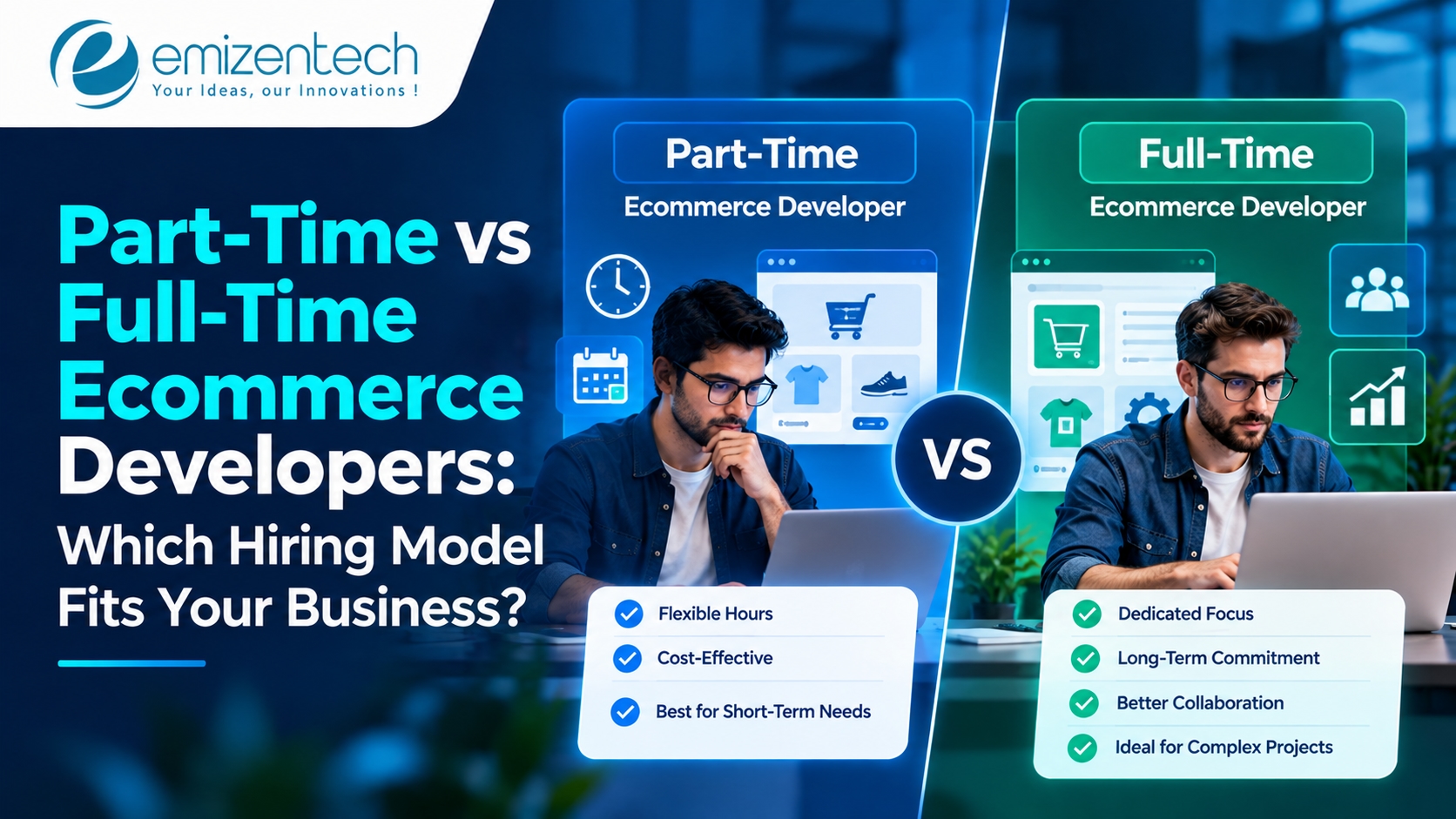
Choosing between a part-time and full-time ecommerce developer affects your development budget, store performance, and ability to introduce new features. Hiring too much capacity can increase expenses, while insufficient technical support can delay launches, integrations, and essential store improvements.
An ecommerce website requires more than an attractive storefront. Businesses need reliable checkout processes, secure payment gateways, inventory synchronization, mobile responsiveness, and integrations with shipping, CRM, and ERP systems. The right developer helps maintain these systems while supporting business growth.
Before you hire ecommerce developers, assess your current workload, technical requirements, budget, and long-term growth plans. This guide compares part-time and full-time hiring models to help you choose the right approach for your ecommerce business.
Who Is a Part-Time Ecommerce Developer and Who Is a Full-Time Ecommerce Developer?
The main difference lies in time commitment, availability, and ongoing project involvement. Understanding these hiring models helps businesses decide when to hire ecommerce developers for specific tasks and when full-time support is necessary to manage continuous development, store maintenance, and growth.
What Does a Part-Time Ecommerce Developer Do?
A part-time ecommerce developer works on specific tasks or a predefined number of hours. This arrangement suits businesses that need occasional technical assistance without maintaining a full-time resource.
Typical responsibilities include storefront adjustments, product page improvements, plugin or app configuration, bug fixes, payment gateway updates, and website performance optimization. Part-time developers may also help with smaller integrations or seasonal promotions.
What Does a Full-Time Ecommerce Developer Do?
A full-time ecommerce developer focuses on your store's development and ongoing technical requirements. Responsibilities may include custom storefront development, checkout optimization, API integrations, product catalog management, platform customization, and performance improvements.
This model suits businesses with continuous development requirements, complex ecommerce operations, or a roadmap that involves frequent feature releases.
Part-Time vs Full-Time Ecommerce Developers: Quick Comparison
The following comparison highlights how each hiring model differs in availability, cost, and suitability.
Factor | Part-Time Developer | Full-Time Developer |
Availability | Limited, agreed hours | Full working week |
Cost structure | Hourly or monthly retainer | Fixed monthly compensation or engagement fee |
Best suited for | Maintenance and smaller tasks | Continuous development and complex stores |
Project involvement | Task-focused | Ongoing |
Flexibility | Easier to adjust working hours | Requires planning to change capacity |
Collaboration | Depends on agreed availability | More consistent daily communication |
Ideal business stage | Small stores and limited workloads | Growing stores and complex operations |
Benefits of Hiring Part-Time Ecommerce Developers
Part-time hiring provides access to technical expertise without requiring a full-time commitment. It can be effective when your store needs targeted improvements rather than continuous development.
Lower Monthly Expenses
Businesses pay for a defined number of hours instead of funding a full-time role. This can help startups and smaller retailers manage budgets while addressing essential technical tasks.
Flexible Development Support
Part-time engagement allows businesses to adjust developer hours based on seasonal demand, campaign schedules, and changing priorities.
Suitable for Store Maintenance
Routine updates, minor customization, bug fixes, and performance checks may not require a full-time developer. A part-time arrangement can cover these needs efficiently when the workload is predictable.
Access to Specialized Skills
Businesses can bring in specialists for tasks such as checkout customization, ecommerce SEO implementation, API integration, or payment troubleshooting without committing to a long-term full-time arrangement.
Limitations of Hiring Part-Time Ecommerce Developers
Part-time hiring can become less effective when your store requires frequent updates, immediate troubleshooting, or continuous development.
Limited Availability for Urgent Issues
Payment failures, checkout errors, and inventory synchronization problems can affect revenue. A part-time developer may not always be available to resolve urgent issues immediately.
Slower Delivery for Complex Projects
Large integrations, platform migrations, and custom ecommerce features may require sustained development time. Limited weekly availability can extend delivery schedules.
Reduced Continuity
When developers divide their time among several clients, they may need additional time to revisit technical decisions, understand recent changes, and resume work.
Benefits of Hiring Full-Time Ecommerce Developers
Full-time hiring provides consistent technical involvement for businesses that depend on their ecommerce platforms for daily sales and operations.
Consistent Development Progress
A full-time developer can work continuously on new features, bug fixes, integrations, and performance improvements, helping businesses maintain a steady development roadmap.
Better Understanding of Business Operations
Ongoing involvement helps developers understand product catalogs, customer journeys, fulfillment processes, pricing rules, and other business requirements.
Support for Complex Ecommerce Features
Custom checkout flows, advanced search, multi-store setups, headless storefronts, and ERP integrations often benefit from dedicated technical attention.
Closer Collaboration With Internal Teams
Full-time developers can coordinate more consistently with marketing, sales, operations, and design teams to implement promotions, improve conversion paths, and resolve technical issues.
Limitations of Hiring Full-Time Ecommerce Developers
Full-time hiring offers continuity, but it also introduces fixed costs and ongoing management responsibilities.
Higher Fixed Costs
Businesses must account for compensation or engagement fees, onboarding, software access, equipment where applicable, and management expenses.
Risk of Underutilization
If your store requires only occasional updates, a full-time developer may not have enough work to justify the cost.
Recruitment and Onboarding Time
Finding a suitable candidate and introducing them to your ecommerce platform, workflows, and business requirements can delay the start of development.
Dependency on One Person
A single developer may become a bottleneck if they handle every technical responsibility. Documentation, code reviews, and backup support help reduce this risk.
When Should You Hire Part-Time Ecommerce Developers?
A part-time developer is generally suitable when your technical workload is limited, predictable, and clearly defined.
Consider this model when:
You operate a small ecommerce store with a stable product catalog.
You need occasional theme customization or storefront improvements.
Your main requirements involve maintenance, bug fixes, or routine updates.
You need specialist support for a specific integration.
You have a limited development backlog and a controlled budget.
When Should You Hire Full-Time Ecommerce Developers?
Full-time developers are more suitable when ecommerce development is a continuous business function rather than an occasional requirement.
Consider full-time hiring when:
Your store generates significant revenue and requires ongoing technical support.
You frequently introduce new products, features, or customer experiences.
You need custom platform development or complex third-party integrations.
Your roadmap includes platform migration, headless commerce, or multi-store management.
Your team maintains a consistent backlog of development work.
Cost Comparison: Part-Time vs Full-Time Ecommerce Developers
The total cost depends on experience, location, ecommerce platform, technical complexity, and engagement terms. Businesses should compare overall value rather than focusing only on hourly rates.
Common Pricing Models
Hourly pricing: Suitable for occasional fixes and unpredictable workloads.
Monthly retainer: Provides an agreed amount of development time or ongoing support.
Fixed-project pricing: Works for clearly defined deliverables, such as a storefront redesign or integration.
Monthly dedicated engagement: Provides a developer or team for ongoing development under agreed terms.
Illustrative Monthly Cost Comparison
Suppose both developers charge $25 per hour. A part-time developer working 20 hours per week would cost approximately $2,000 per month, while a full-time engagement covering 160 hours would cost approximately $4,000 per month, assuming four weeks per month.
These figures are examples, not verified market averages. Actual prices vary by location, experience, and contract structure. They also exclude potential additional expenses.
Hidden Costs to Consider
Include onboarding, project management, software licenses, testing, infrastructure, security, and potential rework in your calculations. For an ecommerce store, downtime, checkout errors, and poorly implemented integrations can also create indirect business costs.
Is There a Middle Option? Dedicated Ecommerce Developers
Businesses do not always need to choose between limited part-time support and a traditional full-time employee. A dedicated engagement can provide consistent development capacity through an external service provider.
When you Hire dedicated ecommerce developers, you can obtain ongoing technical support without managing every aspect of in-house recruitment. Depending on the agreement, the provider may also offer project coordination, replacement arrangements, and access to additional specialists.
A hybrid model is another option. One developer can manage routine store improvements, while specialists handle security reviews, performance optimization, or complex integrations when required.
How to Choose the Right Ecommerce Developer
Regardless of the hiring model, evaluate candidates against your actual business and technical requirements.
1. Check Ecommerce Platform Experience
Look for experience with the platform your store uses, whether Shopify, WooCommerce, Magento or Adobe Commerce, or BigCommerce.
2. Assess Integration Skills
Review their experience with payment gateways, shipping services, inventory systems, CRM platforms, and ERP integrations.
3. Review Previous Projects
Examine live stores, relevant case studies, performance improvements, and examples of custom functionality.
4. Evaluate Security and Performance Knowledge
Confirm that the developer understands secure payment workflows, access controls, testing, page speed, and reliable checkout functionality.
5. Define Scope and Communication
Agree on deliverables, working hours, reporting, response times, code ownership, and post-launch support before signing a contract.
Common Hiring Mistakes to Avoid
Avoid these mistakes when selecting an ecommerce hiring model:
Choosing a developer solely because of a low hourly rate.
Hiring part-time support for a project that needs daily technical attention.
Paying for full-time capacity without a sufficient workload.
Ignoring platform-specific experience and integration requirements.
Failing to document project scope, responsibilities, and acceptance criteria.
Overlooking security, testing, and ongoing maintenance.
Conclusion
The right hiring model depends on your store's complexity, development workload, available budget, and growth plans. Part-time ecommerce developers can be effective for maintenance and smaller improvements, while full-time developers are better suited to continuous development and complex ecommerce operations.
Before making a decision, assess your backlog, prioritize business-critical requirements, and compare the total cost of each arrangement. EmizenTech offers ecommerce development services for businesses seeking technical expertise and flexible development support. Evaluate the available engagement options against your specific requirements to determine the right fit for your store.
Frequently Asked Questions
1. Is it better to hire a part-time or full-time ecommerce developer?
Part-time developers suit smaller tasks and maintenance, while full-time developers are more appropriate for ongoing development, complex integrations, and stores that require consistent technical support.
2. How much does it cost to hire ecommerce developers?
Costs vary based on experience, location, platform expertise, and engagement model. Request a quote based on the actual scope rather than relying on hourly rates alone.
3. When should a business hire dedicated ecommerce developers?
A dedicated engagement can suit businesses that need consistent development capacity but prefer to source technical talent through an external provider.
4. What skills should an ecommerce developer have?
Relevant skills include ecommerce platform customization, frontend and backend development, API integrations, payment workflows, security, testing, and performance optimization.
5. Can I switch from part-time to full-time ecommerce development?
Yes. Businesses can expand development hours or move to a full-time or dedicated arrangement as store complexity and workload increase, subject to the engagement terms.