
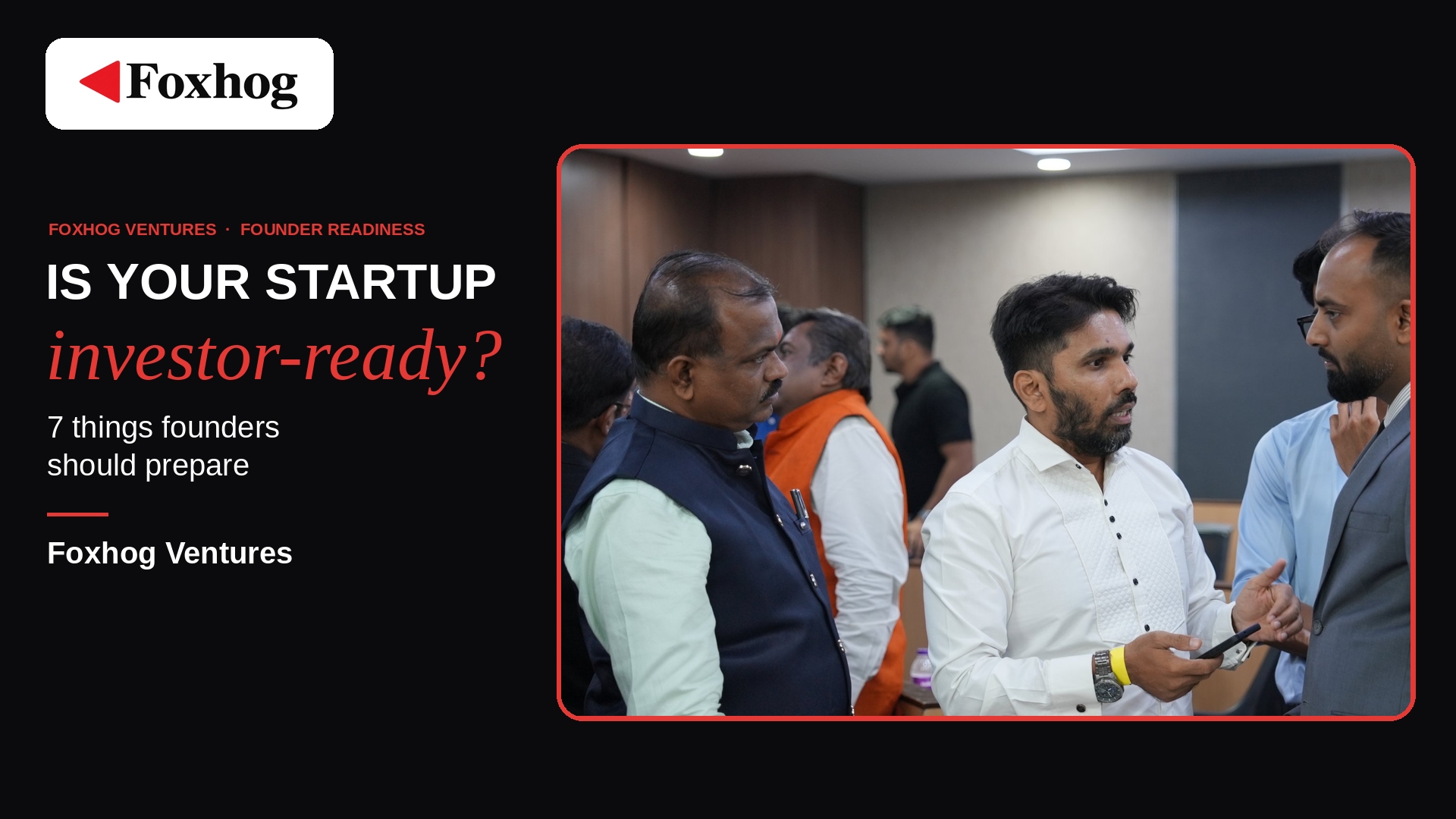
Capital raising is a key objective for many startup founders. But as much as a good idea is what investors want, it isn't always what wins them over. Founders need to demonstrate that their company solves a problem, attracts a customer base, handles money and scales.
The increasing investment trend in India has made founders eager to explore funding options in the country. However, entrepreneurs must be ready before approaching investors. Conference like the Investor Summit 2026 serve to bring investors and startups together to exchange ideas and gain insight into the startup ecosystem.
In this themed section of Foxhog Ventures Investor Summit 2026, founders will learn why it pays to be prepared when seeking investors. No matter if you are an early-stage startup founder or a more mature one seeking to grow your business, this will be able to help you pitch with confidence.
Seven things every founder needs to get ready before approaching investors.
1. A Clear Business Idea That Solves a Real Problem
You must tell potential investors what your startup does and why it is needed. Business idea: A startup's concept is intriguing but founders need to make clear the underlying problem it intends to address.
Before meeting an investor, ask yourself three questions:
· What problem does my startup solve?
· Who will benefit from my product or service?
· Why would customers choose my business over other options?
For instance, a startup providing digital payment services to small shops needs to state in what way its platform simplifies payments, saves time or assists shopkeepers in managing the transactions.
Keep it simple. Don't overload your reply with jargon or oversell it.
Better startup investor ready: Keep a one paragraph introduction about your product, customers and that one great thing. This concise intro is all an investor needs to understand what you do.
2. A Strong Business Plan and Growth Strategy
A definite business plan clarifies to an investor how you plan to establish your idea as an operational business.
Your plan should include an explanation of your business model, target market, pricing, competition, and growth targets. It should also outline how your startup will generate revenue and control costs.
Investors may ask questions such as:
· How will your business make money?
· How large is your target market?
· What makes your product different?
· How will you attract new customers?
· What are your plans for the next two to three years?
Predict all future events, You don't have to: Set practical goals based on research and current information.
At Founders Connect events, founders of startups and investors gather together to discuss business issues. Founders who are familiar with their business plans are more likely to have a clear vision of their direction and to answer questions.
3. Financial Records That Build Trust
Your financials help investors see where you are right now. While your startup is still new, you know where your money has come from and where it's going to.
Prepare the following records wherever applicable:
· Revenue and expense statements
· Cash flow details
· Business bank statements
· Existing loans and liabilities
· Sales forecasts and financial projections
· Records of previous investments
If you're not yet making any money, be transparent about this. Talk about what stage you're at, how much money you've spent and how far you have to go before making a profit.
Investors want to understand whether their money will go toward expanding your business or making it more efficient. You might be raising capital to hire employees, build a prototype, buy equipment, or get to new markets.
And clear financial documents allow you to build trust and promote productive conversations about funding.
4. A Pitch Deck That Tells Your Startup's Story
A pitch deck is a brief presentation that describes your business to potential investors. Your pitch deck should introduce your startup to the investors and provide a clear image of your company.
A useful pitch deck usually includes:
1. Problem: The issue your business aims to solve.
2. Solution: Your product or service.
3. Market: The customers you want to reach.
4. Business model: How you plan to earn money.
5. Competition: Other solutions available in the market.
6. Traction: Your progress, customers, sales, or early results.
7. Team: The people building the business.
8. Financial plan: Your revenue goals and major expenses.
9. Funding requirement: How much capital you seek and how you will use it.
Use plain language, support everything you say with well-designed charts, and always include concrete facts and figures. When appropriate, don't hesitate to add your customer/consumer comments or initial sales figures.
Or, if you are going to an investor meeting or investor networking in Noida, a well-designed pitch deck will enable you to present your business idea more convincingly.
5. Proof That Customers Need Your Product
A good idea doesn't always make a viable business. So potential investors may look for evidence that people will pay for or adopt your product.
This proof is called traction. It may be made up of paying customers, repeat business, product trials, user growth, customer feedback, or signed business deals.
Early on sales figures might be quite low. You have got to love it. At the start you can show good progress through customer interviews, pilots, beta testing, and early collaboration.
For instance, if you are building a product for small businesses, you could ask local business owners questions, trials with a small number of users and take note of what they think.
Use real data not made up values. If you are still developing the product then report on the tests you have done and the learning that has resulted.
To attract startup funding in India for entrepreneurs one needs to have a thorough understanding of the customer's needs. Having a thorough understanding of the need for funding by startup will result in a more fruitful discussion.
6. A Reliable Team and Clear Roles
Not only do investors look at the business idea but they also want to know the people who are going to create it.
A competent team must possess the expertise to create the product, to sell to customers, to handle the money, and to grow the business.
Create a brief team introduction to give before meeting investors. Introduce who they are and what they can contribute.
It's all about YOU and how you'll plug these vital gaps if you're missing a skill. Maybe you'll need a technical co-founder, a sales person or someone with business experience.
Most importantly, be prepared to be honest about your biggest struggles. Investors don't think every founder is perfect. They want to know that you are capable of learning, thinking and dealing with issues.
At Foxhog Ventures, the broader debate about startup growth and investor relations should serve as a reminder that startup creation is about more than just raising capital. It's about the founders and their capacity to implement the plan.
7. A Realistic Funding Request and Clear Use of Funds
Determine the amount of funding your startup will require and your rationale.
Don't make the mistake of asking for a random amount on the assumption that a bigger investment is what your company needs. Instead, estimate the amount you need to grow at your next level.
Your request may be for new products, new hires, marketing, equipment, working capital, or a new market.
Make a simple plan for the spend of the money and what you intend to do with the funding.
For instance, if you are applying for funding to develop a product, tell them the time-frame of the development, when they should expect to launch it and what customer numbers are expected to be achieved. Be specific about what is an estimate.
Get to know the types of investments, such as the investment agreement, equity and valuation, as well as the benefits you will enjoy from an investing agreement.
A good idea is not to make a false promise of success. It is to demonstrate to us that you are serious about your applications and that you have actually thought about your funding requirements and how you intend to use the funds.
How Investor Summit 2026 Can Encourage Better Founder Preparation
Investors Summit 2026 has a theme that can be used to talk about how would the founders to handle a conversation with the investors. Investors and founders meet and events can be organized to the founders and investors to share their ideas and learn about the expectations.
Foxhog Ventures Investor Summit 2026 is an umbrella term that relates to some discussions about startup investor readiness and readiness of founders.
If you're an entrepreneur checking out Foxhog Ventures at investor summit coverage, the important thing to bear in mind is what marks a startup as ready for real investor engagement: a good business concept, accurate financials, client proof, a competent group and a practical plan for funding.
Investors you are going after in addition to the founders should also research. Check whether an investor's interests, investment stage, and typical funding range match your business. A relevant introduction is more useful than sending the same pitch to everyone.
Good investor networking in Noida and other startup hubs begins with preparation, honest communication, and a clear understanding of what both sides want to achieve.
Conclusion: Prepare Before You Pitch
Getting investment takes more than a promising idea. Founders need a clear business plan, accurate financial records, a strong pitch deck, evidence of customer demand, a capable team, and a realistic funding request.
These seven steps can improve your startup investor readiness and help you approach funding conversations with greater confidence. They can also help you identify gaps in your business before you seek outside capital.
The Investor Summit 2026 and the wider conversation around Foxhog Ventures Investor Summit 2026 offer an opportunity to reflect on why founder preparation and investor connections matter for business growth.
Whether you are preparing for your first pitch or planning your next stage of expansion, take time to understand your numbers, strengthen your business plan, and learn what potential investors expect.
For more information, read the original Investor Summit 2026 in Noida, India article by Foxhog Ventures.
A prepared founder can explain the business clearly, answer difficult questions honestly, and make better decisions about the next stage of growth. That is a strong place to start when seeking investment.



