India Tyre Market: Industry Report 2026–2034
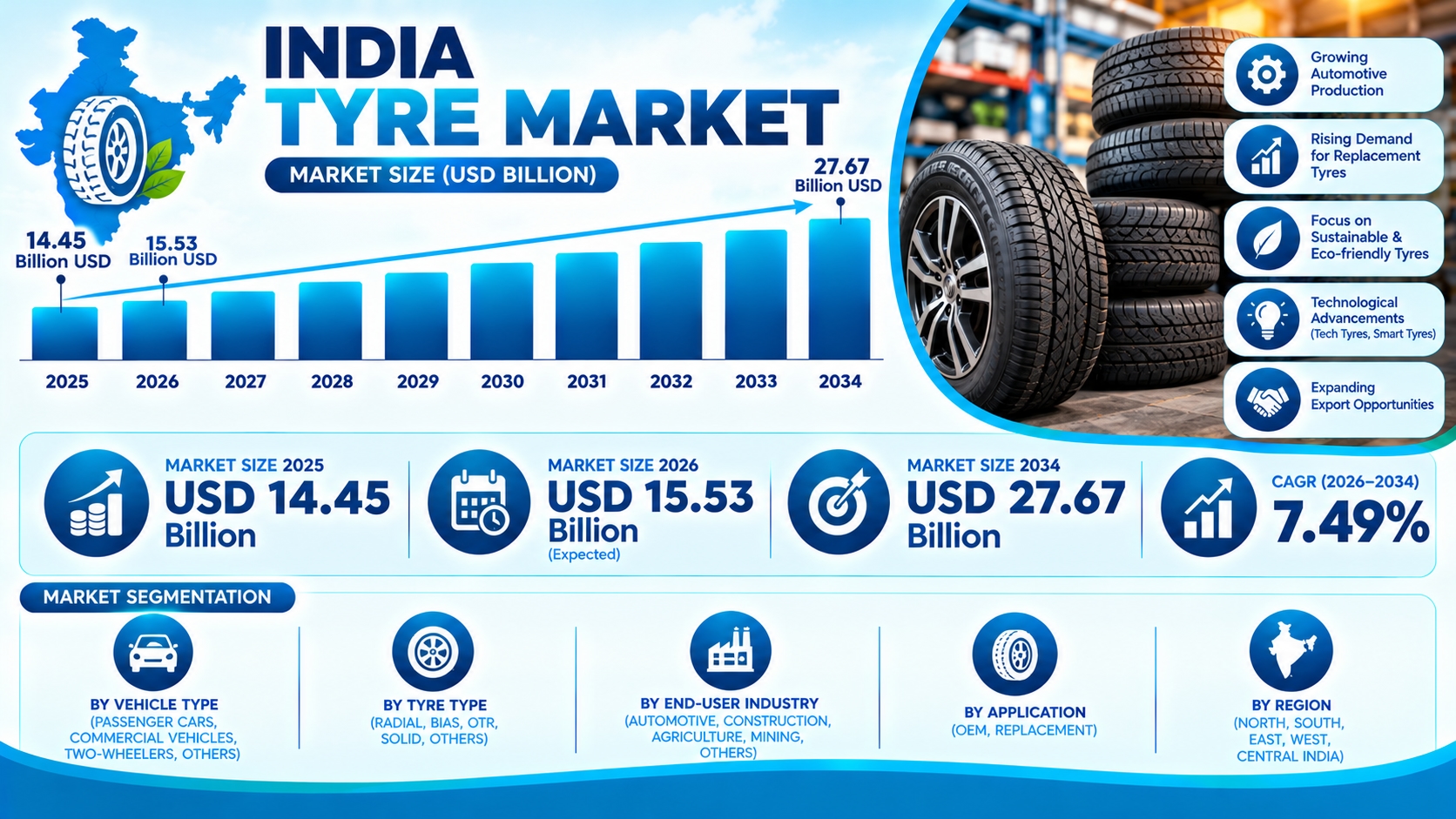
The India tyre market size reached USD 14.45 Billion in 2025 and is projected to reach USD 27.67 Billion by 2034, exhibiting a compound annual growth rate (CAGR of 7.49%) during the 2026–2034 forecast period. The market continues to expand as India’s vehicle parc, highway network, and manufacturing base grow. Driven by rising vehicle production, a large replacement tyre base, domestic manufacturing strength supported by PLI incentives, and the emergence of EV-specific tyres, tyres remain an essential and recurring component of India’s automotive ecosystem. The overall India tyre market share outlook remains positive, supported by highway expansion, premiumization, export competitiveness, and technology investment.
Market Size and Growth Forecast
Market Size in 2025: USD 14.45 Billion.
Market Forecast in 2034: USD 27.67 Billion.
Compound Annual Growth Rate (CAGR): 7.49% during the 2026–2034 forecast period.
Underpinning Momentum: Rising vehicle production and ownership, a strong replacement segment, PLI-supported domestic manufacturing, highway expansion, EV-specific tyre demand, and export competitiveness are supporting long-term market development.
Emerging Trends
Growing Demand for EV-Specific Tyres: Electric vehicles need tyres with low rolling resistance, load-bearing compounds, quieter treads, and reinforced sidewalls. EV-specific tyres are among the fastest-growing sub-segments, at about 12.5% CAGR, opening a premium opportunity for innovators.
Tyre-as-a-Service for Fleets: Fleet operators are adopting pressure monitoring, wear analytics, and telematics-linked service models that reduce downtime and cost per kilometer, shifting tyre sales toward ongoing, service-based relationships.
Shift Toward Synthetic Rubber and Bio-Based Compounds: Manufacturers are exploring synthetic rubber and bio-based materials to reduce dependence on imported natural rubber and meet sustainability goals, as volatile input prices pressure margins.
Radial Mandate and Tubeless Standardization: The move toward radial tyres in commercial vehicles and wider tubeless adoption is improving safety, fuel efficiency, and tyre life, reshaping product mixes for manufacturers across vehicle categories.
Key Growth Drivers
Strong Replacement Demand: A large and growing vehicle parc keeps replacement demand steady, giving the tyre industry in India a recurring revenue base that is less sensitive to new vehicle sales cycles than OEM supply.
Rising Vehicle Production and Ownership: Passenger vehicle sales reached 4.3 million units in FY 2024-25, according to SIAM, while the passenger car market was USD 63.01 Billion in 2025 per IMARC, building both OEM demand and the future replacement base.
Highway Expansion and Better Connectivity: India’s national highway network grew from 91,287 km in 2014 to over 146,195 km in 2024, supporting higher vehicle utilization, longer trips, and faster tyre wear and replacement.
Domestic Manufacturing Strength and Investment: Domestic production accounts for 70.0% of the market, and manufacturing FDI reached USD 19.04 Billion in FY 2024-25, up 18% from USD 16.12 Billion, supporting capacity expansion and automation.
EV Adoption and Premiumization: Growing EV production and rising demand for larger, high-performance radials in SUV and luxury segments are raising tyre value per vehicle and encouraging investment in advanced compounds.
Export Competitiveness: Indian tyre exports recorded turnover above INR 23,073 crore in FY 2024, reflecting global competitiveness and giving manufacturers a diversified revenue base beyond the domestic market.
Evaluate Market Opportunity Before Investing - Request for a Sample Report
Government Policy Support
PLI Scheme for Automobile and Auto Components: Incentives for domestic manufacturing of advanced automotive products encourage vehicle makers and suppliers to expand production, indirectly lifting OEM tyre demand and capacity investment.
National Highway Expansion: Continued investment in highways and expressways increases vehicle movement, freight activity, and tyre replacement cycles, strengthening long-term demand across passenger and commercial vehicle segments.
BIS Certification and Quality Control Orders: Mandatory quality and tyre-labelling norms ensure safety and performance standards, favoring compliant domestic manufacturers and limiting substandard imports in the market.
Anti-Dumping Duties on Select Imports: Trade remedy measures protect domestic manufacturers from unfairly priced imports, helping preserve pricing stability in economy and mid-range segments where low-cost imports compete.
PM E-DRIVE Scheme: Support for electric mobility and charging infrastructure accelerates EV adoption, creating new demand for EV-specific tyres and opening premium product opportunities for manufacturers.
By IMARC Group — Top Competitive Landscape & Positioning:
Covering an in-depth analysis of the competitive landscape, market structure, key player positioning, competitive dashboards, top winning strategies, and detailed profiles of all major industry participants you will gain access to all these exclusive insights within the full research report.
Key players shaping India tyre landscape include:
MRF Tyres
Apollo Tyres Ltd
CEAT Limited
Bridgestone
JK Tyre & Industries Ltd.
Market Segmentation Breakdown:
Vehicle Type Insights:
Two-Wheelers
Three-Wheelers
Passenger Cars (32.0%)
Light Commercial Vehicles (LCV)
Medium and Heavy Commercial Vehicles (MHCV)
Off-the-Road (OTR)
OEM and Replacement Segment Insights:
OEM
Replacement (58.0%)
Domestic Production and Imports Insights:
Domestic Production (70.0%)
Imports (30.0%)
Radial and Bias Tyre Insights:
Radial (64.0%)
Bias
Tube and Tubeless Tyre Insights:
Tubeless (79.0%)
Tube
Tyre Size Insights:
Small (32.5%)
Medium (50.0%)
Large (17.5%)
Price Segment Insights:
Low
Medium (55.0%)
High
Regional Insights:
West and Central India (33.0%)
North India (27.6%)
South India (24.8%)
East India (14.6%)
Recent News & Developments:
CEAT’s Sustainable Tyre Launch: In August 2025, CEAT launched SecuraDrive CIRCL, which it describes as India’s first road-ready passenger car tyre made with up to 90% sustainable, bio-based materials, developed at its Halol R&D facility.
JK Tyre’s Passenger Radial Expansion: In January 2026, JK Tyre inaugurated Phase III of its passenger car radial expansion at Banmore, Madhya Pradesh, part of a multi-phase plan of over ₹1,000 crore.
MRF’s Tamil Nadu Greenfield Plant: In March 2026, MRF signed an MoU with the Tamil Nadu government for a greenfield plant at SIPCOT Industrial Park, Sivaganga district, with about ₹5,300 crore over 12 years and roughly 1,000 direct jobs.
Note: If you need specific information that is not currently within the scope of the report, we can provide it to you as a part of the customization.
Request Customized Data Tailored to Your Interest
Frequently Asked Questions (FAQs):
Q1. How big is the India tyre market?
The market was valued at USD 14.45 Billion in 2025 and is estimated at USD 15.53 Billion in 2026, driven by rising vehicle ownership, infrastructure development, and strong replacement demand.
Q2. What is the tyre industry growth rate in india?
The market is expected to grow at a CAGR of 7.49% during 2026–2034, reaching USD 27.67 Billion by 2034, supported by EV adoption, vehicle production growth, commercial fleet demand, and exports.
Q3. Which production category leads the market?
Domestic production leads with a 70.0% share in 2025, supported by PLI incentives, anti-dumping duties, and BIS certification, while imports account for the remaining 30.0%.
Q4. Which tyre size and region lead the market?
Medium tyres lead with a 50.0% share, used across passenger cars, compact SUVs, and LCVs, while West and Central India leads regionally at 33.0% due to auto hubs in Maharashtra and Gujarat.
Q5. Why are EV-specific tyres the segment to watch?
EV-specific tyres are growing at about 12.5% CAGR, as electric vehicles require low rolling resistance, load-bearing compounds, and sensor-integrated smart tyre technologies.
Q6. What challenges does the sector face?
Volatile natural rubber and petroleum-derived input prices, low-cost imports, high R&D costs for EV and smart tyre technologies, and rising BIS and labelling compliance costs are the key challenges for manufacturers.
Strategic Insight & Verdict:
India’s tyre sector combines a large, recurring replacement base with strong structural drivers in vehicle production, highway expansion, and domestic manufacturing. Growth from USD 14.45 Billion in 2025 to USD 27.67 Billion by 2034 at a 7.49% CAGR reflects a market that is scaling in both volume and value, with domestic production accounting for 70.0% of supply and top domestic manufacturers capturing roughly 65-70% of 2025 revenue.
The convergence of EV-specific tyre demand, fleet tyre-as-a-service models, sustainable bio-based compounds, and major capacity investments by leading manufacturers positions the sector as a long-term growth engine. For manufacturers, fleet operators, and investors, the most compelling opportunities lie in EV and premium radials, sustainable materials, export expansion, and technology-enabled fleet services over the 2026–2034 forecast period.