According to IMARC Group’s report titled “India Loan Against Property Market Size, Share, Trends and Forecast by Property Type, Interest Rate, Tenure, and Region, 2026-2034”, the report offers a comprehensive analysis of the industry, including loan against property market size in India, its growth, trends, and regional insights.
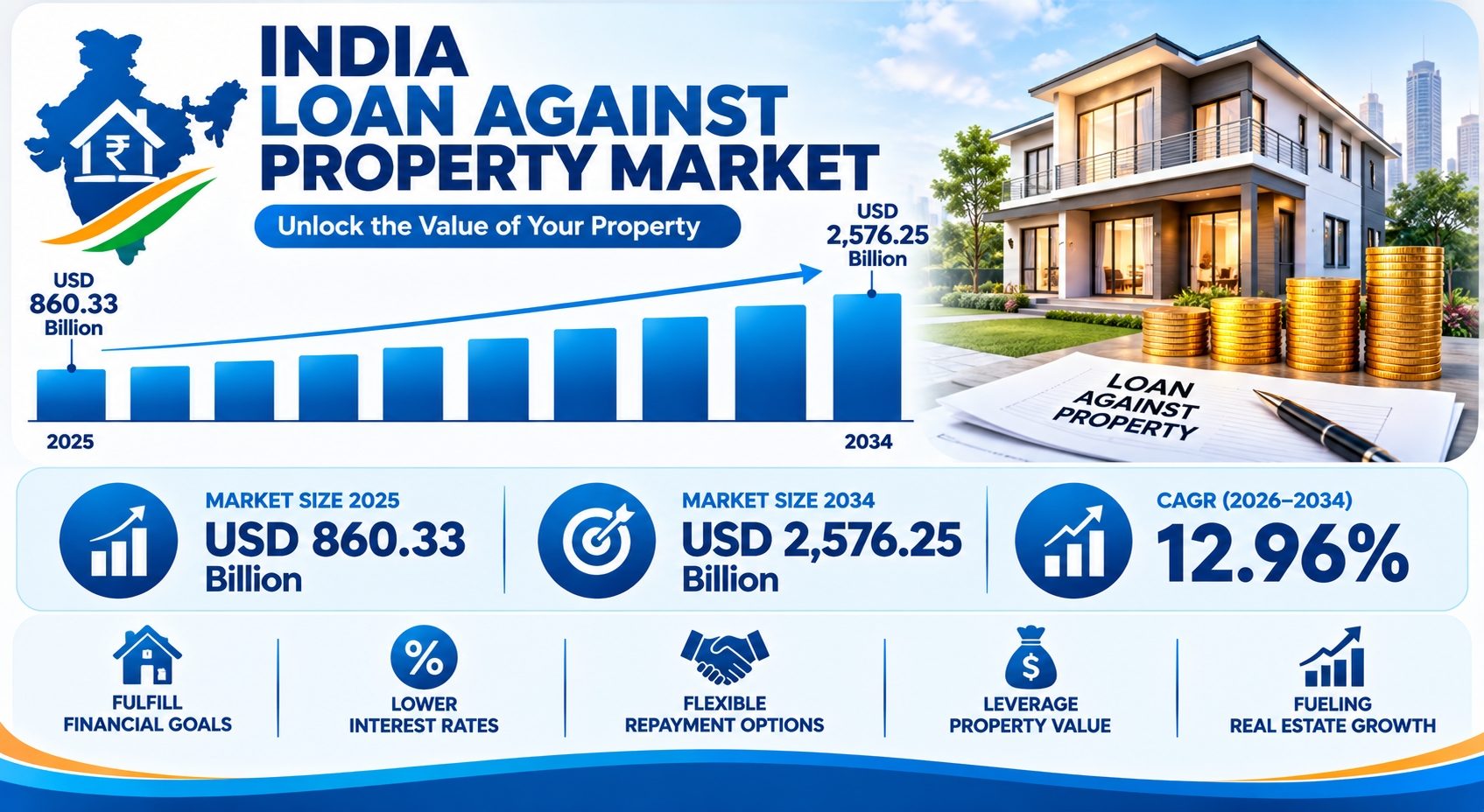
The India loan against property market was valued at USD 860.33 Billion in 2025, expected to reach USD 2,576.25 Billion by 2034, at a CAGR of 12.96% during the forecast period 2026–2034. Borrowers are increasingly leveraging real estate assets to fund business expansion, working capital and personal needs. Secured lending through property mortgages offers accessible credit, while digital lending platforms and streamlined approvals are extending reach from metropolitan areas to emerging urban centers.
Market Key Statistics:
Current Market Size (2025) : USD 860.33 Billion
Projected Market Size (2034) : USD 2,576.25 Billion
CAGR : 12.96%
Forecast Period : 2026-2034
Self-occupied residential property holds the largest share at 43% in 2025, driven by home ownership preferences and borrower comfort with mortgaging primary residences.
Floating rate leads the interest rate segment with a 55% share, aligned with Reserve Bank monetary policy movements.
The 11-24 years tenure dominates at 35% share, balancing manageable installments and total interest outflow.
North India is the leading regional market with a 31% share, backed by commercial activity in Delhi-NCR and robust financial infrastructure.
India Loan Against Property Market Trends & Future Outlook
Digital Transformation Accelerating Loan Origination: Lenders are adopting digital platforms, account aggregator frameworks and AI-powered credit assessment to speed up submission, verification and disbursement, extending services to underserved semi-urban markets while lowering operating costs.
Emergence of Small-Ticket Loan Against Property Products: Specialized schemes for micro and small enterprises are gaining ground. In October 2024, Arka Fincap launched its ‘Uday’ small-ticket scheme with loans of INR 10 Lakh to INR 30 Lakh, addressing funding gaps in tier-two and tier-three cities.
Hybrid Interest Rate Structures Gaining Preference: An initial fixed-rate period followed by a floating rate protects borrowers from short-term volatility while allowing them to benefit from future rate cuts, improving repayment predictability for self-employed borrowers.
Fintech Partnerships Expanding Distribution: Strategic tie-ups between traditional lenders and fintech platforms are widening reach and improving efficiency through technology-enabled underwriting and disbursement.
Dedicated Verticals and Specialized Teams: Housing finance companies and NBFCs are building dedicated teams to improve underwriting, customer acquisition and portfolio management for property-backed products.
Product Customization and Wider Geographic Coverage: The loan against property business in India is expected to see tailored products, competitive pricing and deeper penetration into emerging urban centers over the forecast period.
Why Invest in the India Loan Against Property Market - Key Growth Drivers
Expanding Credit Demand Among MSMEs in Emerging Urban Centers: Growing credit needs of small businesses in tier-two to tier-four cities are driving demand, as secured property-backed loans offer lower interest rates and higher amounts than unsecured lending. As per SIDBI’s MSME Pulse Report (May 2025), the commercial credit portfolio reached INR 35.2 Lakh Crore as of March 2025.
Financial Institutions Diversifying into Non-Housing Secured Loans: Housing finance companies and NBFCs are expanding non-housing portfolios for attractive risk-adjusted returns, backed by tangible collateral that lowers credit risk and allows flexible structuring.
Rising Property Values Enhancing Collateral Capacity: According to the Reserve Bank of India, the All-India House Price Index rose 3.1% year-on-year in Q4 2024-25, with Kolkata up 8.8%, allowing owners to unlock equity without selling their assets.
Technology Reducing Processing Timelines: Advances in property valuation, digital document verification and automated credit assessment have significantly shortened turnaround times and improved customer experience.
Supportive Rate and Regulatory Environment: The RBI lowered the repo rate by 25 basis points since the start of 2025 to 5.25% as of December 2025, reducing EMIs for floating-rate borrowers and encouraging secured lending.
Evaluate Market Opportunity with the Business Sample Report
Government Policy Support:
MSME Udyam Registration: Formal registration of micro and small enterprises improves documentation and credit visibility, helping small business owners qualify for property-backed borrowing across emerging urban centers.
Credit Guarantee Fund Trust for Micro and Small Enterprises (CGTMSE): Credit guarantee cover reduces lender risk on small business loans, encouraging financial institutions to extend collateral-backed credit to MSMEs.
SARFAESI Act, 2002: The framework lets lenders enforce security interest in mortgaged assets without court intervention, improving recovery confidence and supporting competitive pricing.
RBI Account Aggregator Framework: Consent-based financial data sharing enables faster income assessment and underwriting, helping lenders serve self-employed borrowers through digital origination.
RBI Monetary Easing: Repo rate reductions lower floating-rate EMIs, improving affordability and encouraging borrowers to leverage property assets for business and personal funding.
Key Market Challenges
Property Documentation and Title Verification Complexities: Unclear title records, missing approved plans and legal encumbrances extend processing timelines, raise operational costs and sometimes lead to application rejections.
Limited Awareness Among Rural Borrowers: Many property owners in rural and semi-urban areas are unfamiliar with mortgaging assets without giving up ownership or occupancy, constraining penetration beyond metros.
Property Market Volatility: Price stagnation or decline reduces borrowing capacity and increases lender exposure, requiring differentiated underwriting and pricing across regions.
Market Segmentation Breakdown
By Property Type — Self-Occupied Residential Property Leads
Self-occupied residential property dominates with a 43% share in 2025, supported by established legal frameworks, streamlined title verification and favorable loan-to-value ratios. Lower default risk and clear ownership strengthen its position, and it anchors the loan against property market share in India.
By Interest Rate — Floating Rate Dominates
Floating rate leads with a 55% share in 2025, as borrowers seek alignment with RBI policy movements and potential savings during rate-cut cycles. Lower initial rates also improve affordability for first-time borrowers and small business owners.
By Tenure — 11-24 Years Segment Dominates
The 11-24 years tenure holds a 35% share, balancing monthly installments with total interest expenditure. It suits salaried professionals, self-employed owners and small enterprise proprietors seeking predictable repayment.
By Region — North India Leads
North India leads with a 31% share, anchored by Delhi-NCR’s economic concentration, mature banking infrastructure and high property ownership, with strong contributions from Haryana, Punjab, Uttar Pradesh and Rajasthan.
Competitive Landscape & Key Player Positioning
The market research report has also provided a comprehensive analysis of the competitive landscape. Competitive analysis such as market structure, key player positioning, top winning strategies, competitive dashboard, and company evaluation quadrant has been covered in the report. Also, detailed profiles of all major companies have been provided.
Key players include:
Public sector banks offering property-backed lending
Private sector banks with digital disbursement capabilities
Housing finance companies with dedicated non-housing verticals
Non-banking financial companies targeting self-employed and small business borrowers
Fintech-partnered lenders expanding technology-enabled distribution
Recent Developments & News
In May 2025, SIDBI’s MSME Pulse Report showed the commercial credit portfolio at INR 35.2 Lakh Crore as of March 2025, underlining strong MSME credit demand.
In December 2025, the RBI repo rate stood at 5.25% after a cumulative 25 basis point reduction since the beginning of 2025, benefiting floating-rate borrowers.
Request Customized Data Tailored to Your Interest
Note: If you need specific information that is not currently within the scope of the report, we can provide it to you as a part of the customization.
Frequently Asked Questions
Q1. How big is the India loan against property market?
➤ The India loan against property market was valued at USD 860.33 Billion in 2025, reflecting rising use of property-backed credit for business, personal and working capital needs.
Q2. What is the projected growth rate?
➤ The market is expected to grow at a CAGR of 12.96% from 2026 to 2034, reaching USD 2,576.25 Billion by 2034, driven by MSME credit demand, digital lending and rising property values.
Q3. Which segment leads the market?
➤ Self-occupied residential property leads with a 43% share, while floating rate (55%), the 11-24 years tenure (35%) and North India (31%) lead their respective segments.
Strategic Insight & Verdict
The India loan against property market is entering a high-growth phase supported by MSME credit expansion, digitized underwriting and sustained property appreciation. The progression from USD 860.33 Billion in 2025 to USD 2,576.25 Billion by 2034 at a 12.96% CAGR positions the segment as an attractive opportunity for banks, housing finance companies, NBFCs and fintech partners, particularly those that invest in small-ticket products, tier-two and tier-three expansion and technology-enabled disbursement.
Verified Source: IMARC Group