
India Personal Finance Software Market-At-A-Glance
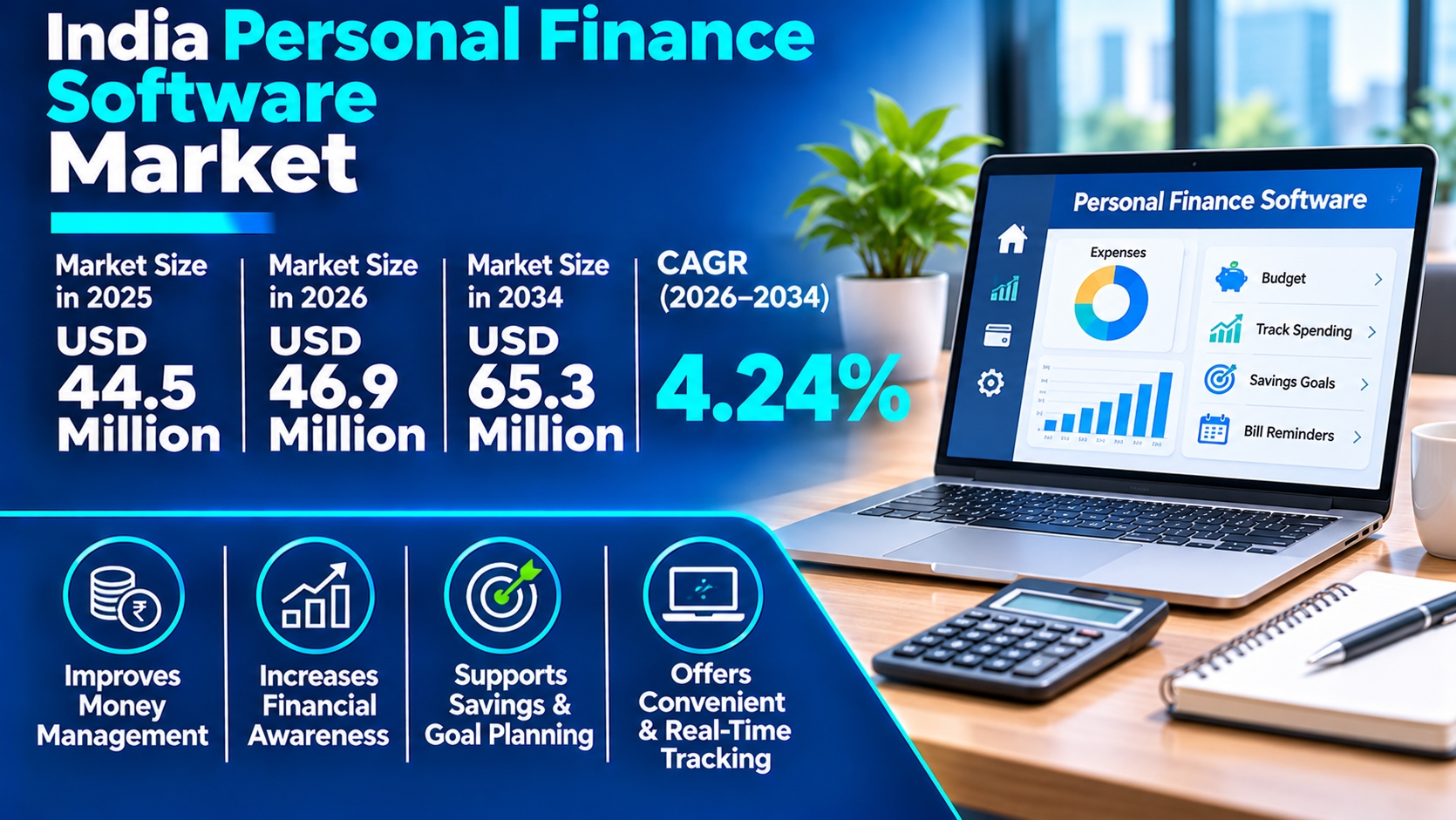
Market Size (2025): USD 44.5 Million
Market Size (2026): USD 46.9 Million
Forecast Market Size (2034): USD 65.3 Million
CAGR (2026-2034): 4.24%
Product Types Covered: Web-based Software, Mobile-based Software
End Users Covered: Small Business, Individual Business
Regions Covered: North India, South India, East India, West India
Why Is the India Personal Finance Software Market Growing?
Proliferation of Digital Payments:
Digital payments are now the preferred way to transact in India. With most spending recorded online, users want tools that integrate with payment data to track expenses, group spending and offer real-time insights, driving demand for the personal finance software market in India.
Implementation of Financial Literacy Initiatives:
Government programs are raising financial awareness. The New India Literacy Programme (2022-2027), with a budget of INR 1,037.90 crore, supports the National Education Policy 2020 and targets core financial knowledge, numeracy and digital literacy.
Rising Smartphone Penetration:
Wider smartphone ownership puts budgeting, expense monitoring and goal-setting tools in more hands, making mobile-first delivery central to adoption.
Growing Awareness of Financial Management Tools:
Consumers are increasingly proactive about budgeting, investment planning and cost tracking. User-friendly digital solutions let individuals and small businesses make informed decisions and improve long-term money management.
Evaluate Market Opportunity with the Business Sample Report
What Are the Key Trends Shaping the India Personal Finance Software Market?
Integration of Digital Payment Data:
Apps are embedding payment data to automate budgeting, categorize expenses and surface real-time insights, moving users from passive tracking to active financial planning.
AI-Based, Mobile-Supported Applications:
Firms offering intuitive, AI-based and mobile-supported apps stand to gain the most as the market matures, with personalization becoming a core differentiator.
Growth of Digital Investment Platforms:
In October 2024, Motilal Oswal Mutual Fund launched the Digital India scheme, an NFO investing in businesses that benefit from India’s digital growth. As more people invest digitally, the need for software that consolidates spending and investing rises.
Government Support Driving Market Expansion
New India Literacy Programme (2022-2027):
Supports National Education Policy 2020 goals
Targets core financial knowledge, numeracy and digital literacy
Builds the user base for budgeting and planning tools
EPFO 3.0:
Reported in January 2025 as a planned rollout allowing direct provident fund withdrawal using ATM cards
Improves financial access and promotes digital financial instruments
Creates integration opportunities for personal finance software
Digital Payments and Account Aggregator Frameworks:
UPI, run by NPCI, has made digital payments mainstream, generating rich transaction data
The RBI-regulated Account Aggregator framework enables consent-based sharing of financial data
Together they allow apps to offer consolidated views of a user’s finances
Data Protection and Financial Education:
The Digital Personal Data Protection Act, 2023 sets expectations for handling personal data and builds user trust
RBI-led financial education efforts, including the National Strategy for Financial Education, support informed financial decision-making
Explore the Full Report with Charts, Table of Contents, and List of Figures
Segment Insights
Product Type Insights:
Web-based Software
Mobile-based Software
The report provides a detailed breakup of the India personal finance software market by web-based and mobile-based software.
End User Insights:
Small Business
Individual Business
The report analyses end-user demand across small business and individual business segments.
Regional Insights:
North India
South India
East India
West India
The report covers all major regional markets across North, South, East and West India.
Competitive Landscape
IMARC Group’s report analyses market structure, key player positioning, top winning strategies, a competitive dashboard and a company evaluation quadrant, with detailed profiles of major companies.
Providers compete on ease of use, automation, AI-driven insights and integration with payments and investment platforms. Firms with intuitive, AI-based, mobile-supported applications are best positioned as consumers demand smarter budgeting and planning tools.
Key Opportunities for Businesses and Investors
High-Growth Areas:
AI-driven budgeting and personalized financial insights
Mobile-first applications for individuals and small businesses
Integration with digital payment and investment platforms
Financial literacy features embedded within apps
Strategic Opportunities:
Partnerships with banks, fintech platforms and investment providers for seamless data integration
Consent-based data models built on the Account Aggregator framework
Strong privacy and security positioning to build trust under the Digital Personal Data Protection Act, 2023
Discuss Your Requirements With an Analyst and Get Your Customized Market Report
Frequently Asked Questions (FAQ)
How big is the India personal finance software market?
The India personal finance software market size increased from USD 44.5 Million in 2025 to USD 46.9 Million in 2026.
What is the projected growth rate?
The market is projected to grow at a CAGR of 4.24% during 2026-2034, reaching USD 65.3 Million by 2034.
What are the key growth drivers?
Key drivers include rising digital literacy, increasing smartphone penetration, growing awareness of financial planning, the shift toward cashless transactions and demand for expense tracking and investment tools.
How is India personal finance software market share analyzed?
IMARC Group’s report breaks down India personal finance software market share by product type (web-based and mobile-based), end user (small business and individual business) and region.
What role does government play?
Initiatives such as the New India Literacy Programme, digital payment infrastructure and financial inclusion efforts are building the awareness and digital habits that support adoption.
Conclusion
India’s personal finance software market is positioned for steady growth through 2034, supported by digital payments, financial literacy programs and rising smartphone use.
The combination of AI-based mobile apps, payment and investment integration and supportive public infrastructure creates a durable foundation. Organizations that invest in personalization, trusted data practices and partnerships across banking and fintech will be best placed to capture this opportunity.
Source: IMARC Group