
India Fleet Management Market Executive Summary
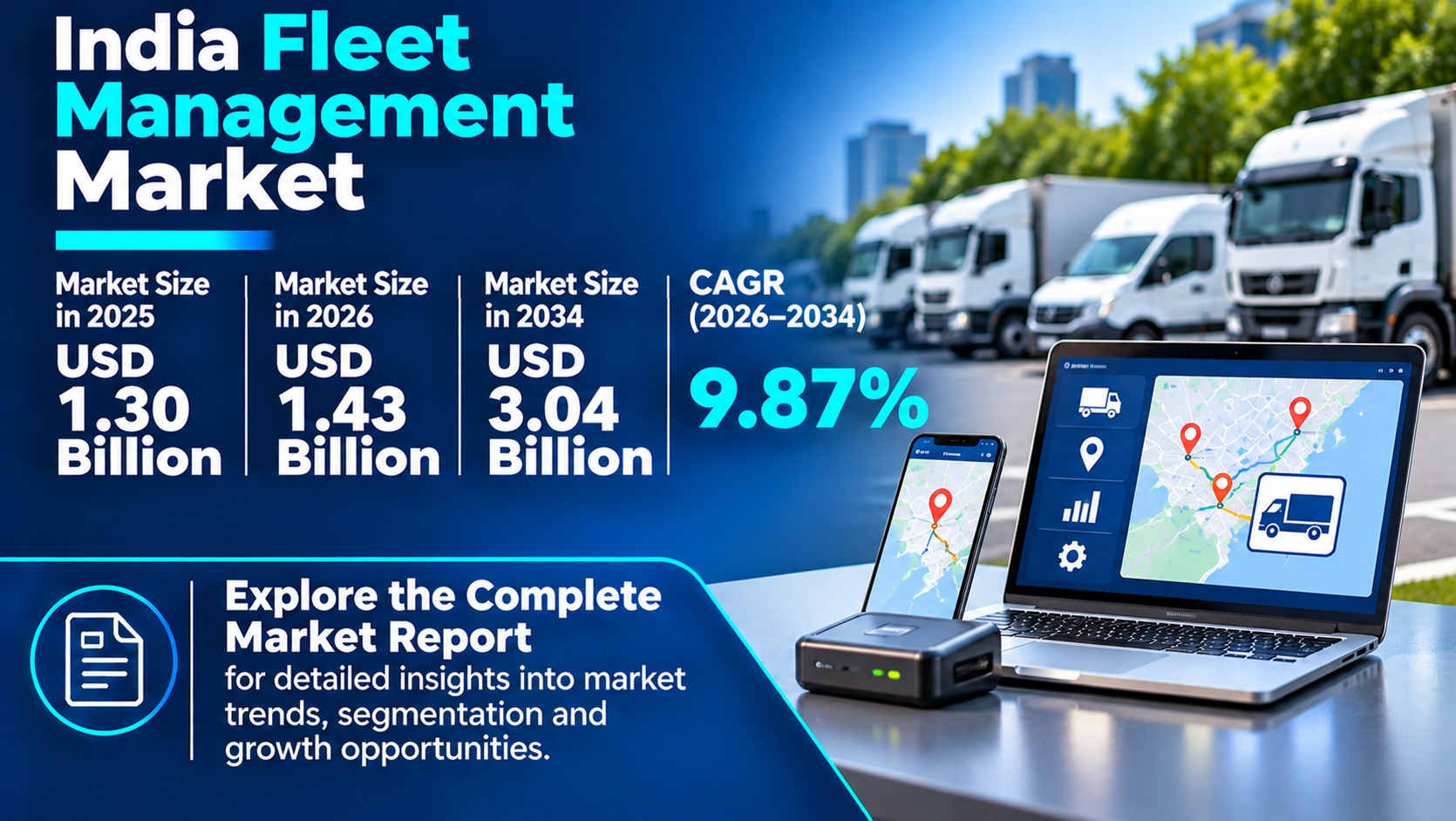
The market is projected to grow from USD 1.30 Billion in 2025 to USD 3.04 Billion by 2034 at a CAGR of 9.87%, with 2026 estimated at USD 1.43 Billion, according to IMARC Group. The fleet management market size in India reflects a clear shift from manual tracking to real-time digital operations. Solutions command a 58% share, commercial vehicles lead vehicle types at 40%, GNSS dominates technology at 65%, and cloud-based deployment holds 52%.
Competition is moderately intense, with domestic technology startups, international telematics providers, and commercial vehicle OEMs competing on AI analytics, cloud platforms, and hardware-agnostic software. Logistics and e-commerce growth, government vehicle tracking mandates, and rising fuel costs are setting the stage for broad digitalization of fleets, from large logistics operators to small and mid-sized owners.
Market Snapshot
Market Size (2025): USD 1.30 Billion
Market Size (2026): USD 1.43 Billion
Forecast Market Size (2034): USD 3.04 Billion
CAGR (2026-2034): 9.87%
Leading Component: Solutions (58% share, 2025)
Leading Vehicle Type: Commercial Vehicles (40% share, 2025)
Leading End Use Sector: Automotive (24% share, 2025)
Leading Technology: GNSS (65% share, 2025)
Leading Deployment Type: Cloud-based (52% share, 2025)
Leading Region: North India (25% share, 2025)
Key Growth Drivers: Logistics and e-commerce, tracking mandates, fuel costs, AI and telematics
India Fleet Management Market Key Drivers
Expanding Logistics and E-Commerce Infrastructure:
Online retail, quick commerce, and last-mile delivery need route optimization, multi-vehicle dispatch, and real-time visibility. Delhivery has expanded AI-driven route optimization, shipment tracking, and automated dispatch across its network to improve fleet efficiency and delivery speed.
Government Mandates and Regulatory Push:
India enforced AIS 140 standards under the Bureau of Indian Standards, mandating GPS-based tracking and emergency alerts in public and commercial transport vehicles, and expanded the Vehicle Location Tracking Device (VLTD) mandate. Broader logistics digitalization efforts, including dedicated freight corridors, the National Logistics Policy, and PM Gati Shakti, strengthen the case for connected fleets.
Rising Fuel Costs and Efficiency Imperatives:
Fuel is a substantial share of operating costs, so even marginal efficiency gains matter. IndianOil expanded its XTRAPOWER Fleet Card and digital fleet solutions to help operators monitor consumption, control expenses, and improve cost transparency.
Telematics, AI, and Cloud Adoption:
Pay-per-use cloud platforms make advanced tools accessible to small and mid-sized fleets. AI and machine learning are turning raw telematics data into predictive maintenance, driver scoring, and fuel optimization.
Evaluate Market Opportunity with the Business Sample Report
India Fleet Management Market Emerging Trends
AI and Predictive Analytics in Fleet Operations:
Platforms are moving beyond tracking to decision support. Tata Motors expanded its Fleet Edge platform with AI-driven analytics and real-time vehicle health monitoring to reduce downtime for commercial fleet operators.
Cloud-Based and SaaS Fleet Platforms:
Subscription pricing suits India’s fragmented trucking sector. Trimble expanded its cloud-based fleet management and telematics solutions in India, improving real-time visibility, performance analytics, and remote asset monitoring.
Convergence with the EV Ecosystem:
Mixed fleets need battery health monitoring, charger scheduling, and range prediction. In 2024, Tata Motors announced that 5 lakh commercial vehicles were connected to its Fleet Edge platform.
Connected Mobility Investment by OEMs:
In November 2025, Maruti Suzuki invested in Ravity Software Solutions, whose AI platforms help OEMs and fleet operators analyze vehicle data and optimize connected fleet performance.
India Fleet Management Market Challenges
Despite robust momentum, the India fleet management market faces persistent structural headwinds:
Extreme fragmentation, with most vehicles owned by small, price-sensitive operators who rely on manual tracking and resist subscription models
Inconsistent network coverage in rural and remote regions causes data loss and delayed alerts, especially for long-haul freight
Data privacy and cybersecurity concerns grow as platforms collect vehicle locations, driver identities, and cargo details
Limited digital literacy and the absence of a comprehensive data protection framework for fleet telematics create adoption uncertainty
Explore the Full Report with Charts, Table of Contents, and List of Figures
India Fleet Management Market Segment Insights
By Component
Solutions: 58% (fleet telematics, driver information management, vehicle maintenance, safety and compliance)
Services (installation and integration, after-sales support, consulting)
By Vehicle Type
Commercial Vehicles: 40%
Passenger Cars
Aircrafts
Watercrafts
By End Use Sector
Automotive: 24%
Energy and Utilities
Manufacturing
Retail
Transportation and Logistics
Construction
Others
By Technology
GNSS: 65%
Cellular Systems
By Deployment Type
Cloud-based: 52%
On-premises
Hybrid
Regional Insights
North India: 25% share (2025)
West and Central India
South India
East and Northeast India
Competitive Landscape
The India fleet management market is characterized by a mix of domestic startups, international telematics providers, and commercial vehicle manufacturers. India fleet management market share is increasingly shaped by technology differentiation, platform capability, pricing flexibility, and localized solutions. Strategic partnerships between technology providers and OEMs, along with mergers and consolidation, are key competitive moves.
Tata Motors | Brand / Platform: Fleet Edge
Core Strength: AI analytics, real-time vehicle health monitoring, and a large connected commercial vehicle base
Trimble | Brand / Platform: Cloud fleet management and telematics
Core Strength: Real-time fleet visibility, performance analytics, and remote asset monitoring
ZF | Brand / Platform: SCALAR
Core Strength: Digital platform for efficiency, safety, route optimization, and cost management
Delhivery | Brand / Platform: Proprietary logistics technology stack
Core Strength: AI-driven route optimization, shipment tracking, and automated dispatch
IndianOil | Brand / Platform: XTRAPOWER Fleet Card
Core Strength: Fuel monitoring and expense control for large vehicle fleets
Recent Developments
January 2025: ZF unveiled SCALAR at the Bharat Mobility Expo 2025, a digital platform for passenger and cargo operators with real-time analytics and predictive insights
November 2025: Maruti Suzuki invested in Ravity Software Solutions to support AI-powered connected fleet performance
Investment Opportunities
High-Growth Segments: AI-driven predictive maintenance, driver performance analytics, and EV-ready fleet platforms address the shift from tracking to decision support.
Small and Mid-Sized Fleet Penetration: Pay-per-use cloud platforms and hardware-agnostic software can reach the fragmented operator base that has largely been underserved.
Compliance-Led Solutions: AIS 140 and VLTD mandates create demand for tracking, emergency alert, and compliance monitoring solutions across a broadening range of commercial vehicles.
Discuss Your Requirements With an Analyst and Get Your Customized Market Report
Frequently Asked Questions (FAQ)
How big is the India fleet management market?
The market grew from USD 1.30 Billion in 2025 to USD 1.43 Billion in 2026. The India fleet management market report from IMARC Group covers component, vehicle type, end use sector, technology, deployment type, and region.
What is the projected growth rate?
The market is expected to grow at a CAGR of 9.87% during 2026-2034, reaching USD 3.04 Billion by 2034.
Which component holds the largest share?
Solutions hold 58%, driven by demand for telematics, driver information management, maintenance, and safety and compliance platforms.
What are the key growth drivers?
Logistics and e-commerce expansion, government tracking mandates, rising fuel costs, and growing adoption of telematics and AI.
What are the major challenges?
Fragmentation among small operators, connectivity gaps in remote areas, data privacy risks, and limited digital literacy.
Conclusion
India’s fleet management market is shifting from basic tracking to intelligent, cloud-based operations. Regulatory mandates provide a compliance floor, while logistics growth and fuel pressures provide a commercial reason to digitize.
Providers that combine AI analytics, affordable subscription models, and EV-ready capabilities will be best positioned to serve both large logistics networks and small fleet owners through 2034.
Source: IMARC Group