
India FMCG Market Outlook
The market is expanding on rising disposable incomes, rapid urbanization, and growing demand for convenience-oriented products. High-volume sales and fast inventory turnover across food and beverages, personal care, health care, and home care make it one of the most dynamic consumer sectors in the economy.
Digital transformation, quick commerce, and the rise of direct-to-consumer brands are changing how products reach shoppers. The India FMCG market size is growing from both sides, with urban consumers premiumizing and rural households shifting to branded goods.
Market Snapshot
Market Size (2025): USD 287.91 Billion
Forecast Market Size (2034): USD 1,150.21 Billion
CAGR (2026-2034): 16.64%
Leading Product Type: Personal Care and Cosmetics (48%)
Leading Demographic: Urban (63%)
Leading Sales Channel: Offline (76%)
Leading Region: Maharashtra (12%)
Key Drivers: Rising incomes, urbanization, digital commerce, government support
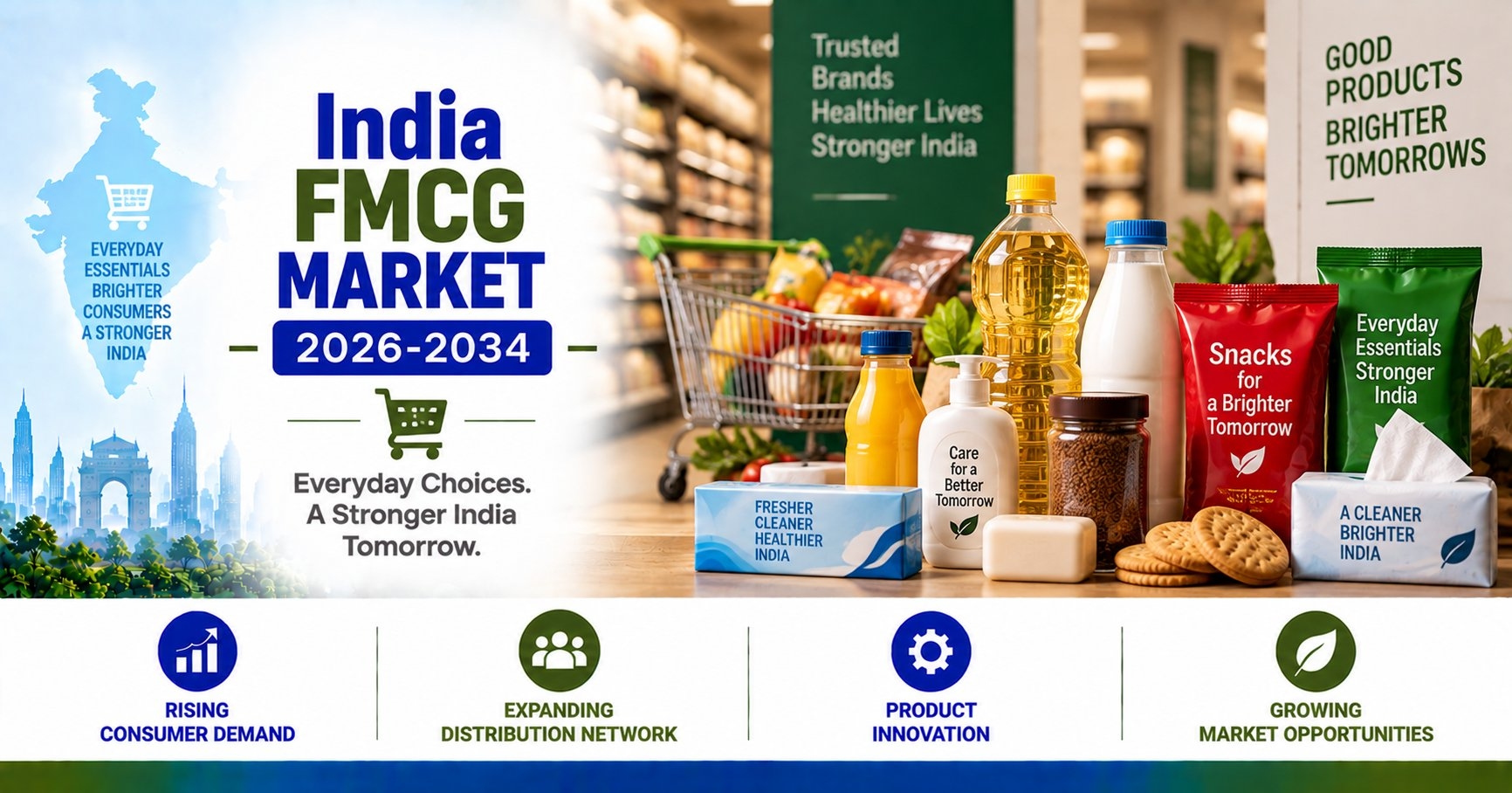
Key Market Drivers
Rising Disposable Incomes and an Expanding Middle Class:
Higher per capita income is moving shoppers toward branded, premium, and convenience-oriented products. Financial inclusion has widened purchasing capacity among previously underserved groups, and rural households are replacing unorganized alternatives with branded goods. By April 2025, household FMCG spending rose by 8% to Rs. 17,792 Crore (US$ 2.07 Billion), according to IBEF.
Digital Transformation and E-Commerce Expansion:
Internet users are projected to exceed nine hundred million, and rural areas account for most new digital adopters. E-commerce and quick commerce bring wider product ranges to smaller towns, while direct-to-consumer models let emerging brands bypass traditional distribution barriers.
Government Initiatives and Policy Support:
The Production-Linked Incentive scheme for food processing has attracted manufacturing investment and created jobs. Rural electrification has expanded refrigeration and storage, GST has simplified interstate commerce, and rural road and digital infrastructure programs improve market access. These measures underpin growth in the fmcg industry in India, particularly its push into smaller towns and villages.
Rapid Urbanization and Changing Lifestyles:
Urban centers such as Mumbai, Delhi, Bangalore, and Chennai serve as demand hubs, with strong preference for premium and convenient products supported by modern retail infrastructure.
Evaluate Market Opportunity with the Business Sample Report
Emerging Trends
Premiumization and Health-Conscious Consumption:
Shoppers are paying more for functional ingredients, organic formulations, and clean-label products, especially in personal care and packaged food. Younger consumers favor holistic wellness lifestyles, pushing manufacturers toward health-focused innovation.
Quick Commerce Revolution:
Ultra-fast delivery platforms have captured a dominant portion of e-grocery orders and are significant revenue contributors for leading FMCG firms. This is prompting traditional retailers and manufacturers to rethink distribution.
Artificial Intelligence Integration:
AI technologies powered approximately half of new FMCG product launches in recent periods and influence pricing across most segments. Leading manufacturers use AI for demand forecasting, personalized marketing, and supply chain optimization.
Acquisitions of Digital-First Brands:
Hindustan Unilever’s acquisition of Minimalist shows how legacy players are buying digital-native brands to capture new consumer groups.
Market Challenges
Despite strong growth momentum, the India FMCG market faces several structural headwinds:
Rising costs of palm oil, packaging materials, and agricultural commodities, along with currency volatility, put pressure on manufacturer margins
Logistics inefficiencies in rural areas and cold chain gaps raise costs and limit reach, while quick commerce adds pressure on traditional distributors and kirana stores
Intense competition from multinationals, domestic giants, regional players, and digital-first startups limits pricing flexibility in mass segments
Premiumization requires significant investment in brand building and product development
Explore the Full Report with Charts, Table of Contents, and List of Figures
Segment Insights
By Product Type
Personal Care and Cosmetics (leading, 48%): body care, hair care, oral care, skin care, baby care
Food and Beverages: juices and drinks, tea and coffee, fresh food, others
Health Care: feminine care, over the counter (OTC), others
Home Care: cleaning products, fragrance, others
Others
By Demographics
Urban (leading, 63%): concentrated purchasing power, modern trade, higher brand awareness
Rural: faster growth than urban, supported by connectivity and agricultural incomes
By Sales Channel
Offline (leading, 76%): Kirana stores, supermarkets, hypermarkets, organized retail
Online: quick commerce and e-commerce, expected to gain share over time
Regional Insights
Maharashtra (leading, 12%): Mumbai, Pune, and Nagpur; strong retail infrastructure and manufacturing base
Tamil Nadu, Uttar Pradesh, Gujarat, Karnataka, West Bengal, Rajasthan, Andhra Pradesh, Telangana, Madhya Pradesh, Delhi NCR, Punjab, Haryana, and others
Competitive Landscape
The market is highly competitive, with multinational corporations, domestic giants, and digital-native brands competing across categories. Leaders use extensive distribution, strong brand equity, and marketing investment, while strategic acquisitions are intensifying.
Key players include AB InBev India, Amul, Asian Paints, Britannia Industries, Coca-Cola India, Colgate Palmolive (India), Dabur, Godrej Consumer Products, Hindustan Unilever, ITC, Marico, Nestlé India, Patanjali Ayurved, PepsiCo (India) Holdings, and Procter & Gamble Hygiene and Health Care. The report also provides competitor positioning and strategy analysis.
Investment Opportunities
High-Growth Categories: Personal care, premium and wellness-oriented foods, and health-focused products are benefiting from premiumization and ingredient transparency.
Rural and Tier-II/III Expansion: Improved connectivity, rising agricultural incomes, and e-commerce are opening new demand in smaller towns, supported by PLI-driven manufacturing investment.
Quick Commerce, D2C, and AI: Fast-delivery platforms, direct-to-consumer models, and AI-led forecasting and personalization are reshaping distribution and product development.
Request Customized Data Tailored to Your Interest
Frequently Asked Questions (FAQ)
What is the FMCG market size in India?
The India FMCG market was valued at USD 287.91 Billion in 2025.
What is the projected CAGR?
The market is projected to grow at a CAGR of 16.64% during 2026-2034, reaching USD 1,150.21 Billion by 2034.
What are the key drivers?
Key drivers include rising disposable incomes, urbanization, a growing middle class, digital and e-commerce growth, government support for manufacturing and rural development, and a shift toward premium and health-conscious products.
Which product type leads?
Personal care and cosmetics leads with about 48% in 2025, driven by grooming awareness, premiumization, and demand for skincare and hygiene.
What are the major challenges?
Major challenges include rising input costs, supply chain complexity, intensifying competition, regulatory compliance requirements, and fast-changing consumer and channel dynamics.
Conclusion
The India FMCG market is positioned for one of the strongest growth runs among consumer sectors, underpinned by income growth, digital adoption, and supportive government policy. Offline retail will remain dominant while quick commerce and e-commerce add reach.
Companies that combine premium innovation, AI-led operations, rural distribution, and agile digital strategies will capture the largest share of value through 2034.
Source: IMARC Group



