
India Fuel Cards Market: Industry Report 2026–2034
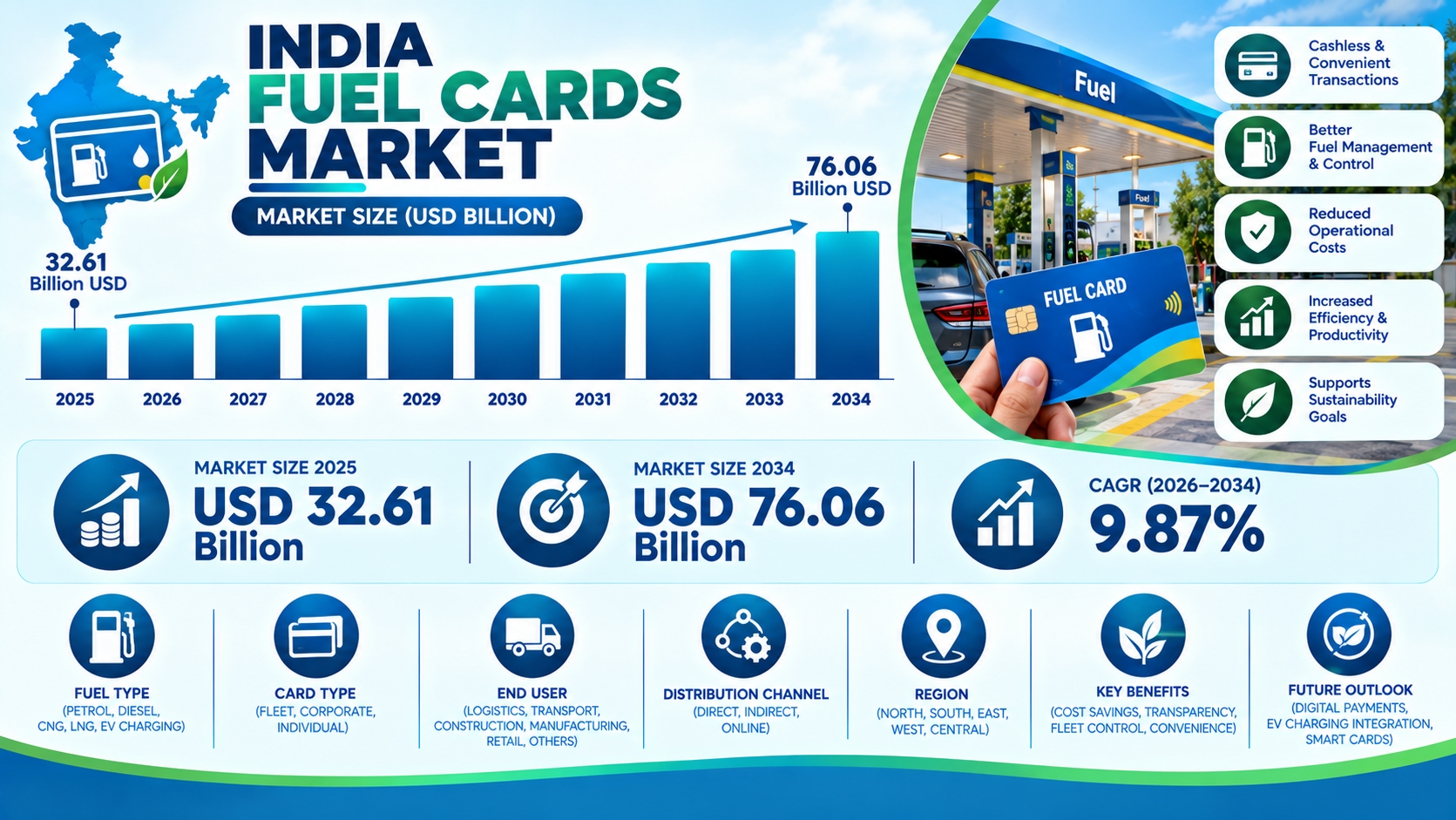
The India fuel cards market size reached USD 32.61 Billion in 2025 and is projected to reach USD 76.06 Billion by 2034, exhibiting a compound annual growth rate (CAGR of 9.87%) during the 2026–2034 forecast period. The market continues to expand as fleet operators, logistics companies, and individual vehicle owners adopt cashless, controlled, and traceable ways to pay for fuel and related services. Driven by organized logistics and e-commerce growth, government digital payment initiatives, and the need to optimize fleet operating costs, fuel cards are becoming an essential tool for transaction transparency and expense control. The overall India fuel cards market outlook remains positive, supported by smart card technology, telematics integration, and the expansion of multi-purpose payment features such as tolls and parking.
Market Size and Growth Forecast
Market Size in 2025: USD 32.61 Billion.
Market Forecast in 2034: USD 76.06 Billion.
Compound Annual Growth Rate (CAGR): 9.87% during the 2026–2034 forecast period.
Underpinning Momentum: Organized logistics and e-commerce growth, government digital payment initiatives, fleet cost optimization, telematics and IoT integration, multi-application card functionality, and stronger fraud-prevention controls are supporting long-term market development. Understanding India Fuel Cards Market Size trends is essential for banks, oil companies, and fintech players.
Emerging Trends
Telematics and IoT Integration: Fuel cards are being linked with vehicle tracking and telematics, capturing odometer readings, locations, and unusual transactions. This supports predictive maintenance, fuel theft detection, and better fleet efficiency. IMARC Group projects India's IoT market to reach USD 3.62 Billion by 2034.
Multi-Application Functionality: Cards now extend beyond fuel to parking, toll payments through NETC integration, and vehicle servicing, giving fleet managers a single payment and reporting tool for multiple vehicle-related expenses.
Customizable Spend Controls and Fraud Prevention: Vehicle-specific limits, category restrictions, PIN authentication, time-based rules, real-time alerts, and biometric pilots are strengthening security, which is increasingly important as cybersecurity cases in India rose from 10.29 lakh in 2022 to 22.68 lakh in 2024.
Co-Branded and Digital-First Offerings: Banks and oil companies are collaborating on co-branded fuel cards with rewards and UPI-integrated payments, while fintechs introduce dynamic pricing alerts, route optimization, and carbon footprint tracking.
Key Growth Drivers
Organized Logistics and E-Commerce Growth: Indian e-commerce was valued at USD 46.2 billion in 2020 and is projected to reach USD 136.47 billion by 2026, growing at 18.29%, according to the International Trade Administration. Expanding delivery fleets are boosting demand for fuel management tools.
Government Digital Payment Initiatives: A ₹1,500 crore incentive scheme for FY 2024-25 to promote low-value BHIM-UPI (P2M) transactions, along with GST input credit documentation, encourages the use of traceable electronic payments for fuel.
Fleet Cost Optimization: Fuel accounts for 30 to 40% of total fleet operating costs, making accurate monitoring and spend control critical. Petrol usage rose 7.03% year-on-year in October, from 3.41 to 3.65 million tonnes.
Corporate Adoption and Expense Transparency: Companies value consolidated billing, detailed reporting, and reduced cash handling, which lower the risk of leakage and simplify reconciliation and tax compliance.
Smartphone Penetration and Mobile Card Management: Mobile apps let users block cards, set limits, and track spending in real time, improving convenience and encouraging adoption among small fleet owners.
Evaluate Market Opportunity Before Investing - Request for a Sample Report
Government Policy Support
UPI P2M Incentive Scheme: A ₹1,500 crore incentive for FY 2024-25 promotes low-value BHIM-UPI merchant transactions, encouraging digital payment acceptance at fuel stations and related outlets.
NETC and FASTag Framework: Electronic toll collection through FASTag links toll payments with digital accounts, enabling multi-purpose fuel and mobility cards for fleet operators.
GST Input Tax Credit Documentation: Clear invoicing and traceable payments support input credit claims, motivating businesses to use fuel cards for documented, tax-compliant fuel purchases.
RBI Prepaid Payment Instrument Guidelines: Regulatory norms for prepaid instruments provide security, KYC, and operating standards that give confidence to issuers and cardholders in digital fuel payments.
Digital India Initiative: Promotion of cashless transactions and digital financial services supports wider acceptance of card-based and app-based payments across the fuel retail network.
Market Segmentation Breakdown:
Type Insights:
Branded
Universal
Merchant
Technology Insights:
Smart Cards
Standard Cards
Application Insights:
Fuel-Refill
Parking
Vehicle Services
Toll Charges
Others
End User Insights:
Individual
Corporate
Regional Insights:
North India
South India
East India
West India
By IMARC Group — Top Competitive Landscape & Positioning:
Covering an in-depth analysis of the competitive landscape, market structure, key player positioning, competitive dashboards, top winning strategies, and detailed profiles of all major industry participants, you will gain access to all these exclusive insights within the full research report. The India Fuel Cards Market Share landscape shows moderate competitive intensity, with petroleum marketing companies, financial institutions, and specialized fleet management providers competing and collaborating.
Key players shaping India's fuel cards landscape include:
Indian Oil
Bharat Petroleum
Hindustan Petroleum
Jio-bp
IDFC FIRST Bank
IndusInd Bank
Recent News & Developments:
Gro Digital Platforms and IDFC FIRST Bank FASTag MoU: In 2025, Gro Digital Platforms, a collaboration between Ashok Leyland and Hinduja Leyland Finance, signed an MoU with IDFC FIRST Bank to introduce FASTag services through Ashok Leyland dealers.
IndusInd Bank Jio-bp Mobility+ Card: In 2025, IndusInd Bank and Jio-bp launched a co-branded, RuPay-backed credit card, the bank's first fuel-linked card, offering rewards across Jio-bp's network of over 2,050 Mobility Stations with UPI-integrated payments.
Expanded Networks and Fintech Features: Oil marketing companies have widened their fuel card networks, while fintechs have introduced dynamic pricing alerts, route optimization, and carbon footprint tracking.
Note: If you need specific information that is not currently within the scope of the report, we can provide it to you as a part of the customization.
Request Customized Data Tailored to Your Interest
Frequently Asked Questions (FAQs):
Q1. How big is the India fuel cards market?
The market was valued at USD 32.61 Billion in 2025 and is expected to reach USD 35.82 Billion in 2026, driven by logistics growth, digital payments, and fleet cost control.
Q2. What is the projected India Fuel Cards Market Outlook?
The market is expected to grow at a CAGR of 9.87% during 2026–2034, reaching USD 76.06 Billion by 2034, supported by structural tailwinds such as organized logistics and digital payment policy.
Q3. Which type and technology segments lead?
Universal fuel cards lead by type with a 43.2% share in 2025, while smart cards dominate by technology with a 64.3% share.
Q4. Which application and end user lead the market?
Fuel-refill is the largest application at 41.6%, and corporate users account for 61.4% of the market, reflecting fleet-driven demand.
Q5. Which region leads the market?
South India leads with a 31% share, supported by automotive clusters in Tamil Nadu, Karnataka, and Andhra Pradesh, port-city logistics hubs, IT and BPO transport demand, and dense fuel retail networks.
Q6. What challenges does the market face?
Limited penetration among small fleet operators and individual owners, infrastructure gaps in rural and remote areas, and security and fraud vulnerabilities such as theft, cloning, and employee collusion are the key challenges.
Strategic Insight & Verdict:
The India fuel cards market is shifting from a niche corporate payment tool to a core component of fleet and mobility finance. Growth from USD 32.61 Billion in 2025 to USD 76.06 Billion by 2034 at a 9.87% CAGR reflects how digital payments, logistics formalization, and cost control priorities are reshaping how Indian businesses buy fuel.
The convergence of smart card technology, telematics integration, co-branded bank and fuel retailer partnerships, and expanding toll and service payment functionality positions the sector as a strong long-term opportunity for banks, oil marketing companies, fintechs, and fleet management providers. The most compelling opportunities lie in corporate fleet programs, smart card adoption, small fleet operator penetration, and multi-application cards that unify fuel, toll, parking, and servicing payments.




