Starting a non-profit organisation in India is a meaningful way to contribute to social development. If you want to establish an organisation working in education, healthcare, poverty alleviation, women empowerment or environmental protection, a Section 8 Company can be a suitable legal structure. Understanding how to register a Section 8 Company helps founders understand the legal requirements, documentation and incorporation procedure under the Companies Act, 2013.
A Section 8 Company operates for charitable and other permitted non-profit objectives. It can generate income through its activities, but its profits must be used towards its objectives rather than distributed as dividends among members.
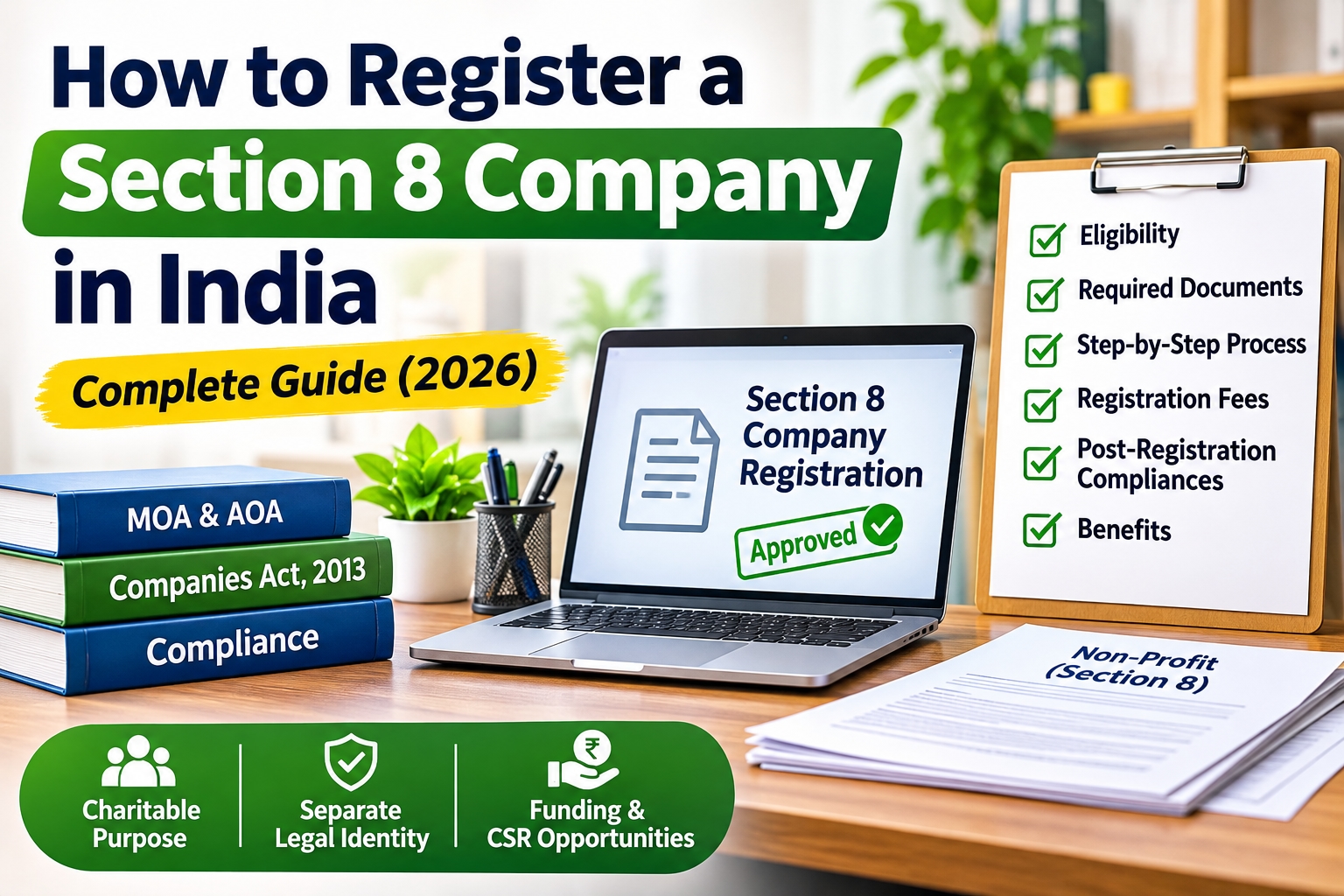
What Is a Section 8 Company?
A Section 8 Company is a non-profit organisation incorporated under Section 8 of the Companies Act, 2013. It is established to promote activities such as education, science, sports, research, social welfare, charity, environmental protection and other similar objectives.
Unlike ordinary companies, a Section 8 Company cannot distribute dividends to its members. Its income and profits must be utilised to achieve its stated objectives.
Key Features of a Section 8 Company:
Operates for charitable and non-profit purposes.
Has a separate legal identity.
Cannot distribute profits as dividends.
Follows a structured corporate governance system.
Can approach eligible government agencies, donors and CSR funding organisations.
Must comply with applicable MCA filing and reporting requirements.
Eligibility Criteria for Section 8 Company Registration
Before applying, founders should ensure that their proposed organisation meets the legal requirements.
Requirement | Details |
|---|---|
Legal Framework | Companies Act, 2013 |
Private Company | Minimum 2 members and 2 directors |
Public Company | Minimum 7 members and 3 directors |
Registered Office | Address in India |
Objectives | Charitable or other permitted non-profit activities |
Profit Distribution | Dividend distribution is prohibited |
Minimum Capital | No prescribed minimum paid-up capital |
At least one director must satisfy the applicable Indian residency requirement under the Companies Act, 2013.
Documents Required for Section 8 Company Registration
Preparing the documents correctly helps avoid application objections and unnecessary delays.
Documents of Directors and Members
PAN Card of Indian applicants.
Aadhaar Card or other valid identity proof.
Passport-size photographs.
Residential address proof.
Email address and mobile number.
Registered Office Documents
Electricity bill or other acceptable address proof.
Rent agreement, if the premises are rented.
No Objection Certificate (NOC) from the property owner, where applicable.
Company-Related Documents
Proposed Memorandum of Association (MOA).
Articles of Association (AOA).
Details of proposed directors and subscribers.
Declaration and supporting information required through MCA forms.
Estimated income and expenditure for the next three years.
Details of proposed charitable activities and objectives.
How to Register a Section 8 Company in India: Step-by-Step Process
The registration process is completed online through the Ministry of Corporate Affairs (MCA) portal. New Section 8 Companies obtain their licence through the integrated SPICe+ incorporation process.
Step 1: Obtain Digital Signature Certificates (DSC)
The proposed directors and subscribers who need to sign incorporation documents electronically must obtain valid Digital Signature Certificates.
Step 2: Apply for Company Name Approval
Choose a unique and meaningful name that reflects the organisation's charitable objectives.
The proposed name should follow MCA naming requirements. Names may include words such as Foundation, Association, Forum or Council, subject to approval.
Step 3: Prepare MOA and AOA
The Memorandum of Association defines the company's objectives, while the Articles of Association explain its internal management and governance rules.
For a Section 8 Company, the MOA is prepared in the prescribed INC-13 format.
Step 4: File the SPICe+ Incorporation Application
Submit the incorporation application through SPICe+ on the MCA portal. Provide details about:
Proposed company name.
Registered office address.
Directors and subscribers.
Share capital, where applicable.
Charitable objectives.
Required declarations and supporting documents.
The Section 8 licence application is integrated into this process for a new company. A separate Form INC-12 is not required for new Section 8 incorporations.
Step 5: Submit Linked Forms and Pay Applicable Fees
Complete the relevant linked forms and upload the required documents. Pay applicable government fees and stamp duty according to the filing requirements.
Step 6: Verification and Approval
The Registrar of Companies (ROC) or relevant MCA processing authority examines the application. If any clarification or additional information is required, the applicant must respond accordingly.
Step 7: Receive the Certificate of Incorporation
After approval, the company receives its Certificate of Incorporation and Section 8 licence. The company can then proceed with its post-incorporation formalities.
For a more detailed explanation, read the step-by-step process to register a Section 8 Company.
Fees for Section 8 Company Registration
The total registration cost depends on the applicable government fees, state-wise stamp duty, professional charges and documentation requirements.
Cost Component | Description |
|---|---|
DSC Charges | Digital signature expenses |
Name Reservation | Applicable MCA charges, if any |
Government Fees | Fees applicable to incorporation filings |
Stamp Duty | Depends on the state and applicable capital |
Professional Fees | Charges for documentation and filing assistance |
Applicants should check the latest MCA fee structure before submitting their applications.
Important Compliances After Registration
Registration is only the beginning. A Section 8 Company must fulfil its statutory and financial responsibilities.
Important compliances include:
Maintaining proper books of accounts.
Conducting statutory audits.
Holding board meetings and annual general meetings as applicable.
Filing annual financial statements in Form AOC-4.
Filing annual returns in Form MGT-7 or MGT-7A, as applicable.
Filing income tax returns and completing applicable tax registrations.
Maintaining proper records of donations and project expenditure.
Eligible organisations can also explore 12AB and 80G-related approvals under the applicable Income-tax Act, 2025 framework, effective from 1 April 2026.
Benefits of Registering a Section 8 Company
A Section 8 Company offers several advantages for organisations planning long-term social development activities.
Legal Recognition: Provides a separate legal identity to the organisation.
Credibility: Builds confidence among donors, institutions and corporate partners.
CSR Opportunities: Eligible organisations can obtain CSR-1 registration to undertake CSR implementation activities.
Tax Benefits: Eligible organisations can apply for applicable tax exemptions and donor deduction approvals.
Structured Management: Provides a formal governance and accountability framework.
Funding Opportunities: Helps organisations approach eligible institutional and corporate funding sources.
Conclusion
Registering a Section 8 Company in India is a structured process that requires proper planning, documentation and compliance with the Companies Act, 2013. From selecting a suitable name and preparing the MOA and AOA to filing SPICe+ and receiving the incorporation certificate, every step must be completed carefully.
If you are planning to establish a non-profit organisation, choosing the right legal structure and completing the registration correctly can provide a strong foundation for long-term social impact.