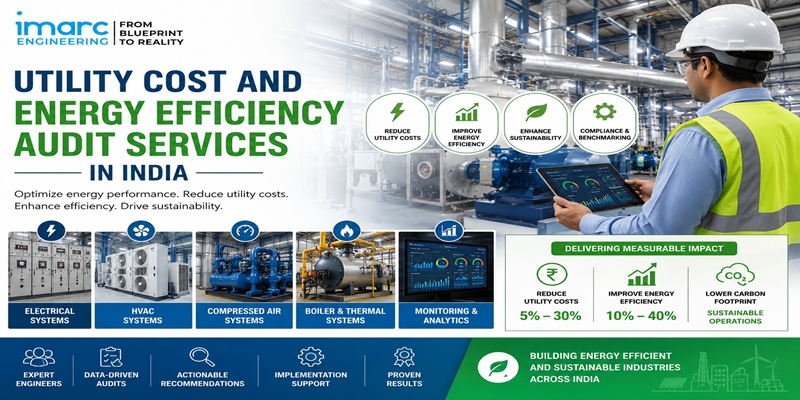
Utility costs can quietly become one of the largest controllable expenses in a manufacturing plant. Electricity, fuel, steam, compressed air, chilled water, cooling systems and process utilities all contribute to the cost of producing each unit. When consumption rises, replacing equipment is not always the first answer. The more useful question is: where is energy being consumed, why is it being consumed, and which improvements will produce a measurable financial return?
An energy cost reduction in manufacturing plant, helps answer those questions using plant data, equipment measurements and operating conditions. For manufacturers, the objective is not simply to reduce energy consumption. It is to reduce utility cost without compromising production capacity, product quality, safety or process requirements.
Why Utility Costs Need a System-Level Review
Industry accounted for nearly 40% of global final energy consumption in 2024, according to the International Energy Agency. The IEA also identifies process optimisation, technical efficiency and better energy management as important opportunities for industrial efficiency improvement.
In a manufacturing plant, however, energy rarely disappears because of one inefficient machine. Losses can be distributed across interconnected systems.
For example:
An oversized pump may operate against a throttled valve.
A compressor may run at a pressure higher than the process requires.
HVAC equipment may operate outside production schedules.
A boiler may lose energy through poor combustion, insulation or steam distribution.
Motors may operate for long periods at unsuitable loads.
Cooling systems may consume additional power because of poor heat transfer or control settings.
This is why an audit should examine systems rather than isolated pieces of equipment.
What Does an Energy Efficiency Audit Examine?
A structured audit establishes how energy enters, moves through and leaves the facility. ISO 50002-1:2025 provides a current international framework for energy audits and describes three levels: walk-through auditing, detailed survey and analysis, and comprehensive engineering analysis. The standard also emphasises evidence-based analysis and Energy Performance Indicators (EnPIs).
Depending on the plant, an audit may examine:
Electricity consumption and demand
Motors and variable-speed drives
Pumps and fans
Compressed-air systems
Boilers and steam distribution
Chillers and cooling towers
HVAC systems
Process heating
Refrigeration
Lighting
Transformers and electrical distribution
Utility-generation and distribution losses
The scope should be determined by the plant's processes, energy profile and business objectives rather than by a fixed checklist.
Step 1: Establish a Real Energy Baseline
The first step is to understand the plant's historical performance.
Useful information includes:
12–24 months of electricity and fuel bills
Production volumes
Operating hours and shifts
Maximum demand
Utility tariffs
Equipment operating schedules
Maintenance records
Existing meter readings
Process and production data
Total monthly consumption alone can be misleading. A plant producing twice as much output may naturally consume more energy without becoming less efficient.
A better measure is energy intensity, such as:
Energy intensity = Energy consumed ÷ Production output
Depending on the industry, this could be expressed as kWh/tonne, kWh/unit, kWh/batch, kg steam/tonne or another relevant production-normalised metric.
This makes it easier to distinguish increasing production from declining efficiency.
Step 2: Map Where Utility Costs Are Going
Once the baseline is established, the next task is to create an energy-use map.
For example:
Incoming electricity → Main distribution → Production + HVAC + Chillers + Compressors + Pumps + Lighting + Other utilities
The same principle applies to fuel, steam and compressed air.
This step often reveals an important distinction: the equipment consuming the most energy is not necessarily the equipment with the greatest savings opportunity.
A large motor operating efficiently may deserve less attention than a smaller system operating continuously under poor conditions.
The audit should therefore combine consumption data with operating behaviour.
Step 3: Measure Equipment and System Performance
Utility bills explain what the plant purchased. Field measurements help explain why it purchased it.
Depending on the system, an assessment may involve:
Electrical load and power measurements
Pressure and flow measurements
Temperature measurements
Combustion analysis
Thermal imaging
Compressed-air leak detection
Equipment loading assessment
Chiller and cooling-system performance
Operating-hour analysis
The U.S. Department of Energy provides system-level assessment resources covering compressed air, pumps, fans, motors, steam, process heating and other industrial systems, reflecting the importance of analysing utilities as connected systems.
The Utility Systems That Often Deserve Attention
Compressed Air
Compressed air can be an expensive utility when pressure, demand and distribution are poorly controlled.
An audit should investigate:
Leakage
Excessive operating pressure
Compressor sequencing
Idle running
Inappropriate applications
Receiver capacity
Dryer operation
Distribution pressure losses
The U.S. Department of Energy highlights reducing inappropriate uses, lowering system pressure, improving storage and controls, reducing leaks and maintaining or upgrading equipment as key compressed-air performance measures.
The important point is that installing a more efficient compressor may not solve the underlying problem if demand itself is unnecessarily high.
Motors, Pumps and Fans
Motor-driven systems should be assessed according to actual operating conditions.
Check for:
Oversized equipment
Low or unsuitable loading
Throttling
Excessive pressure or flow
Long operating hours
Variable-load operation
Opportunities for variable-speed control
For pumps and fans, changing the equipment without understanding process demand can simply move the problem elsewhere. System requirements should be established first, followed by an assessment of equipment selection and control. DOE resources similarly treat pumping and fan systems as integrated systems rather than isolated components.
HVAC, Chillers and Cooling Systems
In plants with controlled environments, HVAC and cooling systems can have substantial utility requirements.
The audit should consider:
Temperature and humidity setpoints
Operating schedules
Chiller loading
Chilled-water temperatures
Pump and fan operation
Cooling-tower performance
Filtration pressure drop
Heat transfer conditions
The goal is not to reduce cooling indiscriminately. Process requirements, product quality, cleanroom conditions and worker safety must remain protected.
Boilers and Steam
For steam-dependent operations, assess:
Boiler efficiency
Combustion conditions
Steam pressure
Blowdown
Condensate recovery
Steam traps
Insulation
Distribution losses
Feedwater conditions
Reducing unnecessary steam demand can sometimes be more valuable than improving boiler efficiency alone because the saving begins before the boiler has to generate the steam.
Step 4: Convert Findings Into Actionable Opportunities
A useful audit should not end with a long list of observations. Each opportunity should explain:
What is inefficient?
What is causing the loss?
What corrective action is proposed?
How much energy could it save?
What investment is required?
What is the expected payback?
Could implementation affect production?
Opportunities can then be grouped into:
Low or no-cost measures
Adjust operating schedules
Correct unnecessary idling
Reduce excessive pressure
Repair leaks
Optimise setpoints
Improve shutdown procedures
Moderate-investment measures
Variable-speed drives
Controls upgrades
Efficient motors
Pump optimisation
Insulation improvements
Utility-system controls
Capital projects
Chiller replacement
Boiler upgrades
Major process-heating improvements
Utility-system redesign
Heat-recovery projects
This classification helps management act instead of allowing the audit report to remain unused.
Step 5: Calculate the Financial Case
Energy efficiency should ultimately be translated into business terms.
A simple calculation is:
Annual energy savings = Baseline consumption − Expected post-project consumption
Then:
Annual cost savings = Annual energy savings × Applicable utility rate
And:
Simple payback = Project investment ÷ Annual cost savings
For example, if an improvement costs ₹12 lakh and is expected to save 150,000 kWh annually at an illustrative effective electricity cost of ₹8/kWh:
Annual saving = ₹12 lakh
Simple payback = 1 year
This is only an example. Actual savings depend on operating hours, tariffs, loading, production and implementation conditions.
For larger projects, NPV, IRR, financing costs, maintenance savings and equipment life may also need to be considered.
Speak With An Expert: https://www.imarcengineering.com/contact?service=utility-cost-energy-efficiency-audits
Why Measurement After Implementation Matters
An approved energy project is not automatically a successful energy project.
Production volumes, operating hours, weather, product mix and process conditions can change after implementation. Therefore, post-project performance should be compared against an appropriate baseline.
This is known as measurement and verification (M&V).
The distinction is important:
An audit identifies potential savings. M&V determines whether the implemented measure actually delivered them.
This approach is also reflected in India's ADEETIE scheme, which links Investment Grade Energy Audits and Detailed Project Reports with post-implementation monitoring and verification.
India-Specific Considerations for Manufacturers
Energy efficiency is also connected with India's industrial energy policy.
BEE reports that the Perform, Achieve and Trade (PAT) framework covered 1,333 energy-intensive industries in 2025, representing 55% of total industrial energy consumption, with reported energy savings of 25.78 million tonnes of oil equivalent.
For eligible MSMEs, the ADEETIE scheme currently operates across 60 industrial clusters covering 14 energy-intensive sectors. It provides technical support around Investment Grade Energy Audits, project reports and monitoring, alongside interest-subvention support for eligible projects. BEE states that eligible projects must achieve and sustain minimum energy savings of 10% during the scheme period to receive annual interest subvention.
These programmes do not mean every manufacturer has the same regulatory obligations or financial eligibility. Businesses should check the requirements applicable to their facility and project.
When Should a Manufacturing Plant Conduct an Energy Audit?
An audit can be particularly useful when:
Utility bills are increasing unexpectedly.
Production has expanded without a corresponding utility review.
Major equipment is approaching replacement.
A plant is planning capacity expansion.
Energy intensity is worsening.
Utility systems are frequently overloaded.
Management is considering major energy-efficiency investments.
The business needs a technically supported investment plan.
For a planned expansion, auditing the existing plant before sizing new utilities can be especially useful. It may reveal whether additional capacity should be created through new equipment or whether existing inefficiencies should be corrected first.
How IMARC Engineering Can Help
IMARC Engineering can support manufacturers with utility-cost and energy-efficiency assessments by combining plant engineering understanding with practical improvement planning. The approach can cover utility data review, equipment and system assessment, performance-gap identification, energy-saving opportunity development, investment and payback analysis, and implementation prioritisation. For expansion projects, the assessment can also help connect existing utility performance with future capacity requirements, so new infrastructure is planned around actual process demand rather than assumptions.
Conclusion
Reducing utility costs is not simply a matter of buying more efficient equipment. The larger opportunity often lies in understanding how production requirements, equipment loading, controls, operating schedules and utility systems interact. A well-structured energy efficiency audit turns consumption data into practical decisions by identifying losses, quantifying savings and prioritising investments. For manufacturers, the strongest outcome is not an audit report alone, but a clear path from measurement to implementation and verified cost reduction, while protecting production and quality.
Contact Us:
IMARC Engineering
Phone: +91-120-433-0800
Email: sales@imarcengineering.com
India: C-130, Sector 2, Noida, Uttar Pradesh 201301
LinkedIn: https://www.linkedin.com/showcase/imarc-engineering/