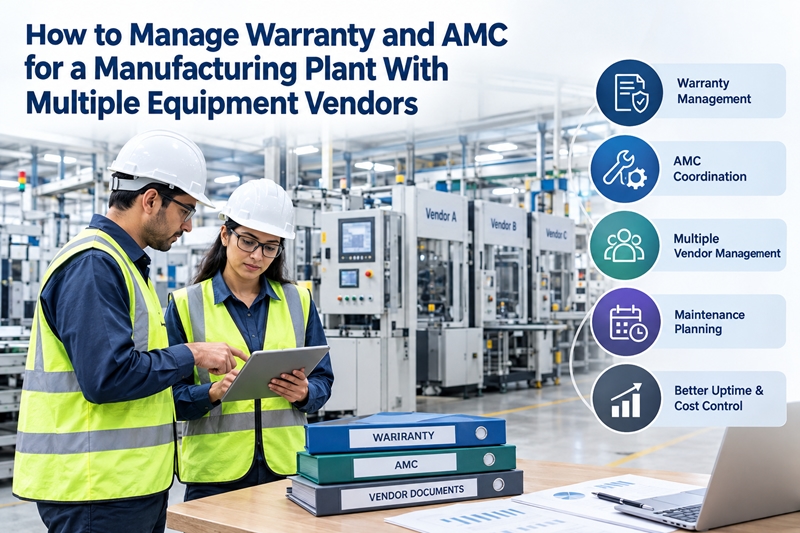
Managing warranty and annual maintenance contracts (AMC) becomes difficult when a manufacturing plant depends on several equipment vendors. A compressor may have one OEM, the HVAC system another, packaging machinery a third, and automation equipment a separate integrator. Each supplier can have different warranty dates, service conditions, response times, spare-parts policies, and AMC terms.
The problem is therefore not simply keeping a list of warranty expiry dates. It is maintaining clear responsibility, coverage, service performance, documentation, and renewal decisions across the entire equipment portfolio.
A practical system for Warranty and AMC for a Manufacturing Plant should connect warranty management with maintenance planning, vendor performance, procurement, and equipment criticality.
Why Multi-Vendor Warranty and AMC Management Becomes Difficult
When equipment comes from multiple suppliers, service information is usually fragmented across purchase orders, warranty certificates, emails, maintenance records, and vendor contracts.
A plant may have to track:
Different warranty start and expiry dates
OEM and distributor responsibilities
Equipment-specific warranty exclusions
Preventive maintenance schedules
AMC renewal dates
Breakdown-response commitments
Spare-parts coverage
Service reports and open complaints
Escalation contacts
Contract values and payment terms
This creates a common problem: the plant knows who supplied the equipment but does not always know who is currently responsible for fixing it, under which contract, and within what timeframe.
The solution is to establish one control system rather than allowing every department or vendor to maintain its own records.
1. Build a Central Warranty and AMC Register
The first step is creating a single, controlled register for every important asset.
At minimum, record:
Asset identification number
Equipment name and model
Manufacturer and service provider
Serial number
Purchase order or contract reference
Installation and commissioning dates
Warranty start and expiry dates
Warranty scope and exclusions
AMC start and expiry dates
AMC type and annual value
Preventive maintenance frequency
Response and resolution commitments
Service contact and escalation contact
Last maintenance date
Open warranty claims
Next required action
Equipment criticality
The register should not be treated as a static spreadsheet. It should answer operational questions such as which critical assets lose coverage in the next 90 days, which claims are overdue, and which vendors are repeatedly missing service commitments.
Track coverage, not just dates
Knowing that a chiller is under warranty until December is useful, but incomplete.
The maintenance team also needs to know whether the warranty covers:
Labour
Replacement components
Travel
Breakdown visits
Preventive maintenance
Software or controls
Calibration
Specific failure modes
This prevents a situation where a plant assumes a repair is covered and discovers only after the breakdown that the relevant component was excluded.
2. Classify Equipment According to Criticality
Not every asset deserves the same level of warranty and AMC attention.
A better approach is to classify equipment according to the consequence of failure.
Critical assets
Failure can stop production, affect product quality, create safety concerns, or cause substantial financial loss.
High-priority assets
Failure may reduce production capacity or significantly disrupt operations.
Medium-priority assets
Failure affects supporting activities but does not immediately stop the production process.
Low-priority assets
Failure has limited operational or financial consequences.
This classification changes how contracts should be managed. A critical compressor may require faster response, stronger spare-parts provisions, and tighter escalation than a non-critical auxiliary machine.
The useful question is not simply “When does this AMC expire?” but “What happens to the plant if this asset is unavailable?”
3. Manage Warranty Claims as a Process
Warranty value is lost when eligible failures are not documented and followed through properly.
A controlled claim process can follow these stages:
Failure identified → warranty verified → claim registered → evidence collected → OEM diagnosis → repair/replacement → performance verification → claim closed
The claim file should normally contain:
Asset and serial number
Purchase documentation
Warranty reference
Failure description
Photographs or diagnostic evidence
Relevant operating readings
Maintenance history
Vendor correspondence
Service reports
Parts replaced
Final resolution
The claim should remain open until the equipment has actually been restored and the required documentation has been received.
A vendor visit alone should not be considered claim closure.
4. Start AMC Planning Before Warranty Expiry
One of the most avoidable problems is allowing warranty coverage to end before the next maintenance arrangement is finalized.
A practical transition plan can begin around 90–120 days before expiry.
120 days before expiry
Review:
Equipment performance
Breakdown frequency
Warranty claims
Vendor response
Recurring failures
Future maintenance requirements
90 days before expiry
Decide whether to:
Continue with the OEM
Evaluate third-party service providers
Change the AMC scope
Reassess the equipment itself
60 days before expiry
Obtain and compare proposals, including technical scope, exclusions, SLA and spare-parts provisions.
30 days before expiry
Complete commercial approval, contract finalization and service scheduling.
The purpose is to make the warranty-to-AMC transition a planned procurement activity rather than an emergency renewal.
5. Don't Automatically Choose the OEM for AMC
OEM AMC can be appropriate for sophisticated equipment, but it should not be the default answer for every asset.
OEM AMC may be preferable when:
The equipment uses proprietary technology
Specialist diagnostics are required
Genuine parts are essential
Software or firmware support is involved
Failure has a high production impact
Competent alternatives are limited
A third-party AMC may be worth evaluating when:
The equipment is standardized
Multiple qualified service providers exist
The equipment is mature
Parts are readily available
OEM pricing is substantially higher
A provider can support multiple equipment brands
The decision should be based on technical capability, risk, service history and total cost, rather than vendor identity alone.
6. Compare AMC Proposals on Total Cost
A low annual AMC price does not necessarily mean lower maintenance expenditure.
Suppose two proposals are:
Vendor A: ₹4 lakh per year
Vendor B: ₹6 lakh per year
If Vendor A excludes emergency visits, travel, major components and specialist support while Vendor B includes several of these items, the ₹2 lakh difference may not represent a genuine saving.
Compare proposals across:
Cost/Service Area | What to Check |
|---|---|
Annual AMC fee | Fixed contractual cost |
Labour | Included or chargeable? |
Spare parts | Included, discounted or excluded? |
Emergency visits | Covered? |
Travel | Included or extra? |
Preventive maintenance | Frequency and scope |
Specialist support | Included? |
Consumables | Responsibility clearly defined? |
Response time | Contractual commitment |
Resolution time | Maximum acceptable duration |
This creates a more realistic comparison than choosing the lowest quotation.
7. Write the AMC Scope and SLA in Measurable Terms
“Prompt service” is difficult to enforce.
A useful AMC should specify measurable commitments such as:
Complaint acknowledgement time
Remote-support response
Engineer deployment time
Diagnosis period
Spare dispatch time
Maximum repair period
Preventive-maintenance frequency
Escalation timelines
Reporting requirements
For critical equipment, the contract should also define what happens when the agreed service level is missed.
The plant should know when a normal service delay becomes a contractual escalation.
Speak With An Expert: https://www.imarcengineering.com/contact?service=warranty-and-amc-coordination
8. Measure Vendor Performance After the Contract Starts
AMC management should continue after the purchase order is issued.
A vendor scorecard can track:
Preventive maintenance compliance
Completed PM visits ÷ scheduled PM visits × 100
Response compliance
Calls meeting response SLA ÷ total calls × 100
Resolution compliance
Cases resolved within agreed time ÷ total resolved cases × 100
Repeat failure rate
Repeat failures ÷ total breakdowns × 100
First-time fix rate
Measures how often the problem is resolved without repeated visits.
These indicators reveal whether an AMC is actually improving equipment reliability or merely generating service reports.
9. Create One Vendor Escalation Matrix
A multi-vendor plant should not depend on finding the right person's phone number during a breakdown.
For each vendor, maintain:
Service Engineer → Service Manager → Regional Head → Senior OEM Contact → Contract/Commercial Escalation
Each escalation level should have a trigger.
For example, if an engineer is not deployed within the contracted response period, the issue should automatically move to the next level.
This makes escalation process-driven rather than dependent on personal relationships.
10. Use Warranty History to Improve AMC Decisions
Warranty history contains valuable information for the next contract.
Before renewing an AMC, review:
Number of breakdowns
Repeat failures
Delayed service calls
Spare-part delays
Unresolved complaints
Vendor response performance
Major component replacements
For example, repeated failures during warranty may justify asking the OEM to strengthen its preventive-maintenance scope or improve spare availability.
The warranty period should therefore be treated as a vendor-performance assessment period, not simply a period of free repairs.
11. Maintain a Single Service and Renewal Calendar
A plant with many vendors should maintain one consolidated calendar for:
Preventive maintenance
Warranty inspections
Calibration
AMC visits
Contract renewals
Warranty expiries
Statutory inspections
Open claims
A simple 30/60/90-day dashboard can highlight:
Next 30 days: expiring coverage, overdue claims and missed PMs
31–60 days: upcoming renewals and quotation requirements
61–90 days: planned negotiations and budget approvals
This gives management enough time to act before a coverage or service problem becomes urgent.
How IMARC Engineering Can Help
IMARC Engineering can help manufacturing companies coordinate warranty and AMC requirements across equipment supplied by multiple vendors. Its support can include warranty tracking, claim coordination, AMC scope and quotation evaluation, service scheduling, vendor follow-up, escalation management, and warranty-to-AMC transition planning. By consolidating these activities around asset criticality and service obligations, manufacturers can improve visibility over coverage, reduce missed warranty opportunities, and make more informed AMC decisions.
Conclusion
Multi-vendor warranty and AMC management is fundamentally a coordination and control problem. A plant needs more than expiry-date reminders: it needs visibility of coverage, claims, equipment criticality, contractual obligations, vendor performance and upcoming renewals. A centralized register, structured claim process, measurable SLA, vendor scorecard and early warranty-to-AMC transition can turn fragmented supplier relationships into a manageable system. The objective is simple: ensure that every critical asset has clear responsibility, appropriate service coverage and a defined escalation path when something goes wrong.
Contact Us:
IMARC Engineering
Phone: +91-120-433-0800
Email: sales@imarcengineering.com
India: C-130, Sector 2, Noida, Uttar Pradesh 201301
LinkedIn: https://www.linkedin.com/showcase/imarc-engineering/