Outlook is taking ten seconds to open an email. Search that spins for a full minute before showing results. The occasional freeze that forces a restart in the middle of writing a message. These are common complaints, and in a surprising number of cases, the cause is the same: a single PST file that has grown far beyond what it should hold.
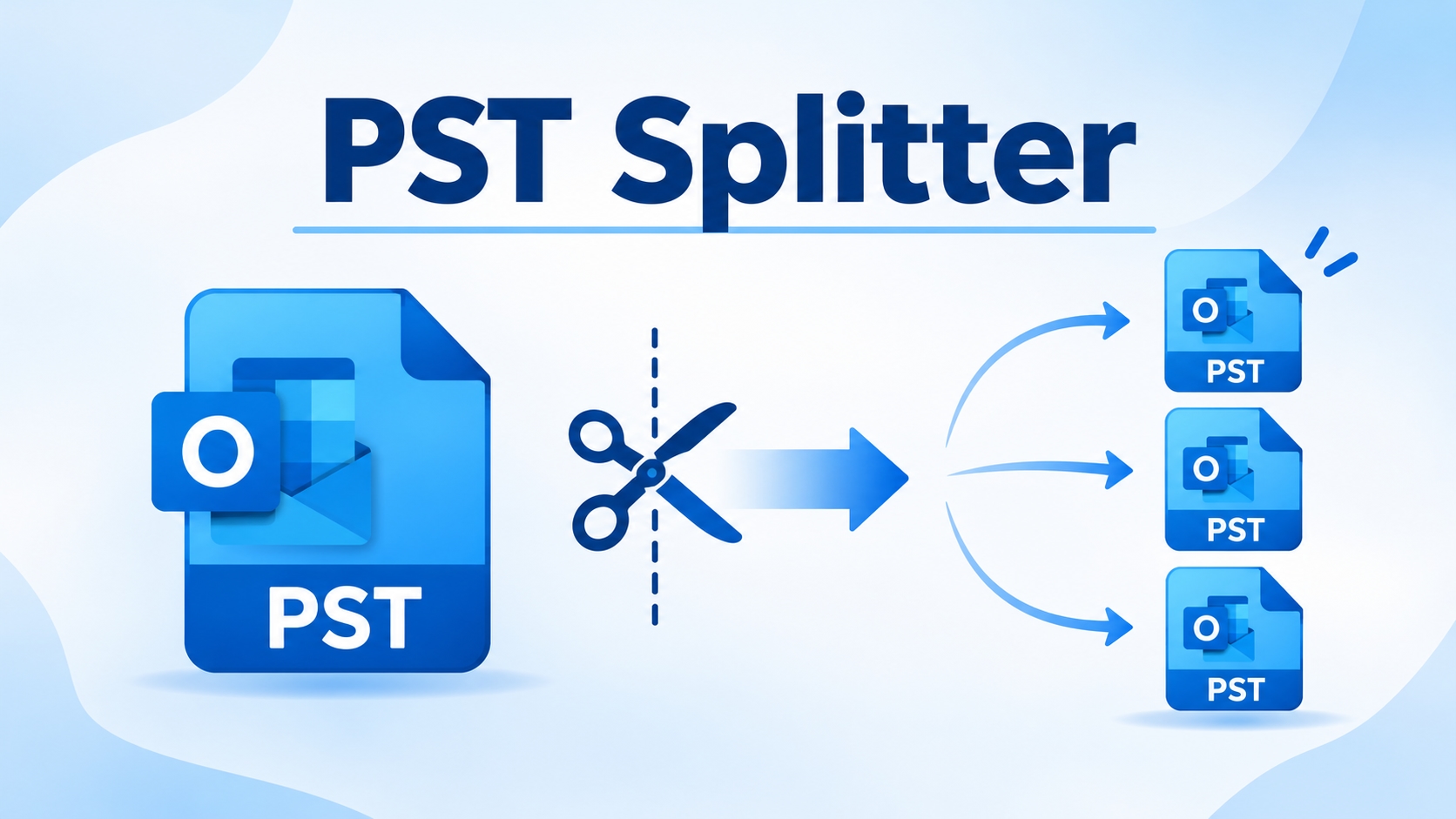
This article follows a real-world scenario of exactly that problem, explains why a large PST slows Outlook down, and shows how splitting the file with the Shoviv PST Splitter Tool solved it.
Why a large PST file slows Outlook down
A PST file is a single database sitting on your disk, and Outlook has to read from and write to that same file every time you open an email, search, move something, or even just leave Outlook running in the background. As the file grows:
Every operation touches more data. A search across a 30 GB file has far more to scan than one across 5 GB.
The file becomes more fragile. Larger PST files are more likely to develop corruption, especially if they sit on an aging drive or get interrupted during a write.
Backups become harder. A single oversized file takes longer to copy, is more likely to fail mid-transfer, and eats more storage with each backup.
Outlook itself has format limits. Older ANSI-format PST files cap out at 2 GB, and even newer Unicode-format files, while supporting much larger sizes, perform worse as they approach the practical limits Outlook and your hardware can comfortably handle.
The result is an inbox that technically still works but increasingly feels like wading through mud.
The scenario: a lawyer whose case files lived in one PST
The person in this story is Arjun, a litigation lawyer at a small law firm. For years, he kept every case-related email, every scanned document attachment and every client exchange in a single PST file connected to his Outlook profile. He rarely deleted anything, partly out of habit and partly because old case correspondence sometimes became relevant again during appeals or disputes.
By the time he noticed a problem, the PST file had grown to just over 50 GB.
At first it was minor annoyances: Outlook took a while to open in the morning, and search results for a client's name sometimes took over a minute. Over a few months it got worse. Outlook froze mid-task several times a week, sometimes while he was drafting an urgent filing. Twice, it crashed entirely and he had to restart his laptop to get it working again. His IT support ran a basic repair, which helped briefly, but the slowness always returned.
The real scare came when his overnight backup job failed two nights in a row, timing out partway through copying the PST file. With case deadlines approaching and years of correspondence sitting in a single large, increasingly fragile file, he could not risk losing it or having Outlook crash during a filing.
What Arjun tried first
Running the Inbox Repair Tool. Scanpst.exe found and fixed some minor errors, and performance improved for a short while. But the file was still enormous, and the underlying problem, its sheer size, remained untouched.
Deleting old emails. He went through and deleted some clearly unnecessary items, newsletters, old internal notices, duplicate attachments. It freed up some space, but he was unwilling to delete real case correspondence, so the reduction was modest compared to the size of the problem.
Outlook's AutoArchive feature. He turned on AutoArchive, which can move older items into a separate PST file based on age. It helped slightly, but it is a blunt tool: it archives by date across the board, without letting him choose specific cases or folders to move, and some active matters were technically old enough to be swept into the archive along with everything else. He also later had to track down which items had landed where.
Buying more storage. He considered simply upgrading his laptop's drive. That would not fix the core issue, a single file too large for Outlook to handle comfortably, and it would do nothing for backup times or the growing risk of corruption.
It became clear that the real fix was to split the one oversized PST file into several smaller, more manageable ones, organized in a way that still made sense for his work.
The solution: Shoviv PST Splitter Tool
Arjun's IT support found the Shoviv PST Splitter Tool and tested the demo on a copy of the file first, to confirm it would preserve the folder structure and attachments correctly before running it on the real archive.
Step 1: Back up the original PST file
Before anything else, they made a full copy of the 50 GB PST file onto a separate drive. Splitting changes how the data is organized, so working from a backup meant there was no risk to the original if anything went wrong.
Step 2: Add the PST file to the tool
They launched the splitter and added the PST file. The tool read the file and displayed its folder structure, showing the size of each folder, which was the first time Arjun had a clear picture of where the bulk of the data actually was. A handful of case folders with large attachments accounted for most of the size.
Step 3: Choose a splitting method
The tool offered a few ways to divide the file, and the choice mattered for how usable the result would be:
By size, creating new PST files once a chosen size limit is reached, useful for simply keeping files manageable without regard to content.
By date, separating older items into their own file, similar in spirit to AutoArchive but with more control.
By folder, keeping specific folders intact in their own PST files, which is useful when folders map to something meaningful, like individual cases or clients.
For Arjun, splitting by folder made the most sense. Each major case already had its own folder, so splitting that way meant each resulting PST file lined up with a case, something his existing filing habits already supported.
Step 4: Preview and set the output
Before running anything, the tool showed how the split would be organized, which folders would go into which resulting file. He adjusted a couple of smaller related folders to combine into one file rather than creating several very small PSTs for minor matters.
Step 5: Run the split
With the plan confirmed, they ran the split. The tool processed the large file and produced several smaller PST files, each named for its corresponding case folder, while preserving the original folder hierarchy, attachments and message formatting inside each one.
Step 6: Connect the new files in Outlook and verify
They added the new, smaller PST files to Arjun's Outlook profile and checked a sample of emails and attachments in several of them against the original backup. Everything matched. He archived the closed cases into files he could store separately, and kept active case files connected in Outlook day to day.
The result
Within a day, Arjun had:
An Outlook profile working with several smaller PST files instead of one 50 GB file
Noticeably faster search, opening and general responsiveness
Backups that completed reliably and far more quickly
Case files organized in a way that matched how he actually worked, with closed matters stored separately from active ones
The freezing and crashing stopped almost immediately, and the backup failures did not recur.
How to avoid an oversized PST file in future
Know your PST size limits. Even in modern Unicode-format PST files, performance tends to degrade well before you hit any hard technical cap, so do not wait until the file is enormous to act.
Split or archive proactively. Set a routine, by quarter, by year or by project, rather than waiting for symptoms to force your hand.
Choose a splitting method that matches how you work. Splitting by folder suits people whose folders map to projects or clients. Splitting by date suits those who mainly care about recency. Splitting by size suits anyone who simply wants manageable files.
Keep attachments in mind. Large attachments are often the biggest contributor to file size. Consider storing bulky documents outside the mailbox where that fits your workflow.
Back up before you split. Always keep an untouched copy of the original file until you have verified the split files are complete and correct.
When does a dedicated PST splitter make sense?
A specialist tool is worth considering when:
Your PST file is large enough that Outlook has become noticeably slow or unstable
Backups of the file are slow, unreliable or failing
Outlook's built-in AutoArchive does not give you enough control over what gets separated
You want to split by folder or project rather than only by date
You need the split files to retain the original folder structure and attachments intact
Final thoughts
A PST file does not announce that it has become a problem. It just gets slower, a little at a time, until freezing and crashing feel normal. Splitting an oversized file is a straightforward fix once you know it is the cause, and doing it in a way that matches how you actually organize your work makes the result genuinely useful, not just smaller.
If Outlook has started to feel sluggish or unreliable, you can download the Shoviv PST Splitter Tool demo to see how your file would be divided before running a full split.
Frequently asked questions
How do I know if my PST file is too large? If Outlook has become slow to open, search or respond, and your PST file is several gigabytes or more, size is a likely contributing factor. Checking the file size directly on disk is a quick first step.
Will splitting a PST file delete any of my data? A reliable splitting tool preserves your emails, folder structure and attachments across the resulting files. Always keep a backup of the original before splitting, as a general precaution.
Can I split a PST file by folder instead of by date or size? Yes. Many splitting tools let you choose folder-based splitting, which is useful when your folders already correspond to projects, clients or cases.
Do I need to keep all the split files connected in Outlook? No. You can keep the files you use regularly connected and store the rest separately, opening them in Outlook only when needed.
Is splitting a PST file different from using AutoArchive? AutoArchive mainly separates items by age and offers limited control. A dedicated splitter typically gives you more options, such as splitting by folder or size, and clearer previews before anything is moved.
Will splitting fix a PST file that is also corrupted? Splitting addresses size, not corruption. If your file shows errors or will not open properly, you likely need a PST repair or recovery tool first.
Read more: https://www.shoviv.com/blog/how-to-split-pst-file-in-outlook-manually/