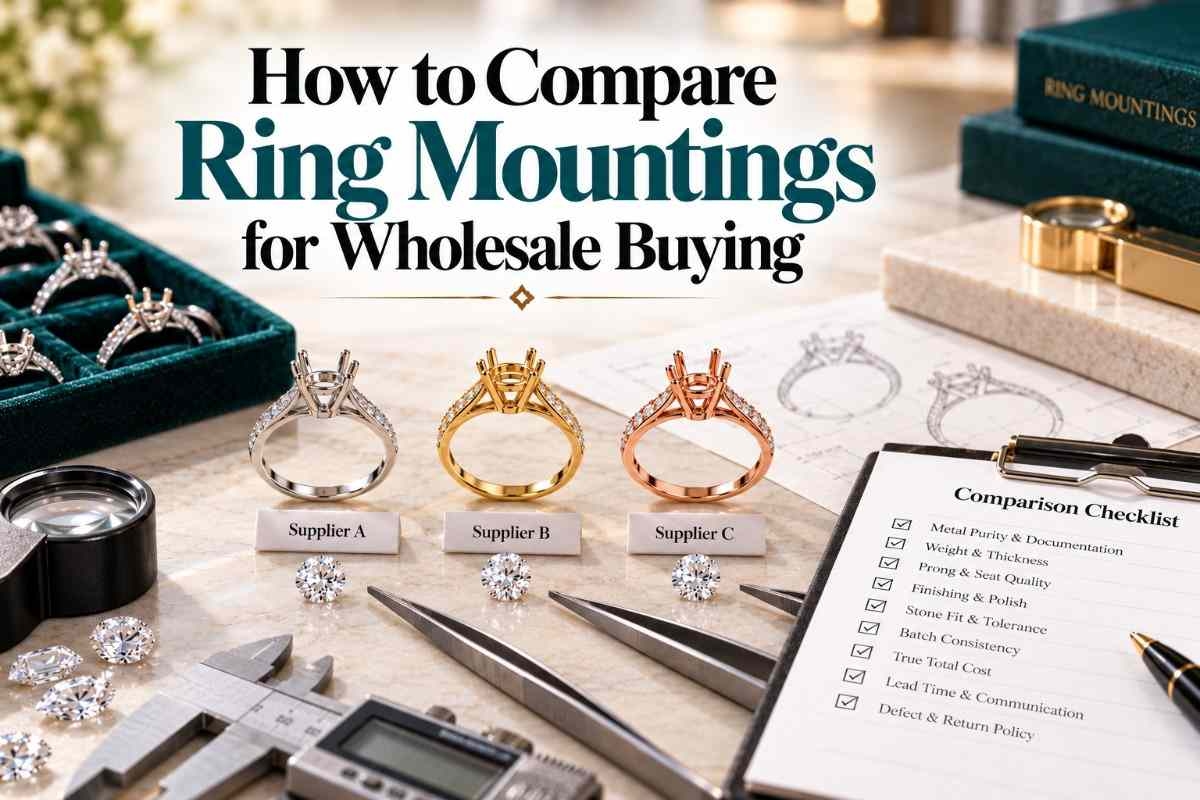
Two ring mountings can look almost identical in a catalogue photo and still be very different from products. One may weigh more, use a different alloy, be finished more carefully, or hold stones less reliably. At wholesale volumes, those hidden differences turn into real money, in the form of rework, returns, and unhappy customers.
The answer is to compare mountings on a like-for-like basis. This guide gives a practical method for comparing ring mountings for wholesale buying, including a simple scorecard you can use with any supplier.
Why Photos and Price Lists Are Not Enough
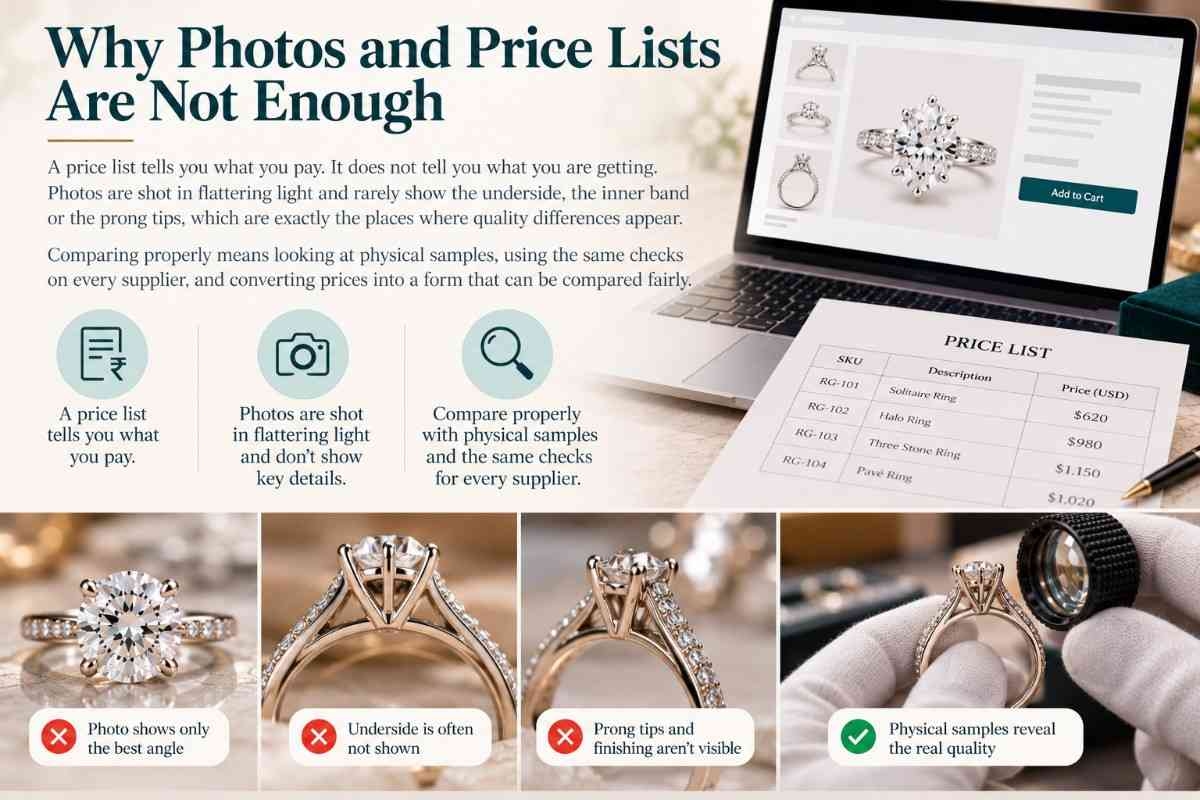
A price list tells you what you pay. It does not tell you what you are getting. Photos are shot in flattering light and rarely show the underside, the inner band or the prong tips, which are exactly the places where quality differences appear.
Comparing properly means looking at physical samples, using the same checks on every supplier, and converting prices into a form that can be compared fairly.
Step 1: Compare Like with Like
Before judging quality, make sure the samples are genuinely comparable. Ask each supplier for the same design type, in the same metal and purity, in the same stone size and ring size. Comparing a heavy 18k mounting against a lighter 14k one, or a plain band against a detailed one, will always mislead.
Where an exact match is not possible, note the differences so you can account for them later.
Step 2: Compare Weight, Metal and Purity
Weight and metal are the biggest drivers of cost and feel.
Weight: weigh each sample on a jeweler's scale. A lighter piece is cheaper in metal but may be thinner and less durable.
Purity: confirm the karat or fineness and check that the hallmark or stamp matches the claim.
Alloy and color: check that color and finish are consistent across pieces.
Ask for documentation of purity and be cautious of any supplier who is vague about it.
Step 3: Inspect Build Quality
This is where most differences hide. Examine every sample under magnification and in good light.
Prongs: even height, symmetrical placement, smooth tips and enough thickness to hold a stone for years.
Seat and basket: a clean, flat seat with no burrs, and a basket that is properly shaped.
Gallery and underside: neat finishing in areas customers rarely see but trained eyes check.
Shank: consistent thickness and a smooth, comfortable inner surface.
Polish: uniform shine with no scratches, pits or missed spots.
Joins and soldering: no visible seams, gaps or rough joins.
Step 4: Test Stone Fit
A mounting exists to hold a stone, so test that directly. Place a real stone of the intended size in each sample and check that it seats flat, sits level and can be held securely without forcing the metal.
Also check tolerance. Try a stone that is a fraction smaller or larger than nominal, as real stones vary, and see whether the mounting copes. Good semi-mounts allow for small variation. Poor ones need heavy adjustment or do not fit at all.
Step 5: Check Consistency Across Pieces
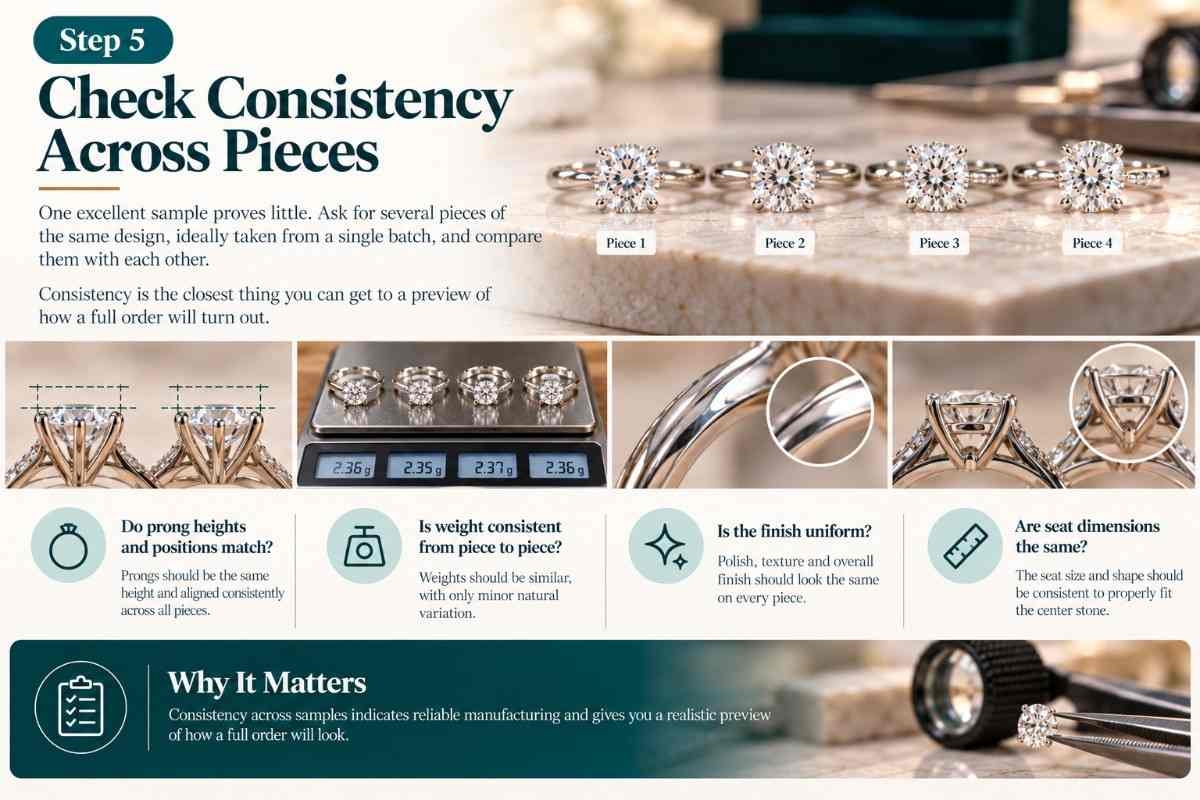
One excellent sample proves little. Ask for several pieces of the same design, ideally taken from a single batch, and compare them with each other.
Do prong heights and positions match?
Is weight consistent from piece to piece?
Is the finish uniform?
Are seat dimensions the same?
Consistency is the closest thing you can get to a preview of how a full order will turn out.
Step 6: Compare True Cost, Not Just Unit Price
A low unit price can hide higher total cost. To compare fairly, break each quote into its parts and then look at the whole picture.
Metal cost: based on weight and purity.
Making labour charges: how they are calculated, per gram or per piece.
Extras: finishing, rhodium plating, hallmarking, packaging and shipping.
Rework risk: how often pieces need correction before they can be sold.
Minimum order quantity: how much stock you must commit to.
A slightly higher quote from a reliable supplier often works out cheaper than a bargain price that brings returns and delays.
Step 7: Compare Supplier Reliability
The product is only part of the decision. Compare how each supplier handles the rest of the relationship.
Lead time: how long a first order and a reorder take.
Communication: how quickly and clearly they respond.
Customisation: whether small design changes are possible without long delays.
Defect policy: what happens if pieces arrive faulty.
Range: whether the catalogue can support you as you grow.
A Simple Wholesale Comparison Scorecard
Score each supplier from 1 (poor) to 5 (excellent) on every line, then total the result. Weight the lines that matter most to your business, such as consistency or stone fit, more heavily.
Criteria | Supplier A | Supplier B | Supplier C |
Metal purity and documentation |
|
|
|
Weight and thickness |
|
|
|
Prong and seat quality |
|
|
|
Finishing and polish |
|
|
|
Stone fit and tolerance |
|
|
|
Batch consistency |
|
|
|
True total cost |
|
|
|
Lead time and communication |
|
|
|
Defect and return policy |
|
|
|
Total |
|
|
|
Comparing Ladies and Gents Mountings
The same method works across categories, but the emphasis shifts. For ladies rings, prong precision, halo evenness and stone-shape compatibility carry the most weight. For gents rings, durability, comfort fit and finish hold up better under scrutiny. When comparing a Gents Ring Mounting, pay particular attention to band thickness, inner-band comfort and how securely flush or channel-set stones are held.
Comparing Whole Catalogues, Not Just Single Pieces
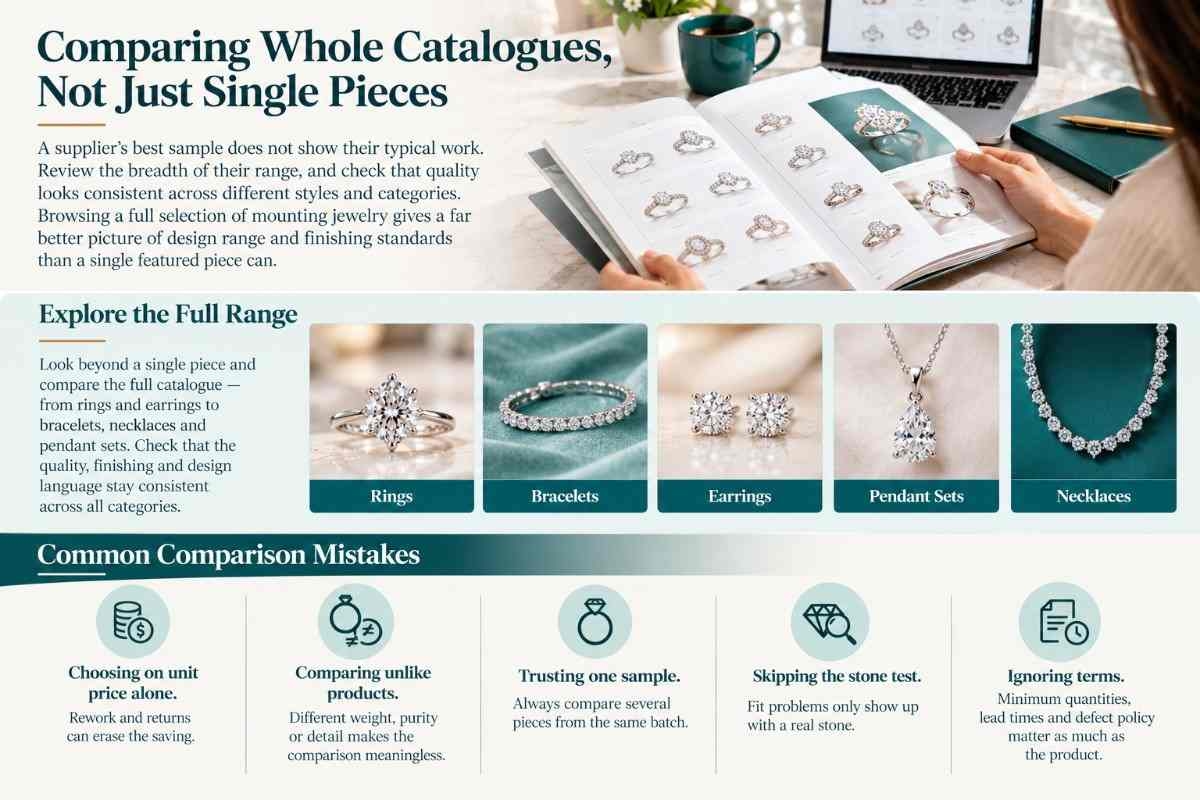
A supplier's best sample does not show their typical work. Review the breadth of their range, and check that quality looks consistent across different styles and categories. Browsing a full selection of mounting jewelry gives a far better picture of design range and finishing standards than a single featured piece can.
Common Comparison Mistakes
Choosing on unit price alone. Rework and returns can erase the saving.
Comparing unlike products. Different weight, purity or detail makes the comparison meaningless.
Trusting one sample. Always compare several pieces from the same batch.
Skipping the stone test. Fit problems only show up with a real stone.
Ignoring terms. Minimum quantities, lead times and defect policy matter as much as the product.
Frequently Asked Questions
1.How many suppliers should I compare before a wholesale order?
Ans. Comparing three is a sensible minimum. It gives enough contrast to spot differences in quality and pricing without becoming unmanageable.
2.What is the most important thing to compare in ring mountings?
Ans. Build quality and consistency matter most, because they decide whether a full order will perform as well as the sample.
3.Should I order samples from every supplier?
Ans. Yes. Samples are the only reliable way to check weight, finishing and stone fit, and they cost far less than correcting a bad bulk order.
4.Is the cheapest ring mounting the best choice for wholesale?
Ans. Rarely. The lowest price often comes with lighter weight, weaker finishing or less consistency, which can raise total cost through rework and returns.
Final Thoughts
Comparing ring mountings for wholesale buying is about replacing impressions with evidence. Match samples like for like, weigh and inspect them, test them with real stones, check consistency, and compare the true total cost and supplier reliability. A simple scorecard turns a confusing decision into a clear one, and it helps you choose the supplier whose quality will still hold up on the hundredth piece.