Foreign manufacturers planning to enter the Indian market must understand the country's product quality and safety regulations. For products covered under applicable Indian Quality Control Orders (QCOs), obtaining the required Bureau of Indian Standards (BIS) certification is essential before selling or importing those products into India.
The BIS Foreign Manufacturers Certification Scheme (FMCS) allows manufacturers with factories located outside India to obtain a BIS licence and use the ISI Standard Mark on eligible products. The certification process involves documentation, factory inspection, product testing and compliance with applicable Indian Standards.
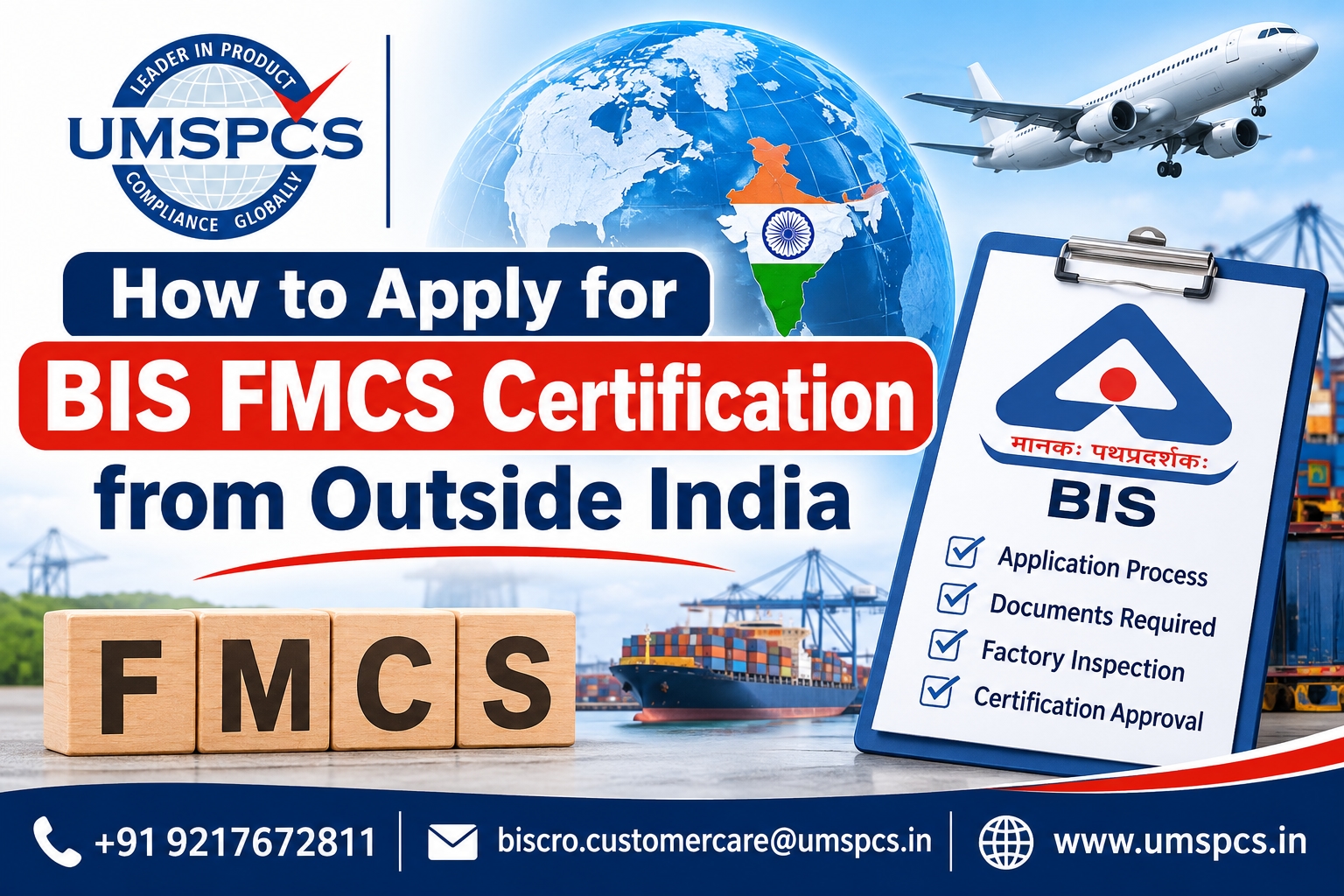
If your company is located in China, Germany, Japan, South Korea, Vietnam, Malaysia, Italy or another country, you can apply for BIS FMCS certification without relocating your manufacturing operations to India.
This guide explains how foreign manufacturers can apply for BIS FMCS certification from outside India.
What Is BIS FMCS Certification?
The Foreign Manufacturers Certification Scheme (FMCS) is a certification programme operated by the Bureau of Indian Standards. It allows overseas manufacturing companies to obtain a BIS licence for products that meet the relevant Indian Standard (IS).
Under this scheme, BIS evaluates the manufacturer's production facilities, quality control arrangements and product conformity before granting permission to use the Standard Mark.
FMCS is generally applicable to foreign-manufactured products other than electronic and IT products covered under the separate BIS Compulsory Registration Scheme (CRS).
Manufacturers should first verify whether their products fall under mandatory BIS certification requirements before starting the application process.
Step-by-Step Process to Apply for BIS FMCS Certification from Outside India
Foreign manufacturers can complete the application process from their home country. However, they must coordinate with their Indian representative and fulfil the technical and regulatory requirements established by BIS.
Step 1: Identify the Applicable Indian Standard
The first step is identifying the correct Indian Standard for the product you manufacture.
Every product covered under BIS certification has specific technical requirements, testing procedures and quality parameters. Foreign manufacturers should check the applicable Indian Standard before preparing their application.
You should verify:
The relevant Indian Standard number.
Whether the product falls under mandatory BIS certification.
Applicable product specifications and testing requirements.
Manufacturing and quality control requirements.
Whether the product is covered under FMCS or another certification scheme.
Selecting the correct standard helps prevent application errors and unnecessary delays.
Step 2: Appoint an Authorized Indian Representative (AIR)
One of the important requirements for foreign manufacturers is appointing an Authorized Indian Representative (AIR).
The AIR acts as the manufacturer's representative in India and helps coordinate regulatory communication and compliance responsibilities with BIS.
The representative must fulfil BIS eligibility requirements and provide the necessary consent and nomination documents.
The AIR is generally responsible for:
Coordinating communication with BIS.
Supporting the application process.
Assisting with document submission and clarification.
Helping coordinate factory inspection and sample-related procedures.
Supporting compliance with BIS licence conditions.
Foreign manufacturers should appoint a qualified and reliable AIR because this representative plays an important role throughout the certification and licence operation process.
Step 3: Prepare the Required Documents
Documentation is a critical part of BIS FMCS certification. Overseas manufacturers must prepare accurate and complete documents before submitting their applications.
Commonly required documents include:
Company registration or incorporation certificate.
Manufacturing factory details and address.
Product technical specifications.
Manufacturing process flowchart.
Quality control and quality assurance documents.
List of manufacturing machinery and equipment.
Testing equipment details.
Calibration records, where applicable.
Details of technical and laboratory personnel.
Authorized Indian Representative nomination documents.
Brand ownership or trademark authorization documents, where applicable.
Undertakings and declarations required by BIS.
Documents originally prepared in languages other than English should be accompanied by suitable English translations.
The exact documentation requirements may vary depending on the product category and applicable Indian Standard.
Step 4: Submit the BIS FMCS Application Online
After preparing the documents, the foreign manufacturer must submit the application through the official BIS Manakonline portal.
As of November 2026, BIS accepts FMCS applications through the online submission process. The earlier offline application facility ended on 31 May 2026.
The applicant should carefully complete the prescribed application details, upload the required supporting documents and pay the applicable application fee.
The foreign manufacturer is responsible for submitting the application. An importer alone cannot apply for an FMCS licence in place of the actual manufacturer.
Incomplete documentation or incorrect information may result in queries and delays.
Step 5: BIS Application Review and Document Verification
After submission, BIS reviews the application and supporting documents.
During this stage, BIS may raise queries regarding product specifications, manufacturing facilities, testing arrangements or other documentation.
The manufacturer and AIR should respond to these queries with accurate information and supporting evidence.
A complete application helps the certification process move forward more efficiently.
Step 6: BIS Factory Inspection at the Overseas Manufacturing Unit
Factory inspection is an important stage of BIS FMCS certification.
BIS officials visit the foreign manufacturer's actual production facility to assess whether the factory can consistently manufacture products according to the applicable Indian Standard.
During the inspection, officials may evaluate:
Manufacturing machinery and production facilities.
Raw material inspection procedures.
Production process controls.
Quality assurance systems.
Testing laboratory infrastructure.
Calibration and maintenance records.
Technical personnel and testing capabilities.
Product marking and identification arrangements.
Foreign manufacturers must make suitable arrangements for the inspection, including travel, accommodation, visa-related expenses and other applicable costs.
If the factory does not meet the required standards, corrective actions may be necessary before the application can proceed.
Step 7: Product Sample Testing
BIS product testing verifies whether the manufactured product complies with the applicable Indian Standard.
Samples are drawn during the inspection process and sent for testing through BIS laboratories or BIS-recognized laboratories, as applicable.
The manufacturer must coordinate the safe transportation and deposition of samples and pay the applicable testing charges.
International test reports based on IEC or other foreign standards cannot automatically replace testing against the relevant Indian Standard.
A satisfactory test report is necessary for the certification application to move towards approval.
Step 8: Payment of Applicable Certification Fees
Once the required inspection and testing stages are completed successfully, the manufacturer must fulfil the applicable financial requirements.
These may include:
Licence fee.
Advance minimum marking fee.
Applicable marking fee.
Other outstanding certification charges.
The manufacturer must also complete the prescribed agreement, indemnity bond and Performance Bank Guarantee requirements.
BIS currently specifies a USD 10,000 Performance Bank Guarantee requirement for the applicable FMCS process. Manufacturers should verify the latest prescribed format and conditions before arranging the guarantee.
Read more about BIS certification For International manufacturer .
Step 9: Grant of BIS FMCS Licence
After successful completion of document verification, factory inspection, product testing and financial requirements, BIS may grant the FMCS licence.
The manufacturer can then use the BIS Standard Mark only for the approved product varieties, manufacturing premises and conditions mentioned in the licence.
The licence must be maintained through continued compliance with BIS requirements.
How Long Does BIS FMCS Certification Take?
According to BIS, the average time required for granting an FMCS licence is generally around six months from the date of recording of a complete application.
However, the actual timeline can vary depending on:
Completeness of submitted documents.
Availability of inspection schedules.
Factory readiness.
Product sample transportation.
Laboratory testing results.
Timely payment of certification fees.
Responses to BIS queries.
Manufacturers should plan their Indian market entry accordingly rather than assuming that certification will be completed within a fixed number of days.
Common Mistakes Foreign Manufacturers Should Avoid
Several mistakes can create unnecessary complications during the BIS FMCS application process.
Some common issues include:
Selecting an incorrect Indian Standard.
Submitting incomplete company documentation.
Appointing an unsuitable Authorized Indian Representative.
Having insufficient testing infrastructure.
Failing to prepare the factory for inspection.
Providing incorrect product specifications.
Delaying sample transportation and testing.
Ignoring clarification requests from BIS.
Working with experienced BIS certification professionals can help manufacturers identify these issues before submitting their applications.
How UMSPCS Can Help with BIS FMCS Certification
Applying for BIS FMCS certification from another country can be challenging because foreign manufacturers must coordinate documentation, technical compliance, factory inspection and product testing with Indian regulatory requirements.
UMSPCS provides professional BIS certification consultancy support to manufacturers planning to enter the Indian market.
Our support can include:
Identifying applicable Indian Standards.
Reviewing application documentation.
Assisting with AIR-related formalities.
Coordinating the certification application process.
Helping manufacturers prepare for factory inspection.
Supporting sample testing coordination.
Providing guidance on BIS licence requirements and compliance.
Whether your manufacturing facility is located in China, Germany, Japan, South Korea, Vietnam, Thailand, Malaysia or another country, professional guidance can help you understand the FMCS certification process.
Conclusion
BIS FMCS certification is an important regulatory requirement for foreign manufacturers whose products are covered under applicable Indian certification orders. Although the application can be initiated from outside India, manufacturers must fulfil all prescribed technical, documentation, inspection and testing requirements.
By identifying the correct Indian Standard, appointing an eligible Authorized Indian Representative, preparing the factory and submitting a complete online application, overseas manufacturers can move towards obtaining their BIS licence.
If you are planning to export regulated products to India, UMSPCS can help you understand the BIS FMCS certification process and prepare for the necessary compliance requirements.