What happens when an insurance company takes days to process a claim that customers expect to settle in hours? Traditional insurance systems often struggle with slow workflows, disconnected applications, and growing customer demands. Digital transformation is changing this approach, helping insurers simplify operations, improve service delivery, and respond faster to business needs.
Guidewire and microservices play different but complementary roles in this transformation. Guidewire InsuranceSuite manages core processes such as policy administration, billing, and claims, while microservices help connect specialized applications through APIs. Together, they can support more flexible insurance ecosystems, smoother integrations, and better digital experiences for customers.
Why Insurance Companies Are Moving Toward Digital Transformation
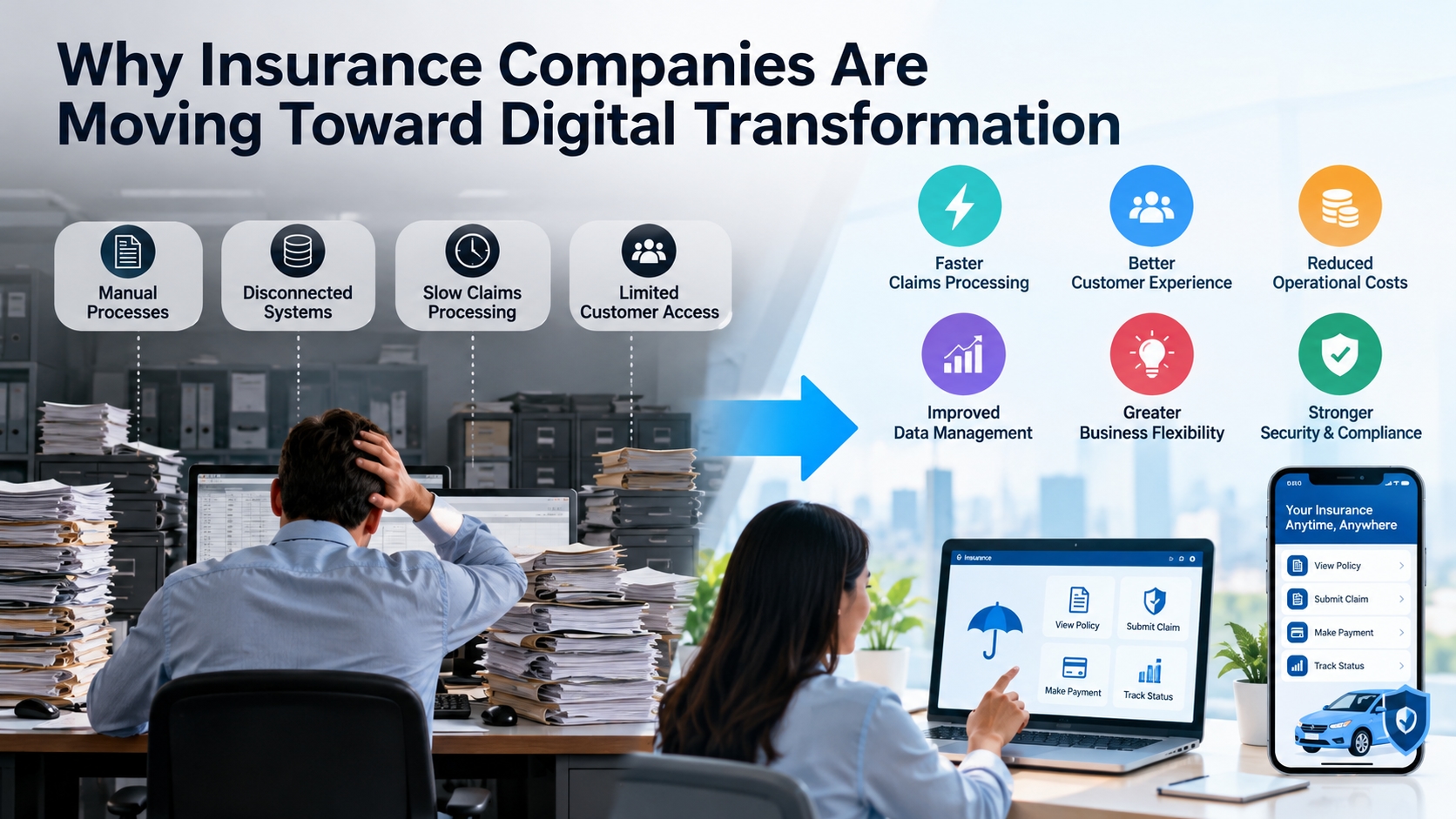
Insurance companies handle thousands of policies, claims, payments, and customer requests every day. However, many still depend on legacy systems that require manual data entry, involve lengthy approval processes, and make information difficult to access across departments. As customers increasingly expect faster claim settlements, online policy management, and instant updates, insurers are adopting digital technologies to improve efficiency and service quality.
Digital transformation is not simply about replacing old software. It involves connecting business processes, improving data accessibility, and building systems that can adapt to changing customer needs. Platforms like Guidewire help insurers modernize core insurance operations, while APIs and microservices support integration with other applications. For IT professionals interested in this transition, a Guidewire online course can provide practical exposure to insurance workflows, platform configuration, and integration concepts.
Key Reasons Insurance Companies Are Embracing Digital Transformation
Faster Claims Processing: Automated workflows reduce repetitive tasks and help claims teams process requests more efficiently.
Better Customer Experience: Digital portals allow policyholders to access policy details, submit claims, and track updates without depending entirely on customer support.
Reduced Operational Costs: Streamlined processes can reduce paperwork, duplicate data entry, and administrative effort.
Improved Data Management: Integrated systems make customer, policy, and claims information more accessible to authorized teams.
Greater Business Flexibility: Modern architectures help insurers introduce new products and connect third-party services without rebuilding their entire technology infrastructure.
Stronger Security and Compliance: Modern platforms can support access controls, audit trails, and regulatory reporting, although effective implementation and governance remain essential.
For insurance companies, the goal is to create a connected digital environment where employees can work efficiently and customers receive reliable, convenient services.
What Role Do Microservices Play in Modern Insurance Architecture?
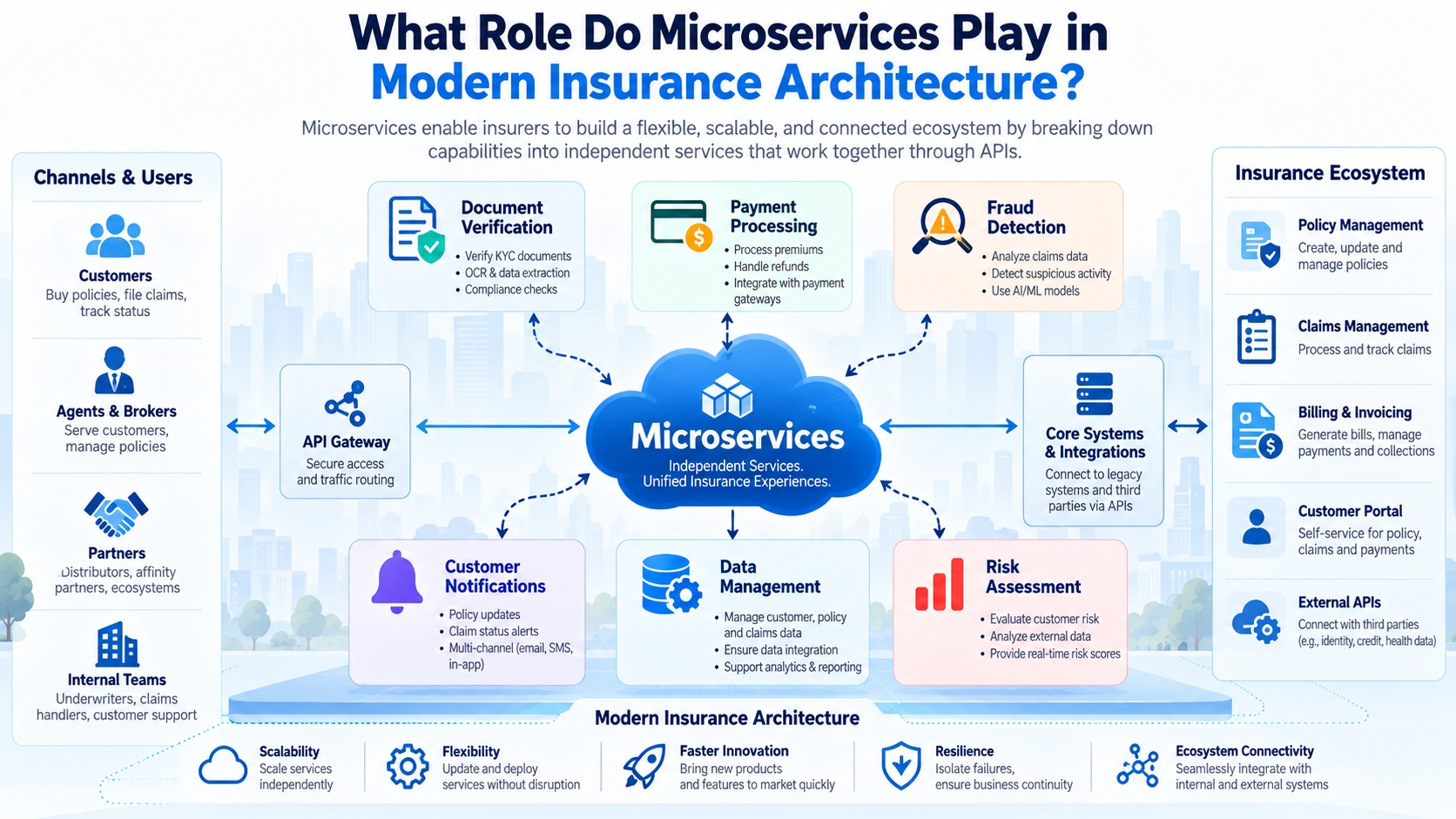
Insurance companies rely on multiple applications to manage policies, claims, billing, customer information, and payments. In traditional monolithic systems, these functions may be tightly connected, making updates and integrations more complicated. Microservices offer a different approach by dividing applications into smaller, independently deployable services, each designed to handle a specific business function.
In modern insurance architecture, microservices can support activities such as document verification, payment processing, fraud detection, and customer notifications. For example, when a customer submits an insurance claim, a dedicated service can verify documents while another sends claim status updates. These services communicate through APIs or messaging systems, allowing insurers to improve individual capabilities without necessarily changing the entire application.
Microservices can also complement enterprise platforms like Guidewire InsuranceSuite by connecting core insurance operations with external digital services. Through API-based integrations, insurers can build customer portals, introduce automation, and connect third-party applications while retaining Guidewire for essential insurance processes. However, successful implementation requires careful attention to data consistency, security, monitoring, and system reliability.
How Guidewire and Microservices Work Together in an Insurance Ecosystem
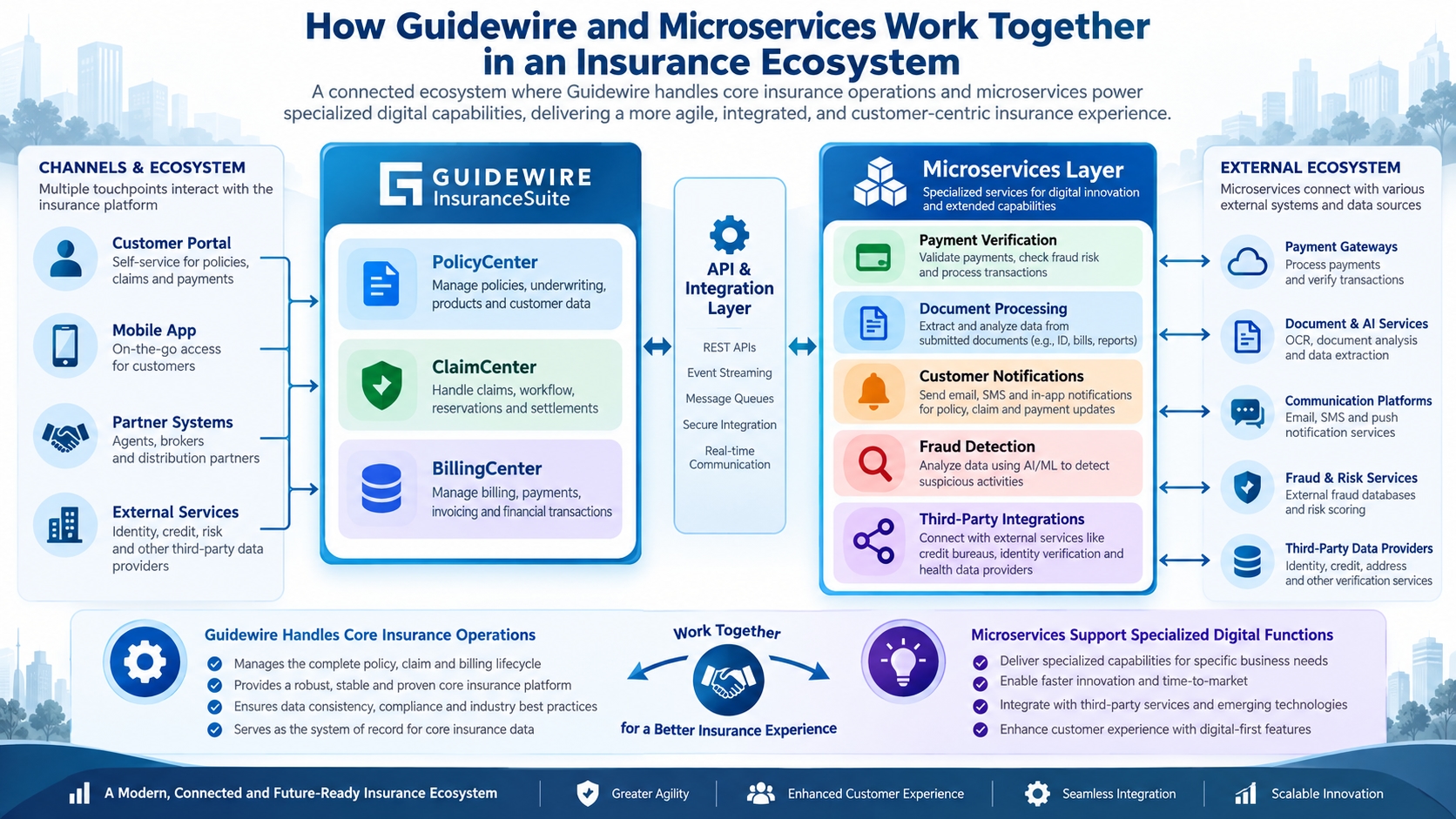
Guidewire and microservices serve different purposes in an insurance technology ecosystem, but they can work together to create more connected and flexible applications. Guidewire InsuranceSuite manages essential insurance operations through PolicyCenter, ClaimCenter, and BillingCenter, while microservices can handle specialized functions such as payment verification, customer notifications, and document processing. Understanding Guidewire InsuranceSuite vs Microservices Architecture helps businesses recognize how a core insurance platform and an architectural approach can complement each other rather than compete.
For example, when a policyholder submits a claim through a digital portal, Guidewire ClaimCenter can manage the claim lifecycle while external microservices handle tasks such as document validation, fraud screening, and automated notifications. These applications communicate through APIs and integration services, allowing information to move between systems securely. This approach helps insurers introduce new digital capabilities, improve operational efficiency, and update supporting services without unnecessarily modifying their core insurance applications.
How API Integration Connects Guidewire With Digital Insurance Applications
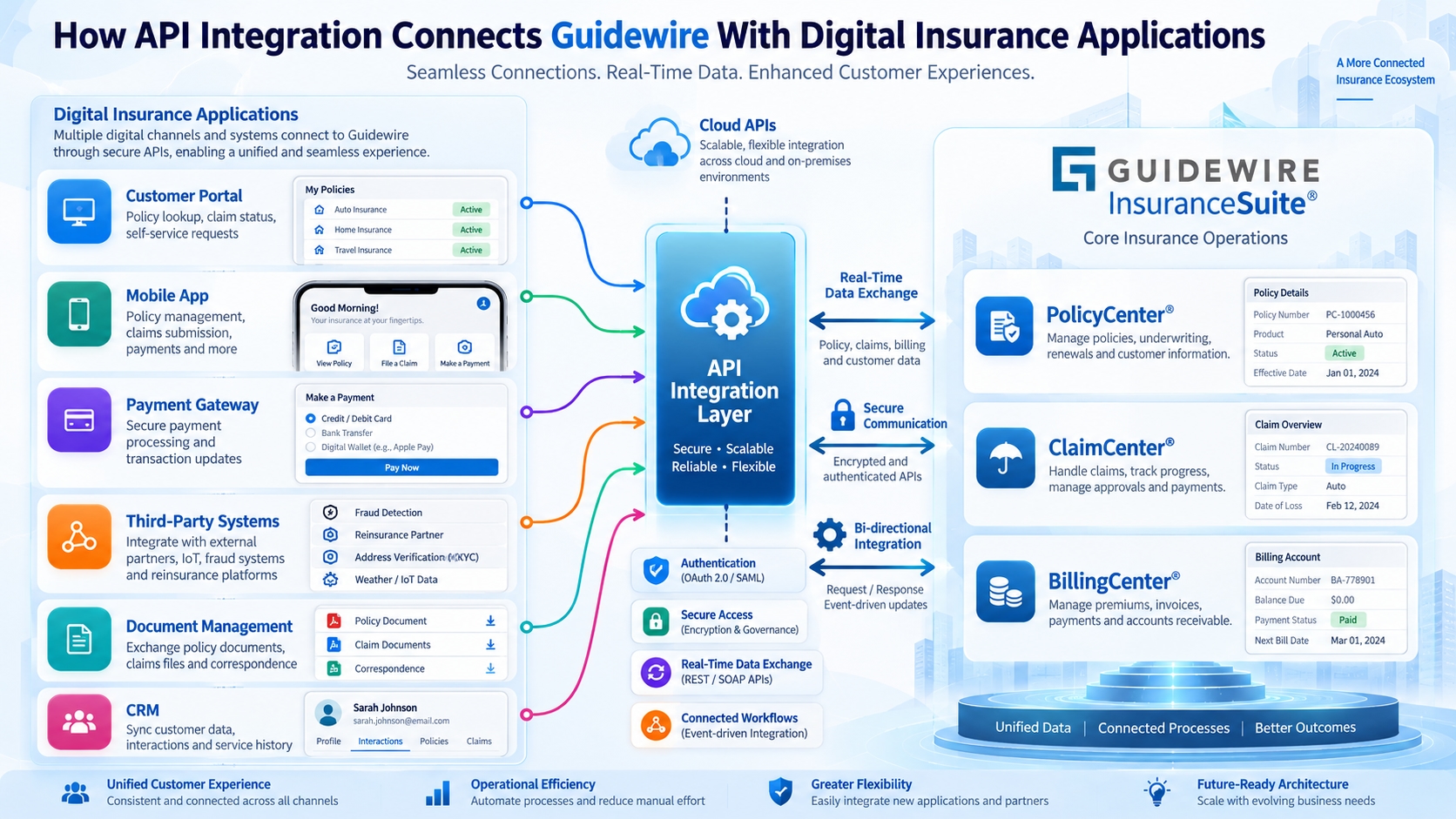
Modern insurance companies use several digital applications to manage customer interactions, payments, claims, and policy information. Without proper integration, these systems may operate separately, resulting in duplicate data entry and delays in communication. API integration allows Guidewire InsuranceSuite to exchange information with external applications, helping insurers connect their core insurance operations with customer portals, mobile apps, payment gateways, and other business systems.
Guidewire provides Cloud APIs that enable authorized applications to interact with supported insurance processes and data. For example, a customer using an insurance mobile app may request policy information or check the progress of a claim. Through API integration, the application can retrieve relevant details from Guidewire PolicyCenter or ClaimCenter without requiring the customer to access the core insurance system directly. Authentication, authorization, and appropriate data controls help protect sensitive information during these interactions.
API integration also allows insurers to introduce new digital services without rebuilding their existing insurance platforms. A company might connect Guidewire BillingCenter with an external payment provider or integrate ClaimCenter with a document management service. When combined with microservices, these integrations can support automated workflows and more flexible application development. However, reliable implementation requires careful API design, error handling, security controls, and monitoring to ensure information flows accurately between connected systems.
Real-World Example: Automating Insurance Claims With Guidewire and Microservices
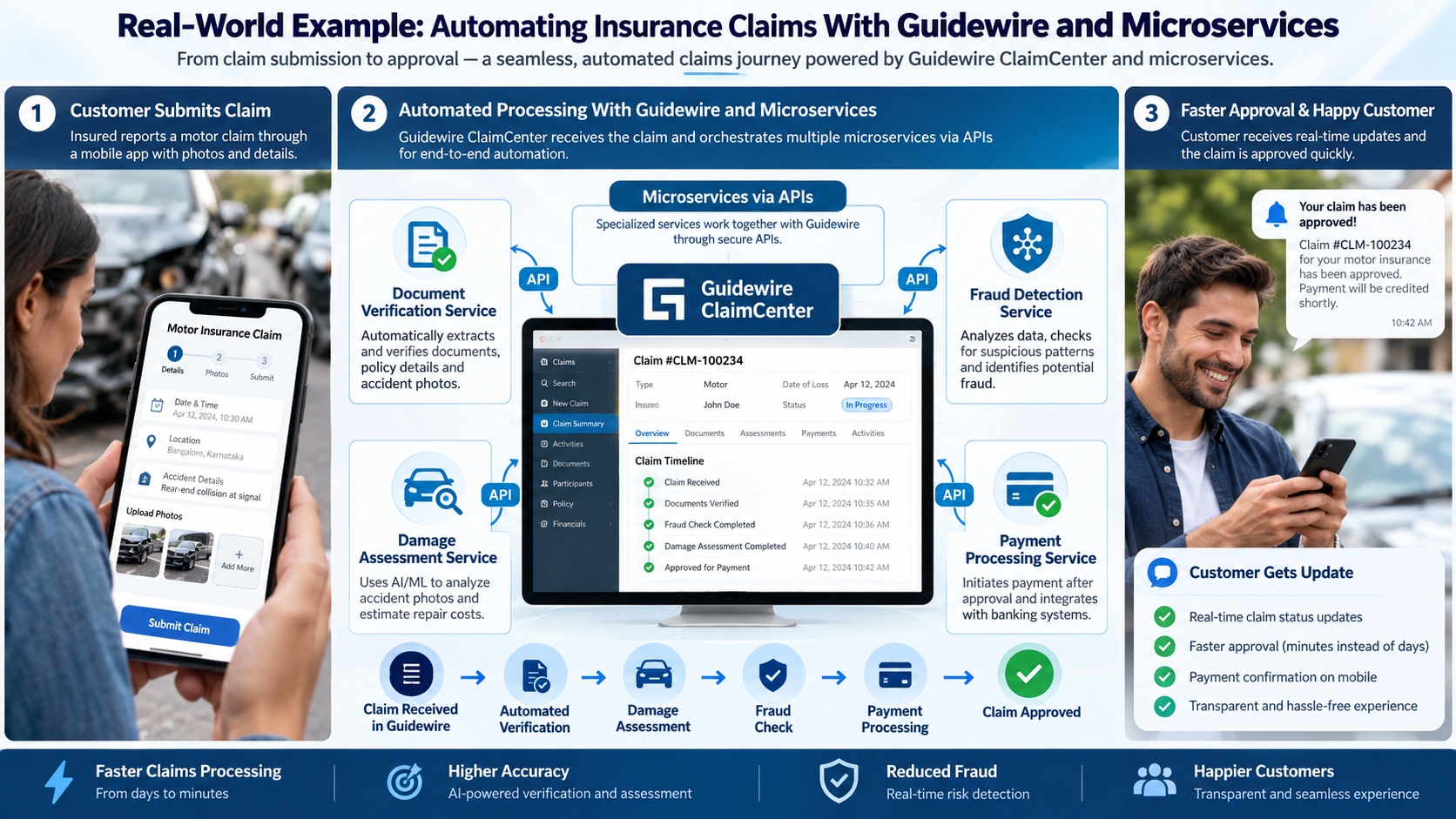
Imagine a customer submitting a motor insurance claim after a minor accident. Instead of visiting an insurance office or completing lengthy paperwork, the customer uploads accident photos, vehicle details, and supporting documents through a mobile application. Guidewire ClaimCenter manages the claim process, while integrated microservices can handle document verification, fraud screening, and customer notifications. Through APIs, these services exchange relevant information, helping claims teams review cases more efficiently and reduce unnecessary manual work.
For example, an insurer could connect ClaimCenter with an external vehicle damage assessment service that analyzes uploaded images and returns an estimated repair cost for review. Once the claim reaches a new stage, a notification service can automatically update the customer through SMS or email. Building such integrations requires knowledge of Guidewire configuration, APIs, and insurance workflows. Professionals exploring Guidewire training in Mumbai can focus on these practical skills to understand how enterprise insurance applications support claims automation and digital transformation.
Conclusion: Building a More Connected Future for Insurance
Digital transformation in insurance is not just about adopting new technologies but making existing systems work more efficiently together. Guidewire provides a reliable foundation for managing policies, claims, and billing, while microservices and API integrations help insurers introduce automation, connect external applications, and improve customer experiences without completely replacing their core systems.
As insurance technology continues to evolve, the combination of Guidewire and microservices can help organizations build more adaptable and connected digital ecosystems. For developers and IT professionals, understanding how these technologies work together is becoming an important skill for building, integrating, and maintaining modern insurance applications.