
Key Takeaways
You can modernize legacy systems in fintech without downtime by moving in controlled phases, not in one big-bang cutover.
Start with system discovery: map dependencies, data flows and undocumented business logic before you commit to a budget or timeline.
Match the approach to each workload: rehost, replatform, refactor, wrap with APIs, or rebuild.
In the UAE, design for data residency, audit rights, recovery targets and a documented exit plan from day one.
Protect performance with baselines, parallel runs and load tests before every cutover.
Put cost governance in place early so the cloud bill does not erase the business case.
Your payment engine still works. That is exactly the problem. It settles transactions, passes audits and keeps customers paid, yet every new product, partner integration or regulatory change takes months because the platform underneath was built for a different decade.
If you lead technology at a UAE bank, payments company or fintech scale-up, you have probably asked the hard question: how do you modernize legacy systems without risking the security and speed your customers trust you for?
The short answer is sequence. Understand the system first, modernize it in controlled slices, and prove security and performance at every step. Whether you plan a rebuild through custom fintech app development or a gradual move of existing workloads, this guide sets out the approach we recommend for regulated platforms, so you can scope your project with facts instead of assumptions.
Why Legacy Systems Have Become a Business Risk for UAE Fintechs
Legacy system modernization in fintech means restructuring older, often monolithic or mainframe-era applications into modular, API-driven, cloud-ready architectures that scale and meet regulation without interrupting daily operations.
The pressure to do it is rising. The Emirates NBD and PwC report "From Code to Capital" projects the UAE fintech market growing from $3.16 billion in 2024 to $5.71 billion by 2029, with Dubai home to roughly 62% of the country's fintech companies. The UAE also captured about 39% of MENA fintech investment in the first half of 2024. Growth like that rewards teams that ship quickly and punishes teams that cannot.
Regulation adds its own push. Open Finance Regulation C 03/2025 entered into force in 2025 and supports consent-driven, API-based data sharing across regulated institutions. A platform that was never designed to expose clean APIs struggles to take part.
You may be running a legacy platform if any of these sound familiar:
Releases take weeks because nobody is confident about side effects.
Only one or two people understand how fees, limits or settlement logic work.
Partner integrations rely on brittle point-to-point connections.
Peak days, such as salary runs or shopping festivals, need manual scaling.
Security patches wait because nobody wants to touch the core.
Any team offering legacy system modernization services should be able to explain how it will address each of these without putting live transactions at risk. That begins with understanding what you actually have.
The cost of waiting is easy to underestimate. Every quarter you delay, workarounds pile up, specialist knowledge walks out the door, and the gap widens between your release speed and that of competitors built on cloud-native stacks. Delay also raises security exposure, because older components are harder to patch and monitor. Teams that modernize legacy systems on their own schedule keep control of risk. Teams that wait for a failure or a regulatory deadline end up modernizing under pressure, which is the most expensive way to do it.
Step 1: Understand the System Before You Scope the Project
Most modernization projects go wrong at scoping, not at engineering. When the original developers have moved on and documentation is partial, the first deliverable should be system knowledge, not a migration plan. Engineering consultancy TSH makes the same point: the knowledge gap is the primary risk, ahead of the technology itself.
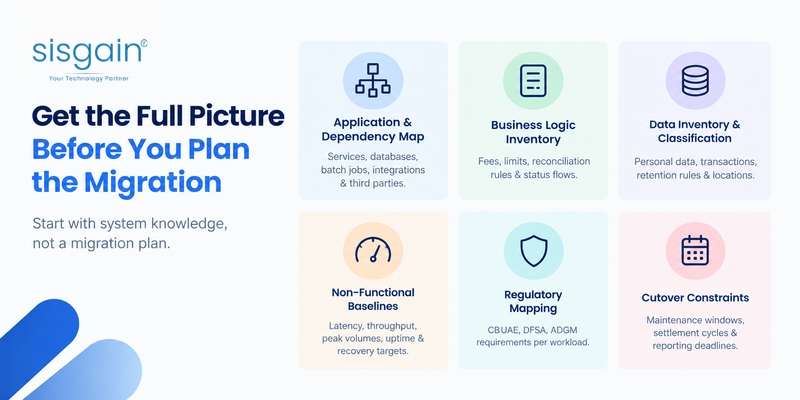
A proper discovery phase covers six things:
Application and dependency map: services, databases, batch jobs, file transfers and third-party connections such as card schemes, KYC vendors and payment rails.
Business logic inventory: fee calculations, limits, reconciliation rules and status flows that live in code rather than in documents.
Data inventory and classification: personal data, transaction records, retention rules and where each sits today.
Non-functional baselines: current latency, throughput, peak volumes, uptime, and recovery time and recovery point objectives.
Regulatory mapping: which Central Bank of the UAE (CBUAE), DFSA or ADGM requirements touch each workload.
Cutover constraints: maintenance windows, settlement cycles and reporting deadlines.
The output is a ranked modernization backlog that scores each workload by business value and risk. Our Infrastructure management strategy guide shows how to set ownership, monitoring and lifecycle rules before the first workload moves.
Here is a simple test. If you cannot answer "what breaks if this service goes down?" for every component, you are not ready to commit to a timeline. Close that gap first, and the rest of the project gets cheaper and calmer.
In practice, discovery combines several methods. Engineers read and analyse the code, capture real production traffic to see which interfaces actually matter, interview the people who run month-end and settlement, and review old runbooks and incident reports for hidden behaviour. The goal is not a perfect document. It is enough confidence to know where the risk sits, so that scope, budget and sequencing rest on evidence you can show your board and your regulator.
Which Modernization Approach Fits Each Workload?
There is no single right answer, and that is where good architecture earns its fee. Choosing the target design is exactly what Cloud Architecture Services in Dubai exist for, because the best pattern changes workload by workload.
Approach | Security impact | Performance impact | Downtime risk | Best for |
Rehost (lift and shift) | Neutral until controls are re-applied | Modest gains | Low | Stable systems facing a data-centre exit deadline |
Replatform | Better patching, logging and key management | Moderate, easier scaling | Low to medium | Sound applications that are costly to run |
Refactor | Smaller blast radius, more interfaces to secure | High, services scale independently | Medium | Core logic that blocks new products |
API layer with progressive migration | Central policy enforcement at the gateway | Depends on layer design | Low | Open Finance readiness and live core platforms |
Rebuild | Security designed in from the start | Highest ceiling | High | Platforms beyond economic repair |
Most UAE fintechs end up with a hybrid. For core banking modernization, the progressive pattern keeps the existing core running until every workload has moved, which is why many teams prefer it over a risky overnight switch. Supporting services are often replatformed, and only the components that genuinely block growth are rebuilt.
Three questions usually settle the choice for each workload. How much business value depends on it? How well do you understand its logic? And how hard is it to change today? A payments engine that earns revenue, is poorly documented and changes rarely is a candidate for an API layer and gradual migration. A reporting service that nobody loves and few depend on is a good first candidate for a simple rehost, which also gives your team a safe pilot. Matching effort to value this way keeps your fintech cloud migration focused on outcomes instead of activity.
How to Modernize Without Compromising Security
Treat security as a design input, not a checklist after go-live. In the UAE, several expectations shape the target environment.
Data residency: industry summaries of CBUAE guidance say customer financial data, transaction records and personal data should remain within UAE jurisdiction. Confirm the current requirement with your compliance team or counsel.
Audit rights and recovery targetsdocumented,: licensed institutions are expected to retain audit rights and document recovery time and recovery point objectives for critical cloud-hosted systems.
Exit plans: the CBUAE outsourcing approach stresses a defined exit plan for each cloud arrangement, as NCC Group explains.
Sovereign financial cloud: in February 2026 the CBUAE and Core42 announced a sovereign financial cloud, and law firm Pinsent Masons advises firms to reassess their cloud and outsourcing arrangements as a result.
DIFC and ADGM: the DFSA Rulebook includes material outsourcing requirements, and the UAE authorities jointly issued guidelines for institutions adopting enabling technologies such as cloud.
These rules are why fintech cloud migration in the UAE needs a regional landing zone, not a generic global template. Third-party risk deserves equal attention: your cloud provider, your migration partner and every vendor connected to the new platform become part of your regulated outsourcing chain, so contracts should cover audit access, incident reporting and exit support. Inside that environment, build in the following controls from the first sprint:
Zero-trust identity with least-privilege access and multi-factor authentication
Encryption at rest and in transit, with keys you control
Network segmentation and secrets management
Security scanning inside the delivery pipeline
Immutable audit logs feeding continuous monitoring
A rehearsed incident response plan
For a closer look at the threats and controls shaping the sector right now, see these Fintech cloud security trends.
How to Protect Performance During Migration
Customers never forgive slow payments, so performance needs the same discipline as security.
Baseline first. Record latency percentiles, throughput and error rates before anything changes, so you can prove you did not make things worse.
Run in parallel. Send shadow traffic to the new service and compare outputs against the legacy system on real transactions before switching.
Cut over gradually. Use canary releases and feature flags to move one customer segment at a time, with a tested rollback.
Test peak and failure. Replay your busiest day and deliberately break components to see how the platform recovers.
Bridge old and new carefully. A synchronous legacy core and an asynchronous, webhook-driven modern stack need a translation layer so neither side sees surprises.
Architecture matters too. Payments provider FSS moved to a UAE-hosted private cloud with its primary site in Dubai and disaster recovery in Abu Dhabi, keeping data inside the country while adding redundancy. A two-site pattern like that supports both residency and resilience. Our Fintech cloud infrastructure best practices guide covers multi-region design, autoscaling and observability in more depth.
Data migration deserves its own plan. Move data in rehearsed waves, reconcile balances and transaction counts after each wave, and keep the legacy source read-only until the business signs off. Any mistake here affects real customer money and creates regulatory exposure, so treat reconciliation as a gate, not a formality.
Finally, set service-level objectives before go-live and watch them continuously. If you cannot see the slowdown, you cannot fix it.
Keep Costs Predictable and Prove the ROI
Cloud does not automatically cost less. Without governance, over-provisioned servers and forgotten environments quietly eat the savings you promised the board. Bringing in FinOps services in Dubai from the first sprint lets you tag spend by product, right-size resources and track cost per transaction as a real business metric.
Agree on a short scorecard before you start, then report against it every quarter:
Release frequency and lead time for changes
Incident count and mean time to recover
Infrastructure cost per transaction
Time needed to launch a new partner integration
Hours spent preparing for audits
When the project ends, those numbers are your business case.
A Phased Roadmap to Modernize Legacy Systems Safely
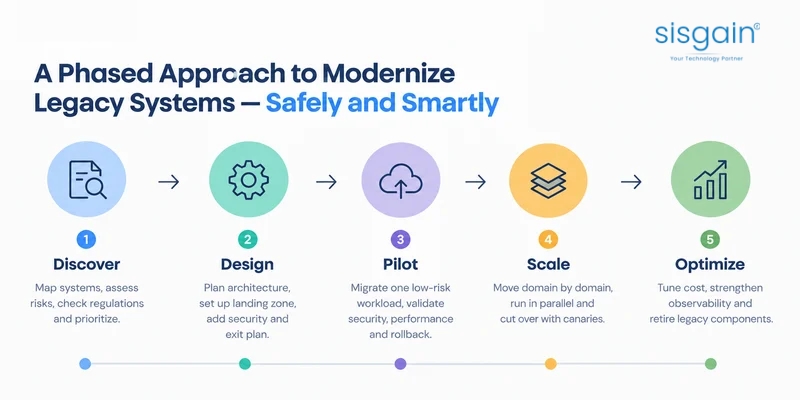
Here is the sequence we recommend when you modernize legacy systems in a regulated environment.
Discover: system map, risk register, regulatory mapping and a ranked backlog.
Design: target architecture, regional landing zone, security controls and a documented exit plan.
Pilot: migrate one low-risk workload end to end and validate security, performance and rollback.
Scale: move domain by domain, run in parallel, and cut over with canaries.
Optimize: tune cost, strengthen observability and retire the legacy components.
Where SISGAIN Fits
As a fintech software development company in Dubai, SISGAIN works discovery-first. We map your systems, rank workloads by risk and value, and hand you a plan your CTO, compliance lead and CFO can all sign off before any build starts. That approach applies whether you are planning core banking modernization, moving a payments platform, or preparing a product for Open Finance.
When you evaluate any cloud migration company in UAE, ask four questions:
Will you document our systems before quoting a fixed scope?
How do you keep data inside UAE jurisdiction and support audits?
What is your rollback plan for each cutover?
Who owns cost governance after go-live?
Clear, specific answers are a good sign. Vague ones are a warning. The best legacy system modernization services combine engineering depth with regulatory awareness, and they are honest about trade-offs, such as when a rebuild is not worth the risk. Ask to see how a provider documents decisions, because that record is what your auditors and your future engineers will rely on.
Conclusion
You can modernize legacy systems in fintech without trading away security or speed, provided you understand the system first, move in phases and prove every step. Start with discovery, match each workload to the right approach, and build UAE compliance in from day one. Done this way, legacy system modernization becomes a series of small, reversible steps rather than a leap of faith, and your customers notice better products, not outages.
Ready to scope your project with confidence? Talk to SISGAIN's experts, a cloud migration company in UAE that starts with your systems, not a template, and request a modernization assessment today.
Frequently Asked Questions
1. What is legacy system modernization in fintech?
It is the process of updating older platforms into modular, cloud-ready, API-driven systems. The goal is faster delivery, better security and easier compliance, and it is the core of any legacy system modernization services engagement.
2. Can you modernize legacy systems without downtime?
Yes, in most cases. Phased migration, parallel runs and canary cutovers keep live services running while workloads move one at a time.
3. How long does fintech legacy modernization take?
It depends on system size, documentation quality and compliance scope. A discovery phase gives you a realistic timeline instead of a guess.
4. Should we lift and shift, refactor or rebuild?
Most teams use a mix. Rehost stable systems, refactor logic that blocks growth, and rebuild only what is beyond repair.
5. How do we stay compliant with UAE data residency rules?
Host regulated data in UAE regions for your fintech cloud migration, retain audit rights and document recovery targets and exit plans. Confirm current rules with your regulator or counsel.
6. What if the original developers are gone and documentation is missing?
Start with reverse-engineering and dependency mapping, then validate against live transaction behaviour. System knowledge must come before any migration plan.
7. How do we stop cloud costs from growing after migration?
Tag spend by product, right-size resources and track cost per transaction. Review the numbers monthly instead of waiting for the invoice.