
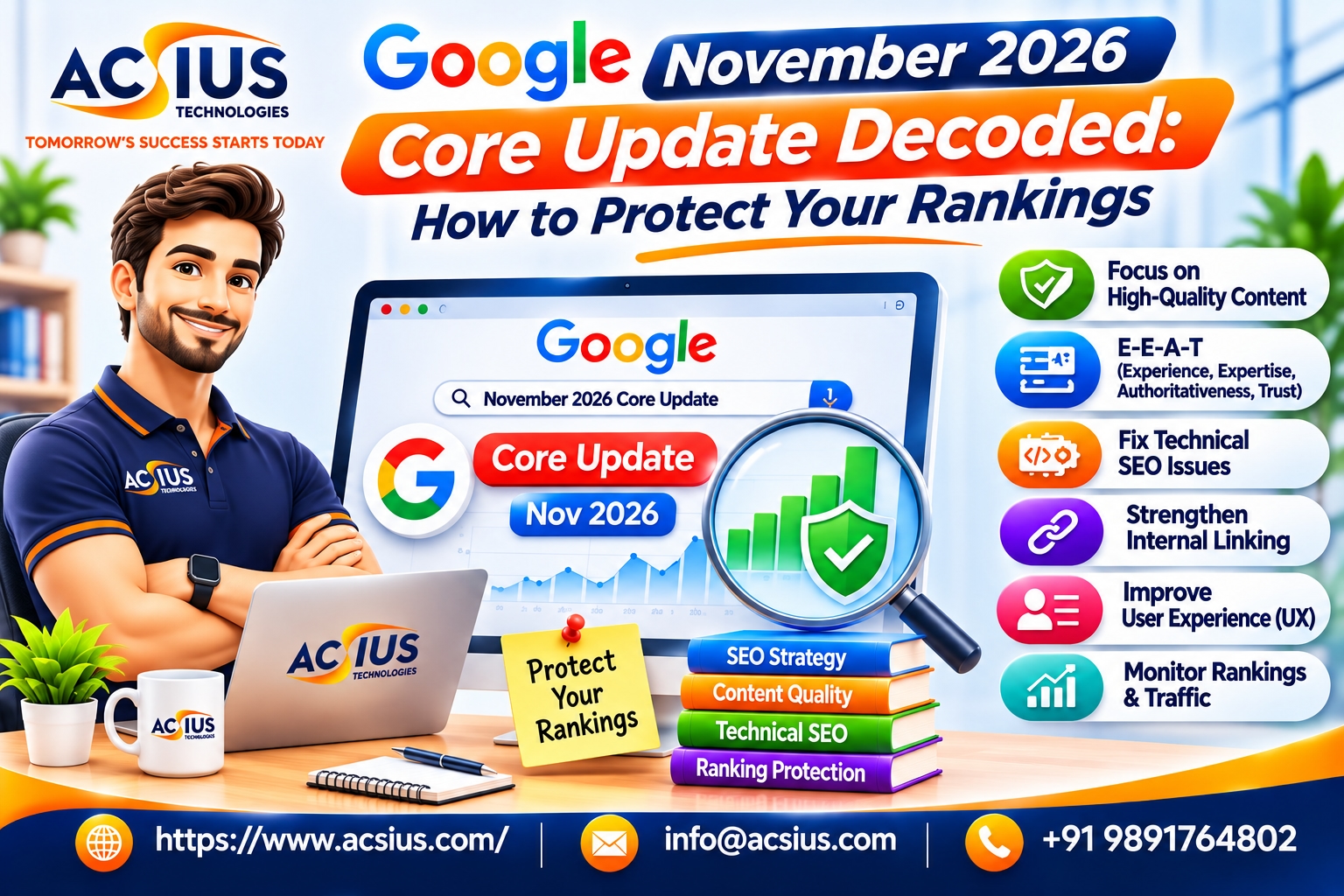
When Google announces a core update, the SEO world tends to split into two camps: people who panic and people who ignore it. Neither response is useful. The smart approach sits in the middle. You understand what has actually been confirmed, protect what already works, and avoid making hasty changes that you will regret later.
This guide decodes the November 2026 core update in plain language. It explains what Google has said, what it has not said, and what that means for your rankings, then gives you a practical protection plan you can follow before, during, and after the rollout. It is written to help you make calm, evidence-based decisions rather than chase rumors.
What Google Has Confirmed
Here is what is known, based on Google's Search Status Dashboard and reporting from established search publications:
Google began rolling out the November 2026 core update on November 10, 2026, at around 10:06 a.m. Pacific time.
It applies globally and to all languages.
Google says the rollout may take up to two weeks, which points to a finish around late November. As of this writing, it is still in progress.
Google described it as a regular update meant to better surface relevant, satisfying content from all types of sites.
It is the third core update of 2026, after the March and May updates, and the eighth ranking update on the dashboard this year, counting several spam updates.
Google has not said what this update changes and has not published new guidance specific to it.
That last point matters most. Anything beyond these facts is interpretation. Treat confident claims about what the update "targets" with caution until real data from many sites accumulates.
What a Core Update Does, and What It Does Not Do
A core update is a broad adjustment to the systems Google uses to rank pages. It is not a penalty, it does not single out a website, and it is not a manual action. Instead, it changes how well pages are judged to match what searchers want, so some pages rise and others fall relative to one another.
This leads to three useful ideas:
Rankings are relative. A page can drop even though nothing is wrong with it, because other pages now look more helpful for that query.
Movement is normal during rollout. Rankings can swing back and forth for days before settling.
There is no single fix. Google says there is no one switch to flip for recovery, and gains or losses reflect many factors.
Understanding this protects you from the most common mistake: assuming a drop means you broke a rule.
Step 1: Do Not Panic and Do Not Rewrite Everything
The fastest way to make things worse is to react emotionally. During a rollout, data is noisy. If you rewrite dozens of pages today and your rankings change tomorrow, you will not know whether the update, your edits, or random fluctuation caused it.
Instead, follow Google's own suggested routine: wait until the update is complete, then wait at least a full week more, and compare your Search Console data from that week with a baseline from the week before the rollout began. For this update, the baseline is the week before November 10.
What you can do right now is take a snapshot. Export your top pages, queries, clicks, impressions, and conversions for the baseline week, along with the same period last year if you have it. This gives you something solid to compare against later.
Step 2: Rule Out Technical Problems First
Before blaming the algorithm, check whether something on your own site is broken. Technical problems often look like ranking losses, and unlike core updates, you can fix them immediately.
Check the following:
Indexing. Are important pages still indexed? Look for sudden drops in the Pages report in Search Console.
Accidental blocks. Look for stray noindex tags, robots.txt rules, or canonical mistakes, especially after recent site changes.
Server errors and downtime. Review hosting logs and crawl stats.
Redirects and 404 errors. Make sure valuable pages have not broken, and that redirects go straight to the right destinations.
Speed and mobile usability. Slow or unstable pages hurt user experience.
Structured data. Confirm that markup is valid and matches visible content.
If you find a real technical issue, fix it right away. This is the one kind of change you should not postpone.
Step 3: Strengthen the Fundamentals That Hold Up Through Updates
Google has not detailed this update, but its guidance on core updates has been consistent for years. Sites that rank well over time tend to share a few qualities. Make these your protection plan.
Helpful, original content
Ask whether each important page offers something beyond what already exists in the results. Original examples, data, expert insight, and clear explanations give people a reason to choose your page. Remove or merge pages that only repeat common information.
Real experience and expertise
Show who is behind your content. Add named authors, honest bios, credentials, and first-hand details such as original photos, test results, and case studies. These are core to what Google's quality rater guidelines call E-E-A-T, meaning Experience, Expertise, Authoritativeness, and Trustworthiness. E-E-A-T is not a single ranking factor, but it describes the reliability Google's systems aim to reward.
Trust signals
Make sure visitors can easily find who you are, how to contact you, and what your policies are. Display real reviews, cite credible sources, and disclose sponsored content or affiliate relationships. Keep information accurate and updated.
Clear answers and structure
Place direct answers near the top of each section, use descriptive headings, and keep paragraphs short. Pages that are easy to scan satisfy readers faster, and clear structure helps both search engines and AI systems understand your content.
A steady, well-run program of this kind is the core of dependable Organic SEO Services, which combine technical health, content quality, internal linking, and authority building so your rankings rest on solid ground rather than on tactics that can be undone by the next update.
Step 4: Protect Your Visibility in AI Search
Core updates and AI features are connected. Google has said that its AI Overviews and AI Mode rely on its ranking systems and follow standard SEO fundamentals, and that pages need to be indexed and eligible for snippets to be linked in AI responses. So changes to core systems can ripple into AI-driven results as well as traditional listings, although the specific effect of this update is not yet known.
To protect and grow your presence there, focus on being easy to understand and trustworthy:
Lead with direct answers and use question-based headings.
Write complete, natural sentences rather than keyword fragments.
Use structured data where it fits, such as article, product, FAQ, and organization markup.
Cite reliable sources and keep statistics current.
Build recognition beyond your site through reviews, mentions, and quality links.
Sample your priority queries regularly in AI Overviews, AI Mode, ChatGPT, Gemini, and similar tools to see whether your brand appears.
Because measurement here is imperfect, many brands work with providers of AEO Services in India to track brand mentions across AI platforms, identify content gaps, and structure pages for answer engines. Treat these tools as directional rather than exact, and be cautious of any promise that a specific citation can be guaranteed.
Step 5: Protect Your Local Presence
If your business depends on nearby customers, local visibility deserves its own checks during the update period. Local results rely partly on different signals, such as proximity, relevance, and prominence, but your website content still supports them.
Review these items:
Google Business Profile. Confirm categories, services, hours, photos, and posts are accurate, especially around holidays and sale periods.
Consistency. Keep your business name, address, and phone number identical across your website and directories.
Reviews. Encourage honest reviews and reply to all of them.
Location pages. Make sure each page has unique, useful local information, not copied text with a changed city name.
Performance data. Watch calls, direction requests, and website clicks from your profile alongside organic traffic.
Businesses with several branches or service areas often use dedicated local seo services India to manage profiles, citations, reviews, and location pages at scale, which keeps their local presence consistent and credible while search results shift.
Step 6: Prepare for Seasonal Noise
This update is rolling out just before the biggest shopping week of the year in many markets, and the first clean week of post-update data may overlap with Black Friday and Cyber Monday. Seasonal demand makes comparisons tricky because traffic changes with shopping behavior as well as with rankings.
To keep your analysis honest:
Compare with the same period last year, not only the previous week.
Segment by page type, since product pages and blog posts behave differently in sale periods.
Separate branded and non-branded queries, because brand searches rise around promotions.
Track conversions and revenue, not just visits.
Avoid risky site changes, such as migrations or large redesigns, during peak season.
What to Do If Your Rankings Drop
If your data shows a clear decline after the rollout finishes and the waiting period has passed, work through a calm process:
Confirm the pattern. Does the drop align with the rollout dates and affect groups of similar pages, not just a single URL?
Check for technical causes again, in case something changed at the same time.
Compare with the new results. Search your lost keywords and study who now ranks. Are they more thorough, more current, or better matched to intent?
Improve honestly. Add original insight, update facts, clarify authorship, and improve structure and usefulness.
Consolidate weak content. Merge thin or overlapping pages and redirect the old URLs.
Be patient. Google has said improvements may take time to be recognized, and recovery is not guaranteed.
Avoid shortcuts such as buying links, mass-producing content, or hiding text. These approaches can cause bigger problems than a core update.
What to Do If Your Rankings Rise
Gains deserve discipline too. Identify which pages and topics improved and consider why. Keep those pages accurate, add internal links from related content, and avoid large rewrites that could undo what worked. Use the moment to strengthen weaker areas, since future updates can shift rankings again.
If you want an outside perspective on what your data means and what to prioritize, an experienced SEO Company India can audit your site, analyze Search Console patterns, and separate update effects from other causes. Choose a partner that explains its methods openly, avoids guarantees, and links its recommendations to business outcomes.
A Quick Protection Checklist
Right now (during the rollout)
Save your baseline data.
Fix any clear technical errors.
Avoid major rewrites or redesigns.
Monitor, but do not react to daily swings.
After the rollout ends
Confirm completion on the Google Search Status Dashboard.
Wait at least one full week, then compare with the pre-update baseline.
Segment results by page type, intent, brand versus non-brand, and location.
Ongoing
Update important pages regularly.
Strengthen authorship, trust signals, and original content.
Build topic depth and internal links.
Track AI mentions alongside rankings and conversions.
Diversify traffic with email, community, and partnerships.
Final Thoughts: Protect Rankings by Being Genuinely Useful
The November 2026 core update is a reminder that rankings are never permanent. They reflect how well your pages serve people compared with everything else available. You cannot control Google's systems, but you can control the quality of your site: original content, real expertise, transparent trust signals, solid technical health, and accurate, up-to-date information. Measure patiently, act on evidence, and keep improving. That discipline protects you through this update and every one that follows.
If you would like expert help protecting your rankings and building a resilient search strategy, ACSIUS can support you with audits, content planning, technical optimization, local visibility, and AI-focused improvements through clear, ethical, and results-driven methods. Contact ACSIUS today to turn core update uncertainty into a clear plan for steady growth.



