Why Businesses in Singapore Are Rethinking Their Systems
If you run a company in Singapore and you're still tracking inventory in one spreadsheet, invoices in another software, and payroll somewhere else entirely, you already know the problem. Information gets scattered, mistakes creep in, and nobody has a single clear view of what's actually happening in the business. This is exactly the gap that Enterprise Resource Planning Systems were built to close.
The Real Problem Growing Businesses Face
Most companies don't set out to create messy systems. It happens gradually. A finance team adopts one tool, operations picks another, and sales runs on something else again. Over time, these disconnected tools stop talking to each other.
The result is familiar to anyone who has managed a mid sized business:
Duplicate data entry across departments
Reports that take days to compile and are outdated by the time they're ready
Errors in financial records that surface only during audits
Staff spending hours reconciling numbers instead of doing productive work
For companies that rely heavily on accurate financial tracking, this problem is even sharper. Without proper ERP Accounting Software in place, even small errors in billing or reconciliation can snowball into serious cash flow issues.
A Clear Solution That Actually Fits the Business
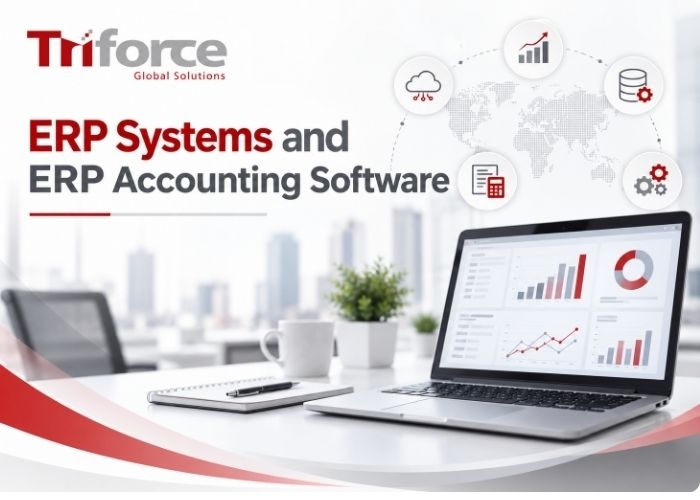
Enterprise Resource Planning Systems bring every core function, finance, inventory, procurement, human resources, and sales, into one connected platform. Instead of five disconnected tools, a business runs on one system where data updates in real time and every department sees the same numbers.
Within this, ERP Accounting Softwares play a specific role. They handle invoicing, ledgers, tax compliance, and financial reporting automatically, removing the manual work that causes most accounting errors in the first place. For businesses operating in Singapore, this also means staying aligned with local tax requirements and reporting standards without scrambling every quarter.
What Businesses Actually Gain
The benefits are practical rather than abstract.
Faster, more accurate financial reporting since data doesn't need to be manually pulled from multiple sources
Better visibility into cash flow, stock levels, and department performance
Reduced administrative workload, freeing staff to focus on higher value tasks
Fewer compliance risks because financial records stay consistent and auditable
Easier scaling as the business grows, since new users or modules can be added without rebuilding the whole system
None of this happens automatically just by buying software. It depends on how the system is set up and how well the team understands it.
How Triforce Global Solutions Approaches Implementation
At Triforce Global Solutions, the process starts with understanding how a business actually operates, not just what software it wants installed. Our approach generally follows these steps.
Assessment – We review current workflows, pain points, and financial processes to understand what the business genuinely needs.
System Implementation – We configure and deploy the ERP platform, including the accounting modules, based on the business's specific structure.
Training Services – Staff are walked through the system properly so adoption doesn't stall after launch.
Business Consulting – We help refine processes around the new system so the business gets full value from it, not just a new tool.
Technical and Software Development Services – For businesses with unique requirements, we build custom integrations or features where standard modules fall short.
Maintenance and Support Services – Once live, we stay involved to handle updates, troubleshoot issues, and keep the system running smoothly.
Why Businesses Trust This Process
Triforce Global Solutions works directly with businesses based in Singapore, which means our recommendations account for local compliance needs and regional business practices, not generic templates. We don't disappear after go live. Ongoing support is part of the service, not an add on.
Frequently Asked Questions
What is the difference between an ERP system and standalone accounting software?
An ERP system connects accounting with other business functions like inventory and procurement, so financial data reflects real time operations. Standalone accounting software only manages financial records in isolation.
Is ERP only suitable for large companies?
No. Many small and mid sized businesses in Singapore now use scaled down ERP systems to manage growth without adding excessive administrative overhead.
How long does ERP implementation usually take?
It depends on the size of the business and complexity of existing processes, but most implementations take a few months from assessment to full deployment.
Can existing accounting data be transferred into a new ERP system?
Yes, data migration is a standard part of implementation, though it requires careful planning to avoid errors during the transfer.
Does Triforce Global Solutions offer support after the system goes live?
Yes, ongoing maintenance and support is included as part of our service to keep the system running reliably over time.
Ready to Move Forward
If disconnected systems are slowing your business down, it may be time for a proper Enterprise Resource Planning System built around how your business actually works. Triforce Global Solutions offers full implementation, training, consulting, and support for businesses across Singapore.
Visit www.triforcegs.com.sg to speak with our team about what a properly integrated ERP system could look like for your business.