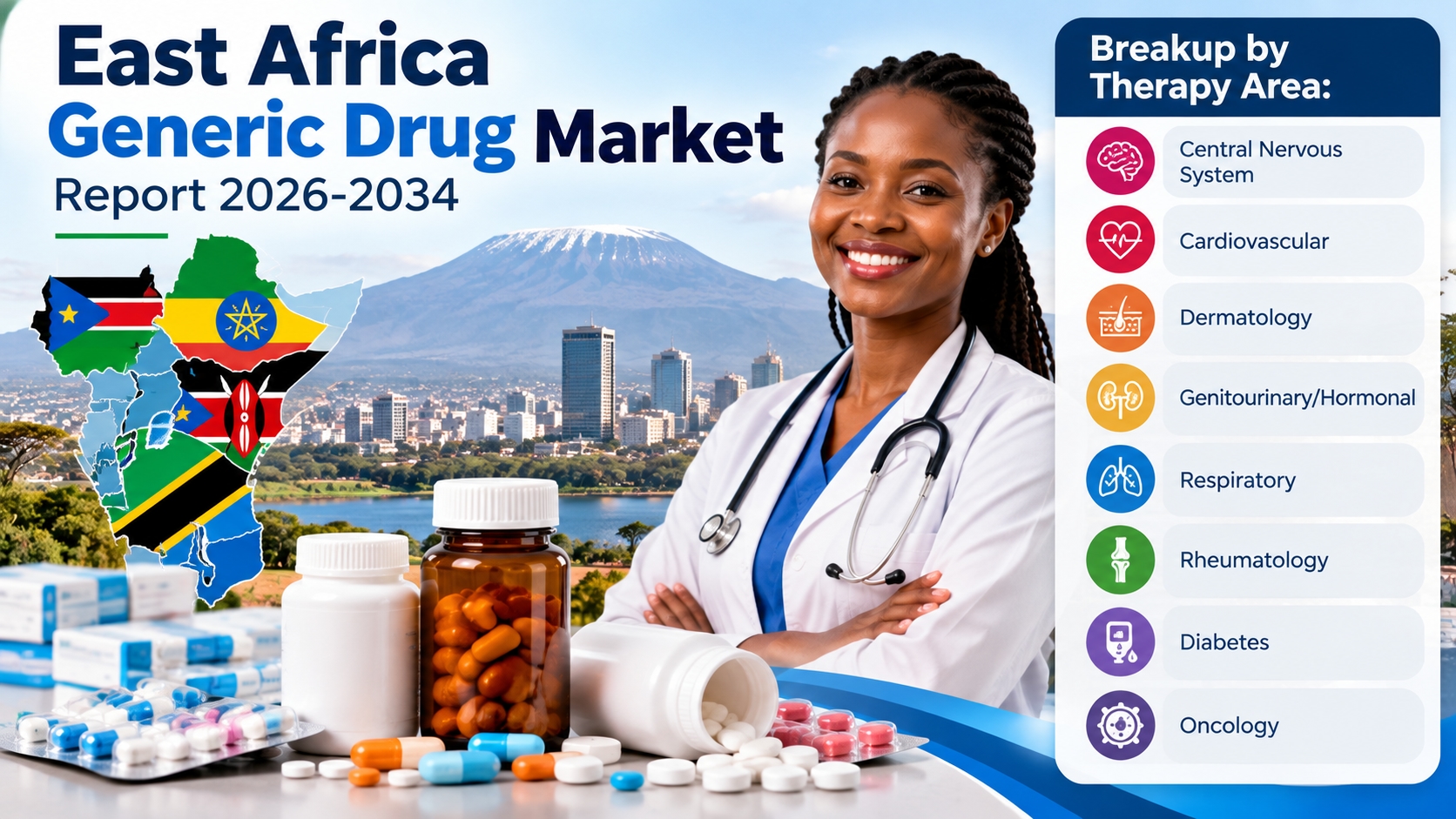
The East Africa generic drug market exhibiting steady growth over the coming years. Rising healthcare costs, a heavy burden of communicable and chronic diseases, and the expiry of branded drug patents are driving demand for affordable treatments. Supportive government programs on local manufacturing and faster regulatory approvals are also expanding the supply of quality generics across the region. East Africa generic drug market size increased from USD 2.6 Billion in 2025 to USD 2.8 Billion in 2026. Looking forward, IMARC Group expects the market to reach USD 4.6 Billion by 2034, exhibiting a growth rate (CAGR) of 6.45% during 2026-2034.
How AI is Reshaping the Future of East Africa Generic Drug Market?
AI-driven demand forecasting helps distributors and public procurement agencies anticipate shortages of essential generics such as antiretrovirals, antimalarials, and antibiotics. This reduces stockouts in remote districts.
Machine learning tools are being used in quality control and bioequivalence assessment, supporting regulators and manufacturers as shared testing infrastructure comes online in markets such as Tanzania.
AI-enabled supply chain platforms optimize inventory, cold-chain monitoring, and last-mile delivery. This improves access to oral and injectable generics outside major cities.
Digital pharmacy platforms use AI to personalize refill reminders and flag potential drug interactions. This strengthens trust in generic alternatives among patients and pharmacists.
AI-assisted formulation and process development is helping regional manufacturers shorten development timelines for multi-source generics, in line with national self-sufficiency goals.
Grab a sample PDF of this report: https://www.imarcgroup.com/east-africa-generic-drug-market/requestsample
Market Growth Factors
The East Africa generic drug market is supported by the region’s high burden of HIV/AIDS, malaria, and tuberculosis, alongside a growing prevalence of diabetes, hypertension, and other chronic conditions. Generic drugs are priced significantly lower than branded drugs because they carry no research, development, or heavy marketing costs. That makes them the first choice for public tenders, mission hospitals, and out-of-pocket buyers in low-income households.
Government-backed local manufacturing programs are reshaping supply. Kenya has over 37 licensed pharmaceutical manufacturers and is the most advanced producer in East Africa. Local manufacturers still supply between 20 percent and 30 percent of national demand, with imports accounting for the remaining 70 to 80 percent. Kenyan manufacturers produce 694 medicine formulations and ship to Tanzania, Uganda, Rwanda, and Somalia. The gap between local output and national demand leaves considerable room for capacity expansion across the region.
Regional investment is also accelerating. Tanzania’s Pharmaceutical Investment Acceleration Taskforce was set up to fast-track approvals, and the country is developing manufacturing hub clusters at Mloganzila and Kibaha, including a 40,000-square-metre industrial area. Registered pharmaceutical projects have reached 14, with capital inflows above USD 87 million. Strong cross-border trade within the East African Community, rising health insurance coverage, and growing retail pharmacy networks add further momentum to generic drug adoption.
Market Segmentation
Segment Insights:
Unbranded Generics
Branded Generics
Therapy Area Insights:
Central Nervous System
Cardiovascular
Dermatology
Genitourinary/Hormonal
Respiratory
Rheumatology
Diabetes
Oncology
Others
Drug Delivery Insights:
Oral
Injectables
Dermal/Topical
Inhalers
Distribution Channel Insights:
Retail Pharmacies
Hospital Pharmacies
Country Insights:
Ethiopia
Kenya
Tanzania
Uganda
Sudan
Rwanda
Others
Recent Developments & News
July 2026: MSD announced voluntary licensing arrangements with seven generic manufacturers, including Universal Corporation Limited in Kenya and Quality Chemical Industries Limited in Uganda, to widen access to its HIV treatment candidates. The deal strengthens the role of East African producers in global generic supply.
June 2026: Kenya launched its Health Products and Technologies Local Manufacturing Strategy. The framework is valued at Sh194.2 billion and aims to achieve pharmaceutical self-sufficiency. Tanzania takes 21 percent of Kenya’s pharmaceutical exports, Uganda 20 percent, and Rwanda and Somalia 8 percent each.
June 2026: A Tanzanian delegation promoted pharmaceutical investment at a fair in Shanghai, highlighting a USD 10 million commitment to a shared quality-control and bioequivalence laboratory at the Mloganzila and Kibaha industrial sites. The Ministry of Health also confirmed growing interest from large international firms, including a Shanghai-listed Chinese company planning to invest in generic medicine production.
February 2026: Kenya joined the WHO-Medicines Patent Pool mRNA Technology Transfer Programme, through which the Kenya BioVax Institute is building local vaccine manufacturing capacity.
January 2026: Tanzania hosted the Pharmaceutical Production Investment Forum, which brought together regulators, local manufacturers, foreign investors, and financiers to unlock investment in domestic medicine production.
December 2025: Tanzania issued a call for expressions of interest from local and international investors to build pharmaceutical manufacturing facilities under its Green-Lane Approval System, offering priority regulatory approvals.
June 2025: Tanzania’s Ministry of Health announced plans to establish 10 new factories for antiretroviral drugs, intravenous fluids, laboratory reagents, tablets, and liquid medicines. It also announced a program to revive the Tanzania Pharmaceutical Industries plant in Arusha for full ARV production.
If you require any specific information that is not covered currently within the scope of the report, we will provide the same as a part of the customization.
About Us
IMARC Group is a global management consulting firm that helps the world’s most ambitious changemakers to create a lasting impact. The company provides a comprehensive suite of market entry and expansion services. IMARC offerings include thorough market assessment, feasibility studies, company incorporation assistance, factory setup support, regulatory approvals and licensing navigation, branding, marketing and sales strategies, competitive landscape and benchmarking analyses, pricing and cost research, and procurement research.
Contact Us
IMARC Group,
134 N 4th St. Brooklyn, NY 11249, USA,
Email: sales@imarcgroup.com,
Tel No: (D) +91 120 433 0800,
United States: +1-201971-6302




