
Quick Summary
The SAP SuccessFactors Employee Central Payroll certification covers employee data, payroll integration, system access, and payroll processing. This guide outlines the scope, key technical areas, SAP training, and readiness checks for the assessment.
Introduction
Payroll implementation links several systems and business processes. Employee information is maintained, transferred to payroll, checked, and reviewed before financial and payment activities finish. Knowing how a setting works helps, and knowing why a record failed to replicate or why a validation alert appeared helps just as much. The C_HRHPC Exam Guide offers a structured view of the knowledge expected from Employee Central Payroll professionals. This article covers the technical subjects, system relationships, and practical situations candidates should understand.
Understanding the certification
Credential and skills
The credential is titled SAP Certified - Implementation Consultant - SAP SuccessFactors for Employee Central Payroll, and its public code is C_HRHPC. SAP describes it as an entry-level implementation qualification that validates core skills for joining a project team under an experienced consultant. The issued badge lists four skills: Identity and Access Management, Payroll Processing, Process Integration, and Systems Integration.
Requirement for implementation consultants
SAP states that consultants implementing Employee Central Payroll hold valid credentials for both C_HCMPAY and C_HRHPC. General payroll knowledge and Employee Central Payroll skills are separate areas, so prepare for each.
Employee Central Payroll architecture
Systems and responsibilities
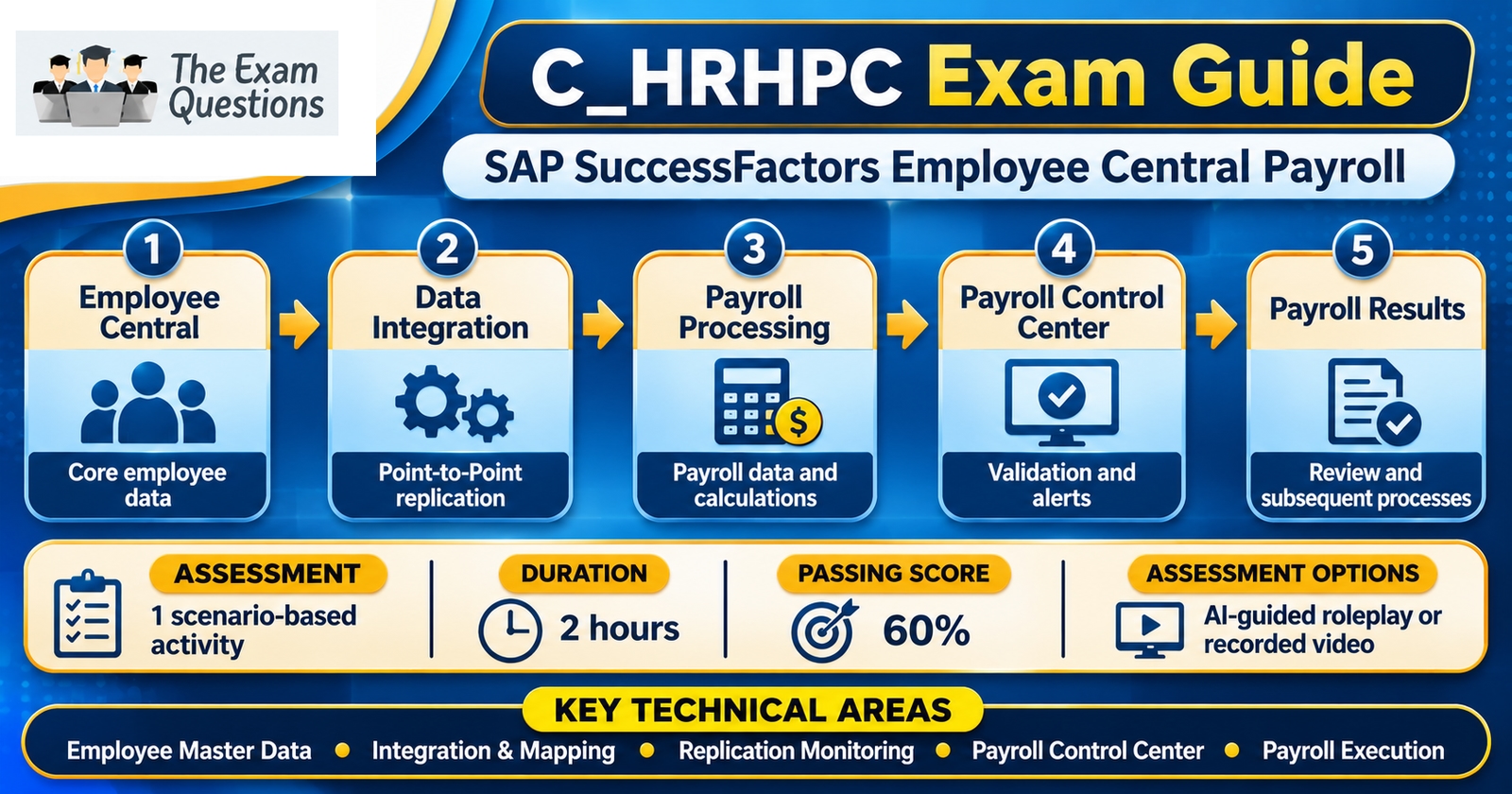
Employee Central manages core employee and employment information and acts as the system of record for core HR data. Employee Central Payroll uses the relevant information for payroll administration and processing. The flow runs from Employee Central through data integration into Employee Central Payroll, then on to payroll processing and financial activities.
Data sources
Relevant payroll data arrives through Point-to-Point integration or through supported Employee Central interfaces and UI mashups. Consultants should know which system maintains each piece of information, since payroll holds only part of the employee record. SAP's implementation training explains these responsibilities and the integration between both systems.
Employee data management
Incorrect or missing employee information affects payroll results and adds work for administrators. Candidates should understand four elements:
Employee master data: personal, employment, and organisational information maintained in Employee Central.
Payroll records: payroll-specific information used in processing, including the relevant infotypes.
Employee events: hiring, termination, promotion, and compensation updates.
Effective dates: the dates that decide when a change applies.
Consider a salary increase effective at the start of a new month. A consultant should explain how the change is maintained, how it reaches payroll, and how its effective date shapes processing. Check the original employee information before investigating unrelated payroll configuration.
Integration and data replication
Main technical areas
Point-to-Point replication transfers relevant employee master data between the two systems. Key areas include master data integration settings, employee event and event-reason mapping, organisational data mapping, pay components and wage types, technical users and permissions, API communication, replication monitoring, and error investigation. SAP's integration course covers configuration in both systems, Point-to-Point replication, and the tools for monitoring and troubleshooting transfers.
A practical example
Suppose an employee appears correctly in Employee Central but is missing from payroll. Check the employee information, review the replication results, examine the relevant mapping, and confirm the transfer after the fix. Identify the failure before changing configuration, since early changes create further issues.
Payroll Control Center
Payroll Control Center (PCC) helps payroll managers and administrators monitor activities, validate information, and manage exceptions, covering both pre-payroll checks and production payroll. Key subjects include:
PCC configuration: setting up the components that manage payroll processes.
Policy groups: organising validation policies for employee groups or processes.
Team responsibilities: assigning alerts to the right administrators.
Continuous payroll: monitoring employee data and payroll issues during the process.
Authorization: controlling who can reach particular functions and information.
SAP's training course adds roles, subsequent processing, off-cycle payroll, and supporting tools.
Payroll processing and subsequent activities
The main calculation is one stage in a longer process. A typical PCC cycle begins with test payroll data, then initiates policies and reviews alerts. Production starts the payroll and executes the run, followed by simulated or actual Financial Accounting posting. Monitoring reviews actual results and resolves alerts, and completion ends payroll and unlocks relevant data changes. Subsequent activities include Financial Accounting integration, bank transfers, and off-cycle payroll.
SAP's documentation explains how test data supports early validation, how policies surface exceptions, and how payroll managers review results before completing production.
Identity and access management
Payroll information is sensitive, and users hold different responsibilities. Consultants should understand how user roles and permissions govern access within PCC. A payroll administrator might reach the system yet be unable to view a particular employee group or resolve an assigned alert. Check the role and permissions first, since a system-wide technical fault is the less common cause. Correct access configuration protects employee information and keeps responsibilities clearly assigned.
SAP training and certification details
SAP's recommended courses cover the main technical areas. HR812 addresses employee payroll data, administration, payroll processes, and auditing. HRH60 addresses integration, replication, and troubleshooting. HRH65 addresses PCC configuration, roles, and monitoring, and it lists HR812 and introductory HCM Payroll knowledge as prerequisites. SAP also recommends HCM Payroll certification before starting this path.
For credential information and assessment details, consult the SAP official certification page.
Check your technical readiness
Before finishing preparation, confirm that you can answer these questions from memory:
Where is employee information maintained?
How does Point-to-Point replication work, and what commonly causes failed transfers?
How do PCC policies generate alerts?
How do pre-payroll and production payroll differ?
What happens during posting, bank transfers, and off-cycle activities?
Why might a user lack access to a payroll function?
Return to SAP's training material and work through an example for any topic that feels shaky. SAP's current listing shows one scenario-based activity, a two-hour duration, and a 60% passing score. Check the live certification page and your SAP account before booking, since assessment details can change.
Common mistakes to avoid
Studying topics in isolation hides how employee data, integration, and processing depend on one another. Investigate replication problems before changing payroll settings. Give PCC authorization attention, because roles and permissions explain many access issues. Rely on the current SAP certification page for format details, and set aside outdated question counts and old exam patterns. Practise investigating realistic payroll problems, which teaches more than isolated definitions.
Frequently asked questions
What does this certification validate?
Core skills in SAP SuccessFactors Employee Central Payroll, including payroll processing, integration, system access, and related implementation knowledge.
Which technical subjects should candidates understand?
Employee data management, system integration, Point-to-Point replication, Payroll Control Center, authorization, and payroll processing.
What is the current assessment format?
One scenario-based activity, a two-hour duration, and a 60% passing score.
Why do integration and replication matter?
Payroll relies on accurate employee information, and successful replication delivers employee changes to payroll before processing.
Conclusion
The C_HRHPC certification covers the technical knowledge for working with Employee Central Payroll as part of an implementation team. Understanding employee information, integration, payroll controls, access management, and processing shows how the complete system operates. Prepare by applying these relationships to practical situations, practise troubleshooting common problems, and check current requirements before booking. For more SAP certification guides and exam explanations, visit The Exam Questions.