
Quick Summary
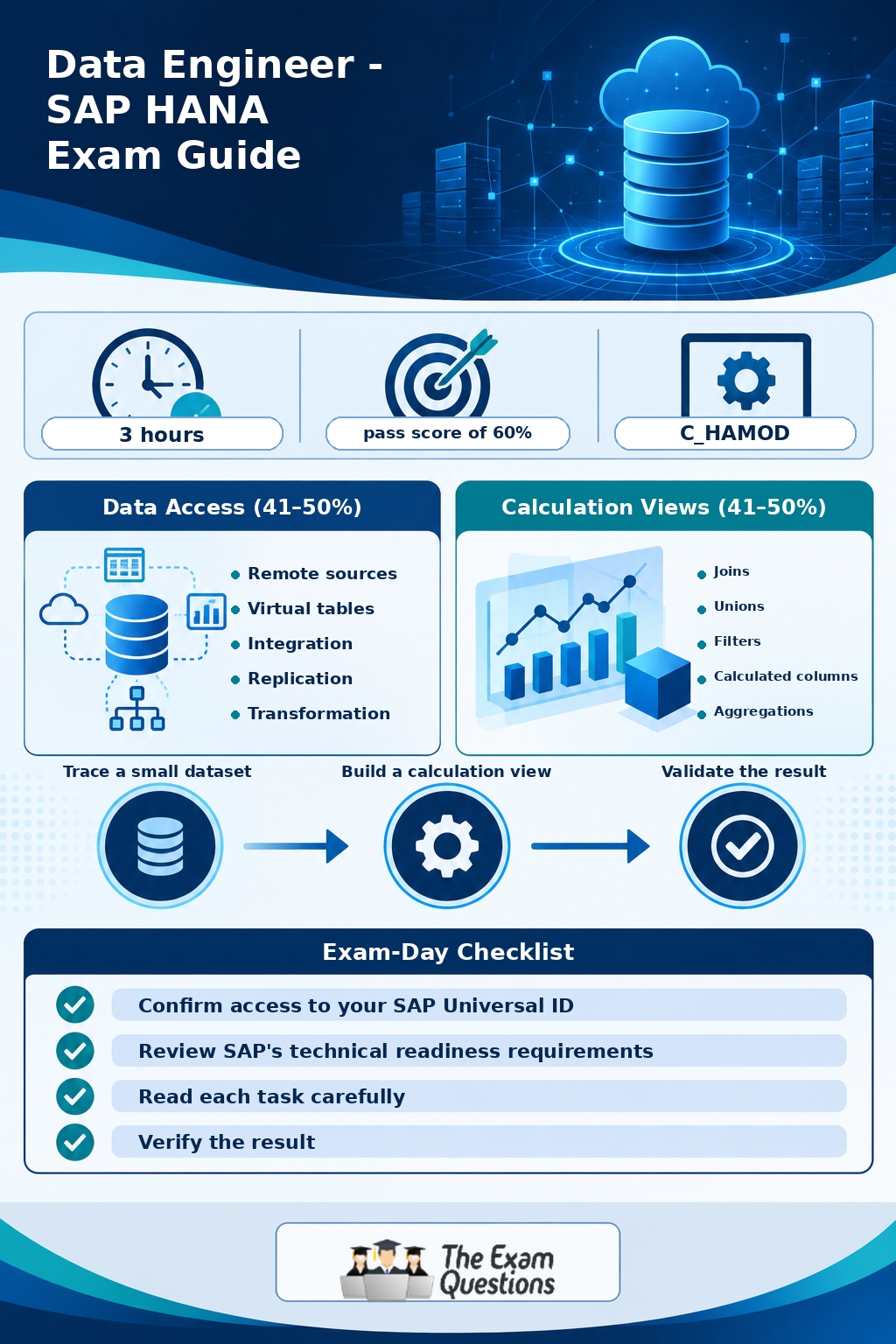
The C_HAMOD certification checks practical data access and calculation view skills in SAP HANA Cloud and SAP HANA. SAP lists a three-hour system-based assessment with a 60% pass score, so strong results come from hands-on practice alongside technical understanding.
Introduction
Data engineering in SAP HANA means making data available, shaping it for analysis, and building models that give business users dependable results. Engineers follow data from its source into the environment, then into the analytical structures that applications read.
This Data Engineer - SAP HANA Exam Guide supports candidates preparing for C_HAMOD. It covers the main skills behind the assessment, the official exam structure, and a practical plan built around real tasks.
What the C_HAMOD Certification Assesses
SAP describes this certification as validation of data provisioning and data modelling skills in SAP HANA Cloud and SAP HANA. The current listing shows one system-based assessment, a three-hour duration, and a 60% pass score. The exam has two topic groups: Data Access (41 to 50%) and Calculation Views (41 to 50%).
Both groups carry substantial weight. Because the assessment runs inside a system, candidates interpret a requirement, choose an approach, carry it out, and check the result. Knowing definitions is only the starting point.
Exam details can change. Confirm the current format, duration, pass score, language, and account requirements on the SAP official certification page before booking.
Core Technical Areas
Data access and provisioning
Data access covers how SAP HANA works with information stored in different places. Understand remote sources and virtual tables, including how data can be reached without copying it into the target database. The right method depends on the source, data volume, latency needs, and intended use.
Provisioning includes integration, replication, and transformation. Integration connects data environments, replication makes data available in another location or structure, and transformation reshapes data for a defined purpose. Know what each activity achieves and when it fits.
For practice, trace a small dataset from source to consumption. Identify its origin, decide how it is exposed, inspect its structure, and mark where transformation or replication belongs. This links individual features into one complete data flow.
Calculation views and data modelling
Calculation views combine data from tables and other sources into structures for reporting and analysis. Depending on the requirement, a model may use joins, unions, filters, projections, calculated columns, and aggregations.
Start from the business question. A sales report, for example, may combine transaction data with product and customer attributes, then aggregate by month or region. The model keeps relationships intact and returns figures users can interpret correctly.
Trace a model from its source nodes to its output. Check join conditions, filters, calculated measures, and aggregation behaviour. Test the result against a small dataset whose correct answer you already know. When an output looks wrong, follow the problem through each node of the model and fix the exact step responsible.
SQL and data quality
SQL supports both data access and modelling, so build confidence with queries, joins, aggregations, and filters. Watch data types, null values, duplicates, and inconsistent keys, since each can distort results.
Validation belongs to the job. Compare source and target counts, inspect sample records, review unexpected nulls, and confirm that business rules apply consistently. A view that runs successfully still needs a check for trustworthy output.
How to Prepare
Map the two official topic groups against your current ability. Mark each as confident, needs practice, or unfamiliar, then spend your time on tasks you cannot yet finish independently.
Next, practise complete workflows. Set up data access, use a remote source or virtual table where your environment permits, and create a calculation view that answers a clear business question. Record the reason behind each design choice and how you checked the output.
Keep an error log with four entries per issue: what failed, why, how you fixed it, and how to spot it early next time. Revisit each task a few days later and complete it from memory.
Add timed practice as well. The official assessment lasts three hours, while individual sessions can be shorter. Set a realistic task, work steadily, and reserve time to validate the result. Aim for a correct, explainable outcome.
Common Mistakes to Avoid
Definitions and screenshots alone build limited system-based skill. Data quality deserves equal attention, because a view can execute while returning duplicated or misleading results.
Some candidates spend too long on topics that sit outside the official outline. Keep Data Access and Calculation Views at the centre of your plan, and let SQL and database fundamentals strengthen them. Rely on SAP's current certification page for exam conditions, and treat third-party claims about question counts or memorised questions with caution.
Exam-Day Checklist
Before the assessment, confirm access to your SAP Universal ID and check that your subscription includes an exam attempt. Review SAP's technical readiness requirements, then test your connection, browser, equipment, and assessment environment in advance.
During the assessment, read each task carefully and identify the expected output. Work through the steps in a controlled order, verify each result, and track the remaining time. A quick validation can reveal an incorrect model or data-access setup before you move on.
Conclusion
Strong C_HAMOD preparation combines a clear grasp of data access with the ability to build and validate calculation views. Use this Data Engineer - SAP HANA Exam Guide to organise your plan around the published topics, then test your knowledge through practical tasks and timed work. Recheck SAP's official page for the latest assessment details before exam day.
Frequently Asked Questions
What is the Data Engineer - SAP HANA Exam Guide for?
It helps candidates understand the C_HAMOD scope, the two main exam topic groups, and the practical skills involved in SAP HANA data access and calculation views.
How long is the C_HAMOD exam, and what is the pass score?
SAP currently lists a three-hour system-based assessment and a 60% pass score. Check the official certification page before booking in case details change.
Which topics should I prioritise for C_HAMOD?
Start with Data Access and Calculation Views, which SAP lists at 41 to 50% each. Practise the related workflows to build skills that definitions alone cannot give.
Is practical experience important for this certification?
Yes. The assessment is system-based and validates data provisioning and data modelling skills. Hands-on work shows how setup decisions shape the final result.
Prepare with a Practical Focus
Use this guide as a checklist: understand the exam scope, practise data access, build calculation views, and validate each result. For focused C_HAMOD practice support, visit The Exam Questions and use it alongside your own hands-on preparation.