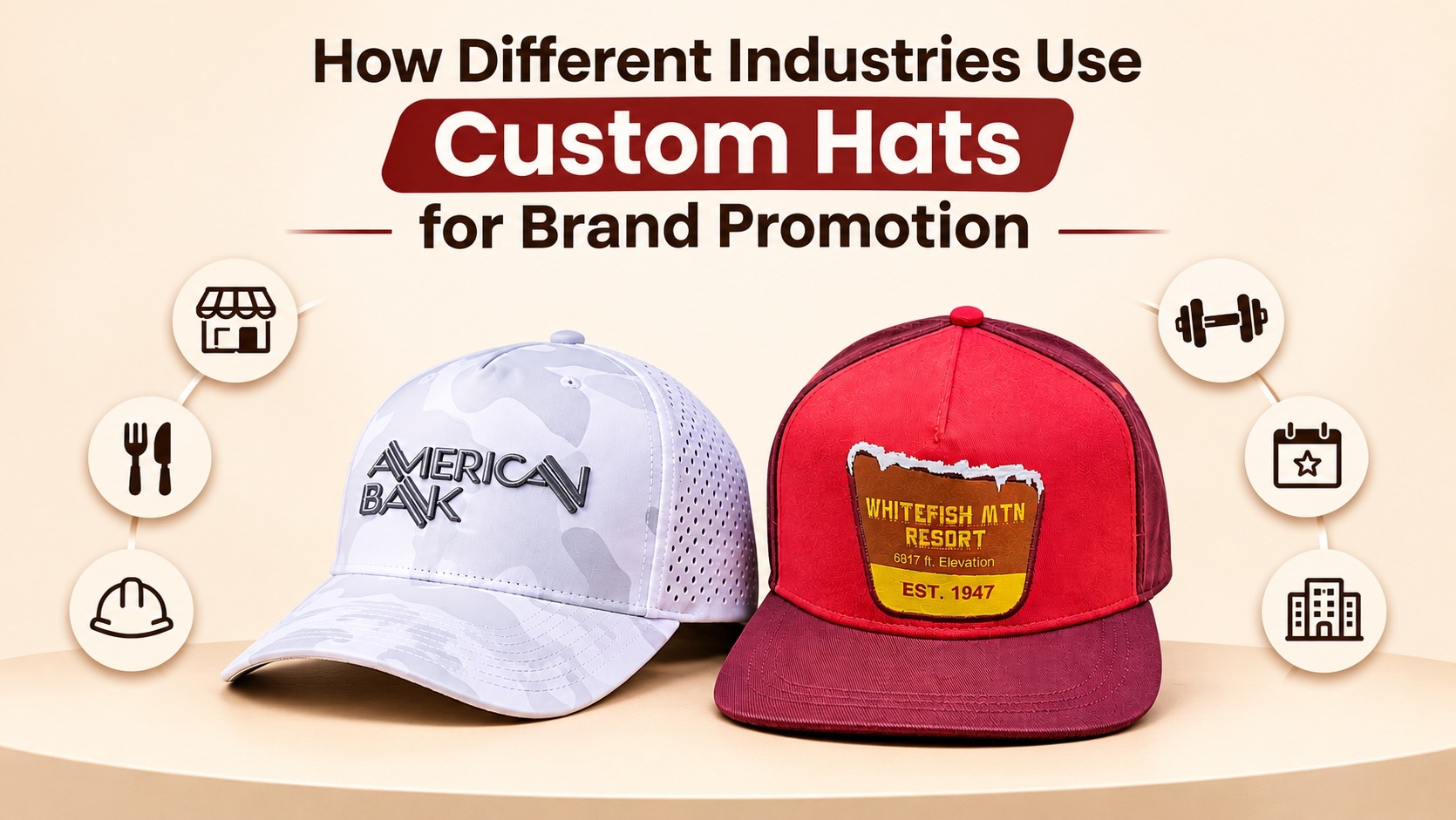
Many organizations use branded apparel to share a name or logo with the public, and hats are among the most common items. Promotional hats are worn in public, shared among groups, and kept for long periods. Because they suit many settings, businesses in very different fields have adopted them for their own purposes. This article describes how several industries use custom hats for brand promotion, what each one tends to prioritize, and what organizations consider when planning an order.
Why Promotional Hats Work Across Industries
A hat sits at eye level, which makes a logo easy to see during a conversation. It is also worn by choice, so it reaches people in everyday places such as commutes, parks, and stores. Unlike a printed flyer, a hat stays in use for months or years and keeps showing the same name each time.
The style also adapts well. A hat can carry a simple logo, a short slogan, or an icon, and it fits casual clothing, work clothing, and event clothing. Adjustable closures let one size fit most adults, which simplifies distribution to large groups.
Common Goals Behind Branded Hat Programs
Visibility
Most programs aim to place a name in front of more people. Hats worn in public places, at events, and during daily travel give a logo repeated exposure without a separate media purchase.
Identification
Matching hats help customers and visitors recognize staff, volunteers, and team members quickly. This is useful on job sites, at events, and in crowded stores.
Goodwill
Free hats given to customers, donors, or participants can create a positive link with the brand. The recipient chooses whether to wear the item, so the gesture is received as a gift and not as an advertisement.
How Industries Apply Branded Headwear
Construction and Skilled Trades
Contractors, electricians, plumbers, and landscapers often work at customer homes and public job sites. Crews that wear matching hats are easy to identify, which helps homeowners and inspectors know who belongs on site. A logo on a hat also appears in photos and on yard signs when crews work outdoors. Mesh back and cotton twill styles are common because they handle heat and frequent washing.
Food and Beverage
Restaurants, coffee shops, breweries, and food trucks issue hats to staff for hair control and for brand display. Customers can pick out employees at a counter or an event booth. Some businesses also sell or give hats to regular customers, which extends the logo into places outside the business and keeps the name familiar between visits.
Retail and Ecommerce
Retail stores and online sellers use hats as part of staff uniforms, as free items included with orders, and as products. Promotional hats placed in packages give online customers a physical item that carries the brand into daily life. Store employees who wear them also appear consistent across locations, which helps shoppers recognize the brand in more than one place.
Sports and Fitness
Gyms, studios, leagues, and race organizers use hats for staff, members, and participants. Event hats are often handed out at registration so participants wear them on race day. Youth sports programs and local clubs also use them as team items, and sponsors may appear on a side or back panel. Photos from games and races then show the same logos for weeks afterward.
Real Estate and Professional Services
Real estate agents, insurance offices, and financial firms use hats less as uniforms and more as client gifts. A hat given at a closing or an open house links the business to a memorable event. Agents may also wear them at community fairs and charity runs, where a casual look suits the setting.
Nonprofits and Education
Schools, universities, and nonprofit groups use hats for fundraising, volunteer teams, and spirit days. Volunteers who wear the same hat are easy to find at a large event, and supporters often keep the item as a memento. Hats may also be offered as thank-you items for donors, which gives a group a simple way to acknowledge support.
Events and Entertainment
Festivals, concerts, conferences, and trade shows use hats to identify staff and to give attendees a keepsake. Promotional hats carried home from an event extend their reach beyond the venue and the date. Event organizers often design a new version each year so each edition has a distinct look.
Choosing Promotional Hats
Match the Style to the Audience
Trucker caps, dad hats, beanies, visors, and bucket hats each suit different settings. A trucker cap fits outdoor work and warm weather. A beanie fits cold climates and winter events. Organizations usually pick the style that their audience already wears.
Design and Decoration
Simple logos with clear lines reproduce well. Embroidery is durable and has a textured finish, while patches and printed transfers can show more detail or more colors. Thread and fabric colors need enough contrast so the logo stays readable from a distance. Supplying a vector file helps the producer prepare an accurate proof.
Fabric and Care
Cotton twill is durable and breathable, while polyester blends dry faster and resist shrinking. Outdoor industries often prefer mesh panels for airflow. Hats that hold their shape through repeated washing keep the logo clear and the brand consistent.
Quantity and Supplier
Orders should reflect the number of staff, customers, or attendees who will receive hats, plus a reserve for later needs. Suppliers differ in minimum quantities, decoration options, and turnaround times. Montauk Hat is one example of a company that produces custom headwear for businesses, clubs, and events. Buyers often request a sample or a digital proof before full production begins.
Measuring Brand Promotion Results
Organizations can track results in simple ways. They can count hats distributed, record how many customers mention a hat, or ask new clients how they heard about the business. A QR code or web address on a hang tag can connect a hat to online activity. Results differ by industry and by how widely hats are worn, so each organization judges its own outcomes.
Conclusion
Industries use custom hats for different reasons. Trades identify crews, restaurants support uniforms, retailers add them to orders, and event organizers offer keepsakes. In each case, promotional hats place a logo in everyday settings and keep it in use over time. Careful choices about style, design, and quantity help an organization match the item to its audience and goals.



