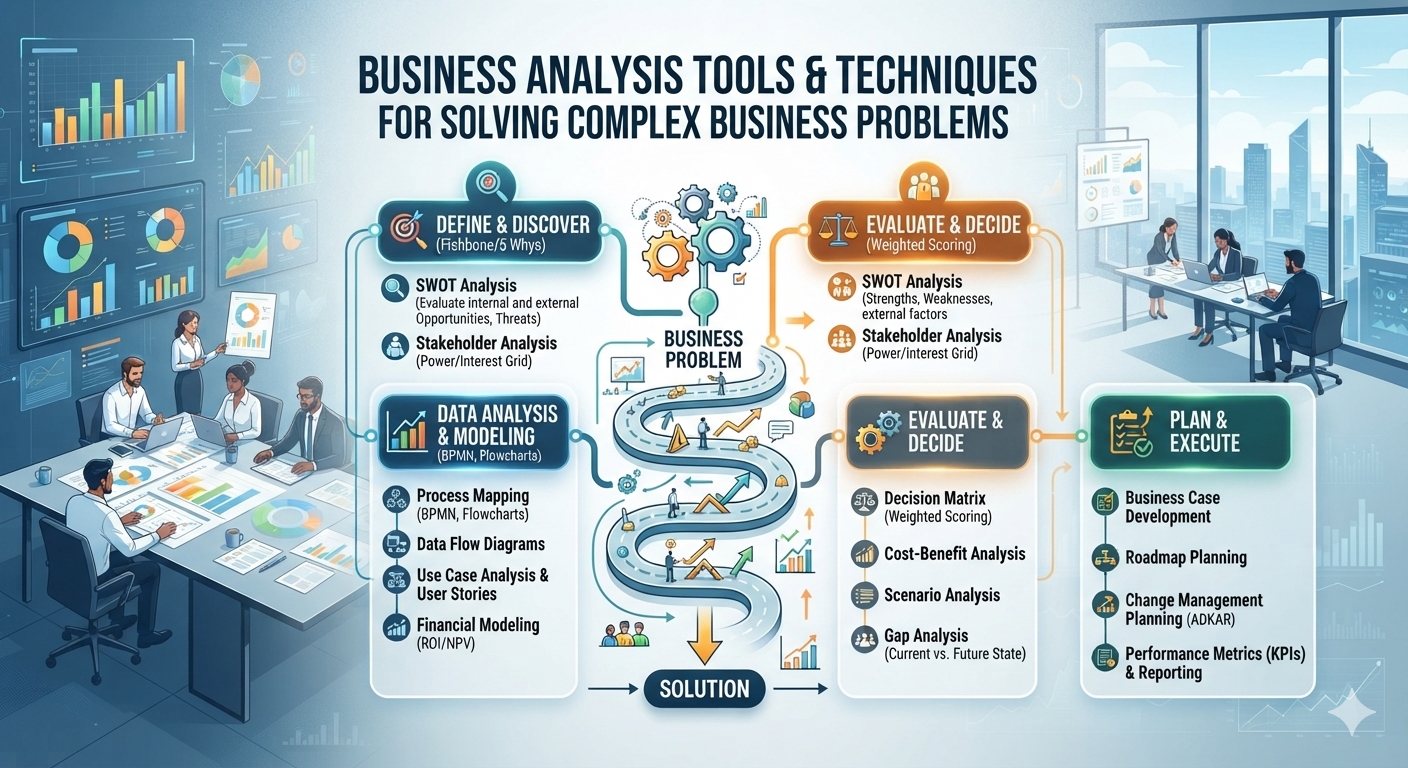
There are complex challenges faced by companies each and every day, such as low sales and poor software performance. The resolution of these challenges needs rationality instead of guesswork. If companies fail to have a systematic approach to solving such problems, they will only waste money and temporary solutions.
Enrolling in a Business Analysis Online Course makes people learn about easy methods of identifying challenges. Business analysts serve as good facilitators for communication between business management and the technical team. They employ easy frameworks and sophisticated tools and software to transform complex challenges into feasible solutions.
Which Business Analysis Frameworks Help Analysts Understand Complex Problems?
Before fixing small technical details, analysts need to see the big picture. Frameworks give analysts a simple way to look at a company from the top down. They help organise messy facts into easy groups so analysts do not feel overwhelmed by too much information.
Framework | Main Purpose | How It Solves Problems |
|---|---|---|
SWOT | Looks at internal Strengths, Weaknesses, Opportunities, and Threats | Shows internal skill levels compared to outside market competition |
PESTLE | Checks Political, Economic, Social, Technological, Legal, and Environmental factors | Spotlights big outside changes that can hurt long-term business growth |
MOST | Checks alignment across Mission, Objectives, Strategies, and Tactics | Shows where daily work strays from core business goals |
CATWOE | Checks Customers, Actors, Transformation, Worldview, Owner, and Environment | Shows how proposed changes will affect every person involved |
Whereas others also contemplate taking the Business Analytics Online Course in order to look into the quantitative statistical data. An analyst depends entirely on these qualitative ways of prioritisation for software development.
Which Techniques Help Analysts Find and Prioritise Problems?
Once the big picture has been taken into account, it becomes necessary to determine why the problem exists in the first place. Investigation methods that are simple to implement assist the analyst in looking past the surface complaints to identify the root cause.
1. Root Cause Analysis (The 5 Whys)
Solutions that provide quick fixes do not address underlying issues. The 5 Whys analysis methodology ensures that the team does not cover up the problem with a temporary fix by asking “why” five times in succession.
Practical Example: The mobile application of a store fails every time the users try to pay for their purchases.
Reason 1: The main server ran out of memory and became inoperative.
Reason 2: There were too many login requests from users at one time due to an unexpected price drop event.
Reason 3: The database failed to process multiple transactions simultaneously.
Reason 4: The database queries were poorly programmed and inefficiently executed.
Reason 5: The development team missed performance testing due to limited time for the launch of the application.
Practical Solution: Implement mandatory automated performance testing for all future applications developed.
2. MoSCoW Prioritisation Technique
Budget restrictions and tight deadlines influence every project. Business Analyst Certification Course teaches students how to prioritise tasks of a project for the construction of the most important elements first.
Must Have: Critical functionalities of the system necessary for launch; without which the entire application will fail.
Should Have: Valuable functionalities which are not critical but can increase the value of the project significantly.
Could Have: Extra information or designs that could be added in case there is any leftover time and budget after the completion of all Must Haves and Should Haves.
Won't Have: Additional features that will be deferred to be added in future versions to stay focused on the current project.
Which Software Tools Help Analysts Document and Communicate Solutions?
It is just half the story to identify the cause of the problem. It is necessary to explain the solution in a way which can be easily understood by developers, designers and managers.
Process Mapping Software: Simple graphical mapping applications draw the business process in a linear format by using shapes that depict the inefficient approval process, manual operations, and wasted time.
Requirements Management Tools: Collaborative online boards contain user requests for features, documentation of system requirements, bug tracking for applications, and daily tasks of developers.
Data Visualisation Dashboards: Graphical and report-generating applications convert large data sets into a visual screen. Making it easy for managers to monitor business performance daily.
Prototyping Software: Screen design applications develop clickable mock-ups of the application. Letting business owners test an application even before programming is done.
How Do Analysts Apply These Tools in a Real Business Scenario?
Frameworks, simple techniques, and software tools do not work alone. Smart analysts combine them to fix real operational issues from start to finish.
Consider a real case where a large shopping website suffers a 30% drop in online sales:
Environmental Assessment (SWOT/PESTLE): The analyst analyses the market environment and discovers that other competing stores offer their customers faster payment processes.
Root Cause Identification (5 Whys): After analysis of the reasons why customers leave the store without making any purchase. It becomes clear that making a new customer account takes time.
Workflow Modelling (Process Mapping): The analyst creates a flowchart of all the processes involved in signing up and reveals six unnecessary process boxes slowing down the consumer.
Requirement Prioritisation (MoSCoW): The analyst specifies a new requirement of developing a "Fast Guest Checkout" functionality to be Must Have for the next development sprint.
Solution Prototyping (Wireframing): The analyst draws a clear model of the new, shorter checkout page so software developers know exactly what to build.
Conclusion
By using frameworks and smart techniques, analysts can reliably turn messy business problems into simple, buildable plans. Frameworks give you the big picture. Simple techniques like the 5 Whys and MoSCoW uncover the true root causes and set main priorities. Learning this step-by-step approach ensures you do not just cover up symptoms, but deliver true value that solves hard business problems for good.