Modern structures keep getting taller, lighter, faster to build, and more exposed to extreme loads. Glass towers sway in the wind, wind turbines rotate above open land, and prefabricated modules arrive on site ready to be lifted into place. Behind all of it sits a quiet, old idea: a steel rod anchored in concrete. Anchor Bolts have been around for generations, yet they remain central to how contemporary structures stay connected to the ground. This article looks at where they work hardest today and what separates a dependable installation from a doubtful one.
Why modern structures ask more of anchors
Older buildings were often heavy and redundant, with thick walls and generous margins. Today’s designs use materials efficiently. Slender steel frames, long-span roofs, and tall, light facades save material and cost, but they also respond more strongly to wind, vibration, and uplift.
That shift places more demand on the base. A lighter structure may see uplift where a heavier one would not, and a flexible frame can move in ways that repeat thousands of times. Anchor Bolts are expected to handle these effects without drama, which is why design and verification have become more rigorous.
Tall buildings and steel frames
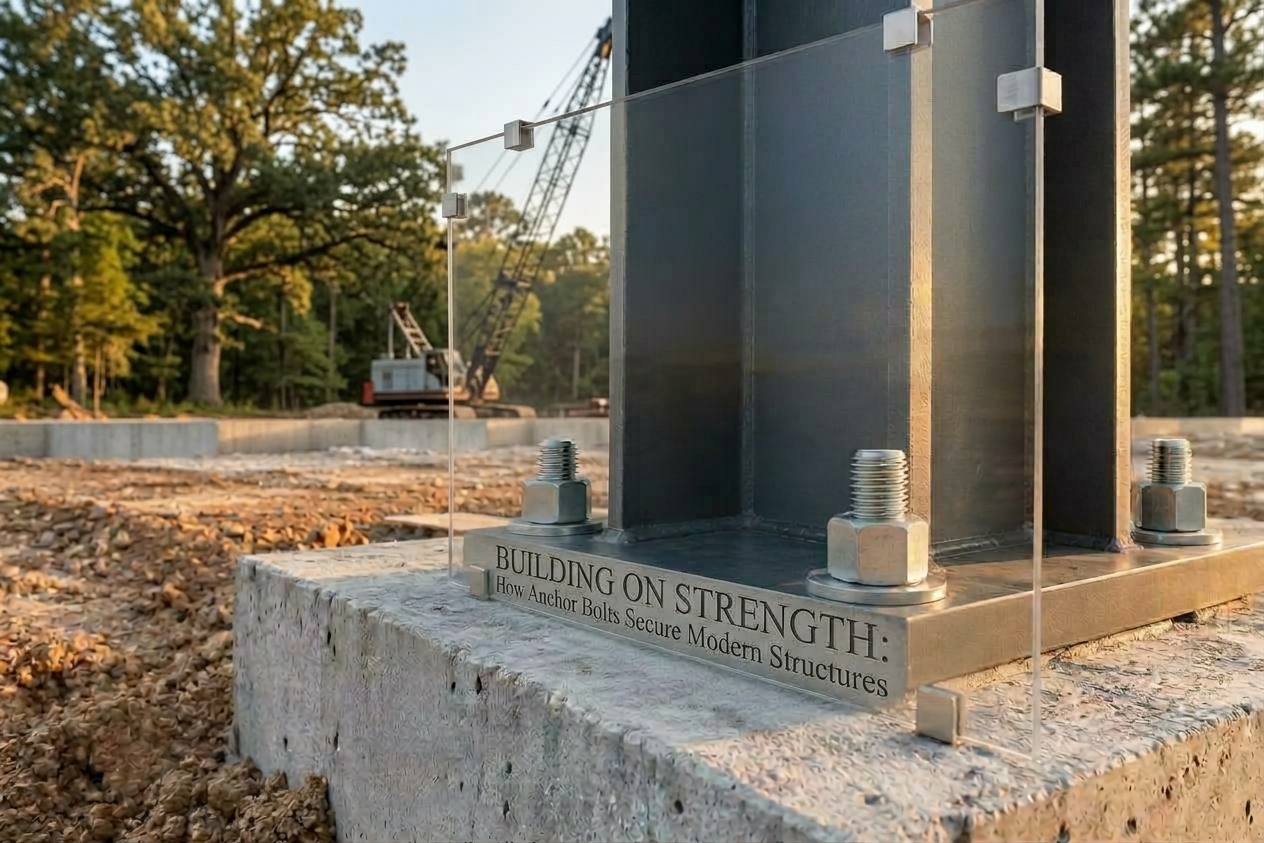
In a steel-framed building, each column ends at a base plate fixed to the foundation by anchor rods. Under normal gravity load, much of the force simply bears down through the plate. Wind and seismic events change that. They try to tip the frame, lift one side, and slide the base, and the bolts take the tension and shear.
Braced frames concentrate these forces at specific columns, so the bolts at those locations are often larger and more heavily detailed than elsewhere. Designers also check that the steel will yield before the surrounding concrete breaks, because ductile behavior gives warning, while brittle failure does not.
Wind turbines and tall slender towers
Few structures show anchor demands as clearly as a wind turbine. The tower carries a heavy rotating machine at height, and every gust and rotation sends repeating loads down into the foundation. Many turbine foundations use a circle of large-diameter, pretensioned bolts, either in a bolt cage or in a ring embedded in the concrete.
Pretension matters here because it keeps the joint clamped, so the bolts experience only a small part of each load cycle. That improves fatigue life, which is the key concern in structures that flex all day long. Lighting masts, signal poles, and sign structures along highways follow similar logic, since wind-driven vibration makes careful tightening and periodic inspection important.
Bridges and infrastructure
Bridge bearings, barrier posts, noise walls, and utility structures all rely on anchors. These installations face water, de-icing salts or coastal air, temperature swings, and repeated traffic loading. Corrosion protection and drainage details are as important as bolt strength, because water collecting around an exposed anchor is a common starting point for deterioration.
Because access can be difficult once a bridge is in service, designers tend to favor durable materials and details that make inspection straightforward.
Precast, modular, and prefabricated construction
Off-site building has changed how connections are made. Precast panels, columns, and modules are manufactured in a factory and lifted into place, so connections need to be quick to assemble and tolerant of small dimensional variations.
Embedded plates, sleeves, and anchor rods are common in these systems. The challenge is tolerance. A module that arrives on a truck can’t be adjusted the way a field-built frame can, so the bolt positions in the foundation have to match the design closely. That puts more weight on accurate templates, careful surveying after the pour, and clear coordination between the foundation crew and the fabricator.
Timber and mixed-material buildings
Mass timber and light-frame wood buildings use anchors too. Sill plates are fastened to concrete foundations with anchor bolts, and hold-down devices tie shear walls to the foundation so they resist uplift and overturning during storms or earthquakes. The principle is the same as in steel: the load needs a continuous path into the foundation, and the connection must be strong enough to carry it.
Retrofits and upgrades
Many modern projects are not new buildings at all. Plants are expanded, equipment is replaced, and older structures are upgraded to meet current codes. In those cases, post-installed anchors are often the practical answer.
Expansion, undercut, screw, and adhesive anchors each suit particular conditions. Their performance depends on the concrete’s condition, hole preparation, and installation workmanship, and some lose capacity in cracked concrete. For these reasons, designers choose products qualified for the actual conditions and follow the manufacturer’s instructions exactly. Dust left in a drilled hole is a well-known reason for weak adhesive anchor performance.
Standards and design rules
Modern practice rests on established standards. In the United States, ACI 318 covers anchoring to concrete, and post-installed products are qualified through test standards such as ACI 355.2 for mechanical anchors and ACI 355.4 for adhesive anchors. ASTM F1554 is widely used to specify anchor rod materials. In Europe and many other regions, EN 1992-4 governs the design of fastenings in concrete, supported by European assessment documents for qualified products.
Which standard applies depends on the project and location, so designers confirm the governing code at the start and keep specifications consistent with it. These documents exist because anchors fail in recognizable ways, including steel fracture, concrete breakout, pullout, edge blowout, and splitting, and the rules are built to keep those modes under control.
Materials, corrosion, and sourcing
Modern structures are expected to last, so corrosion protection gets real attention. Hot-dip galvanizing is widely used for outdoor work, while stainless steel suits harsher chemical or marine settings. Very high-strength steels need extra care with galvanizing, so that choice belongs with the engineer.
Sourcing deserves equal care. Ask for mill test certificates, grade markings, coating information, and dimensional records, and compare them with the specification before installation. Suppliers differ in what they make and document, so it’s sensible to evaluate certification and size range along with price. In the Gulf region, UAE-based manufacturers such as Petrofast Middle East FZC, which lists stud anchors among its products, are one example of the sources available to industrial and infrastructure projects. Whoever you choose, reject any material that doesn’t match its paperwork.
Digital tools and better planning
Technology has made anchor work more precise. Building information modeling helps teams catch clashes between anchor layouts and reinforcement before the concrete is poured, which is where many expensive mistakes begin. Laser scanning and total stations allow bolt positions to be checked quickly against the model, both before and after the pour.
Digital records help later, too. When bolt positions, tightening data, and certificates are stored with the project model, future owners can see what was installed and plan inspections intelligently.
Installation habits that still matter
Whatever the technology, the basics decide the result:
Hold bolts in position with a rigid template and verify them after concrete placement.
Confirm embedment depth, edge distance, and projection against the drawings.
Never bend, heat, or force bolts to fit a misaligned plate.
Use matched bolts, nuts, and washers, and grout the base plate properly for even bearing.
Tighten using the specified method and record it, rechecking where vibration is expected.
Inspect periodically for corrosion, loose nuts, and cracked grout.
Putting it together
Modern structures reach higher, span farther, and go up faster than ever, but they still depend on the same principle: a reliable load path from the steel into the ground. Anchor Bolts make that path possible. Choosing the right type, specifying the right material and protection, installing with care, and inspecting over time are what let a building, tower, or bridge stand up to what the weather and the years bring. Always follow the project engineer’s specifications and the applicable code.