
Managing multiple debts can make your finances difficult to organize. Different balances, interest rates, and payment dates can quickly become overwhelming.
Debt consolidation loans may offer one way to simplify repayment by combining multiple eligible debts into one new loan and one monthly payment. But consolidation is not automatically the right choice for everyone.
Here’s what U.S. borrowers should know before considering this option.
What Is Debt Consolidation?
Debt consolidation means combining multiple debts into a single repayment arrangement.
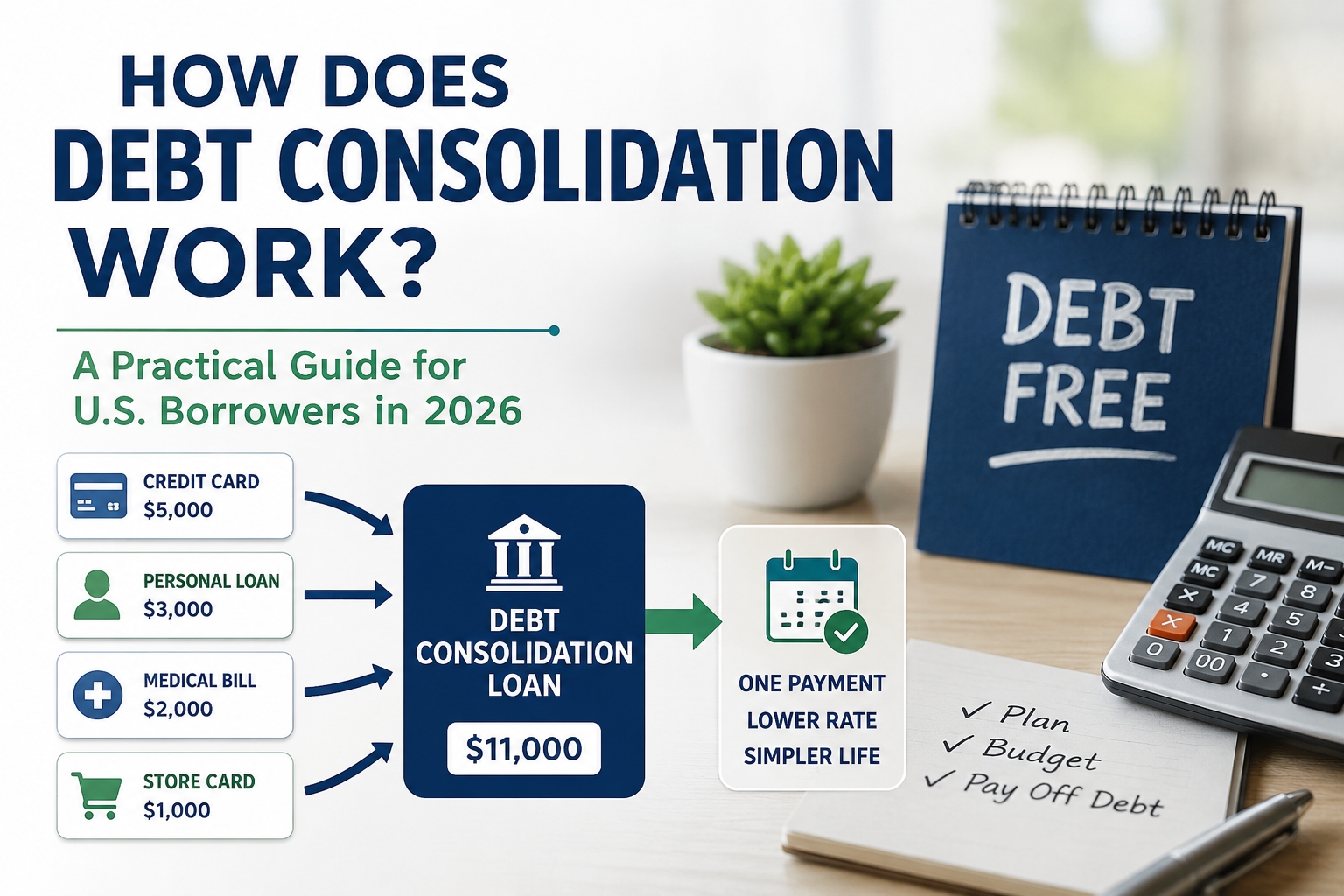
For example, suppose you have $5,000 in credit card debt, $3,000 on another card, and $2,000 in personal loan debt. If you qualify, you could use a consolidation loan to pay those balances and then make one monthly payment on the new loan.
The goal is generally to make repayment easier to manage. Depending on the interest rate, fees, and loan term, consolidation may also reduce the overall cost of borrowing.
However, it does not eliminate your debt. You are still responsible for repaying the new balance.
How Do Debt Consolidation Loans Work?
The process usually involves a few basic steps.
1. Review Your Existing Debt
Start by listing the debts you want to consolidate. Record each balance, interest rate, minimum payment, and due date.
This gives you a clear picture of your current financial obligations.
2. Compare Loan Options
Different lenders offer different rates, terms, fees, and eligibility requirements.
When comparing debt consolidation loans, look at:
APR
Monthly payment
Repayment term
Origination fees
Total repayment cost
Credit requirements
Don't choose a loan based only on its monthly payment. A longer repayment period can lower the monthly amount while increasing the total interest you pay.
3. Apply for a Loan
Lenders may consider your credit history, income, existing debts, and ability to repay.
Your credit score can affect the offers available to you. Borrowers with stronger credit may qualify for more competitive rates, while those with lower scores may receive fewer options or higher rates.
4. Pay Off Existing Debts
If you're approved, the loan proceeds can be used to pay eligible debts.
Depending on the lender, the funds may be sent directly to creditors or provided to you so you can make the payments yourself.
You then begin making payments on the new loan.
What Debts Can You Consolidate?
The debts eligible for consolidation depend on the lender and loan product.
Common examples include:
Credit card balances
Personal loans
Medical bills
Store credit balances
Other eligible unsecured debts
Credit card debt is often considered for consolidation because credit cards can carry relatively high interest rates.
If you qualify for a lower APR, replacing higher-interest balances could potentially reduce your interest costs.
What Are the Benefits?
Debt consolidation may provide several advantages.
Simplified payments: Instead of managing several creditors, you may have one monthly payment.
Easier budgeting: A predictable payment can make monthly financial planning easier.
Potential interest savings: A lower APR may reduce the interest you pay, depending on the loan terms.
Structured repayment: Many personal loans have fixed repayment periods, giving you a defined timeline for repayment.
For borrowers researching potential options, debt consolidation loan options can be a useful starting point for understanding how these loans work.
Can You Consolidate Debt With Bad Credit?
A low credit score can make borrowing more difficult, but it doesn't necessarily prevent you from finding consolidation options.
Some lenders consider borrowers with less-than-perfect credit. However, the interest rates and terms may be less favorable.
If you're comparing debt consolidation loans for bad credit, consider the complete cost rather than focusing only on approval.
Ask yourself:
What is the APR?
Are there upfront fees?
What is the monthly payment?
How long is the repayment period?
How much will I repay in total?
A high-interest consolidation loan may not provide much financial benefit if the new borrowing cost is higher than your existing debt.
What Are the Risks?
Debt consolidation can simplify your payments, but it has potential drawbacks.
A longer repayment term could mean paying more interest overall. Fees can also increase the cost of the loan.
Another major concern is taking on new debt after consolidation. If you pay off your credit cards and then continue using them without changing your spending habits, you could end up with both a consolidation loan and new credit card balances.
For that reason, consolidation works best when it is combined with a realistic budget and repayment plan.
How Should You Compare Loans?
When searching for the best debt consolidation loans, don't rely solely on online rankings or advertisements.
Instead, compare the actual terms available to you.
Look at:
APR
Fees
Monthly payment
Repayment period
Total repayment amount
Eligibility requirements
The "best" loan isn't necessarily the one with the lowest advertised rate. It is the option whose overall cost and repayment terms fit your financial situation.
Final Thoughts
Debt consolidation can help some U.S. borrowers simplify multiple debts into one monthly payment. It may also reduce interest costs when the borrower qualifies for favorable terms.
But consolidation isn't a quick fix or a way to erase debt.
Before applying, compare the APR, fees, repayment period, and total cost. Make sure the new payment fits your budget and consider how you will avoid accumulating additional debt.
For borrowers across the USA, The Fin Astra connects you with trusted lending partners to explore personal, business, emergency, debt consolidation, vehicle, and home improvement loan options. Its goal is to make the financing process simple, secure, and hassle-free.
For More Info Please Read :https://thefinastra.com/blogs