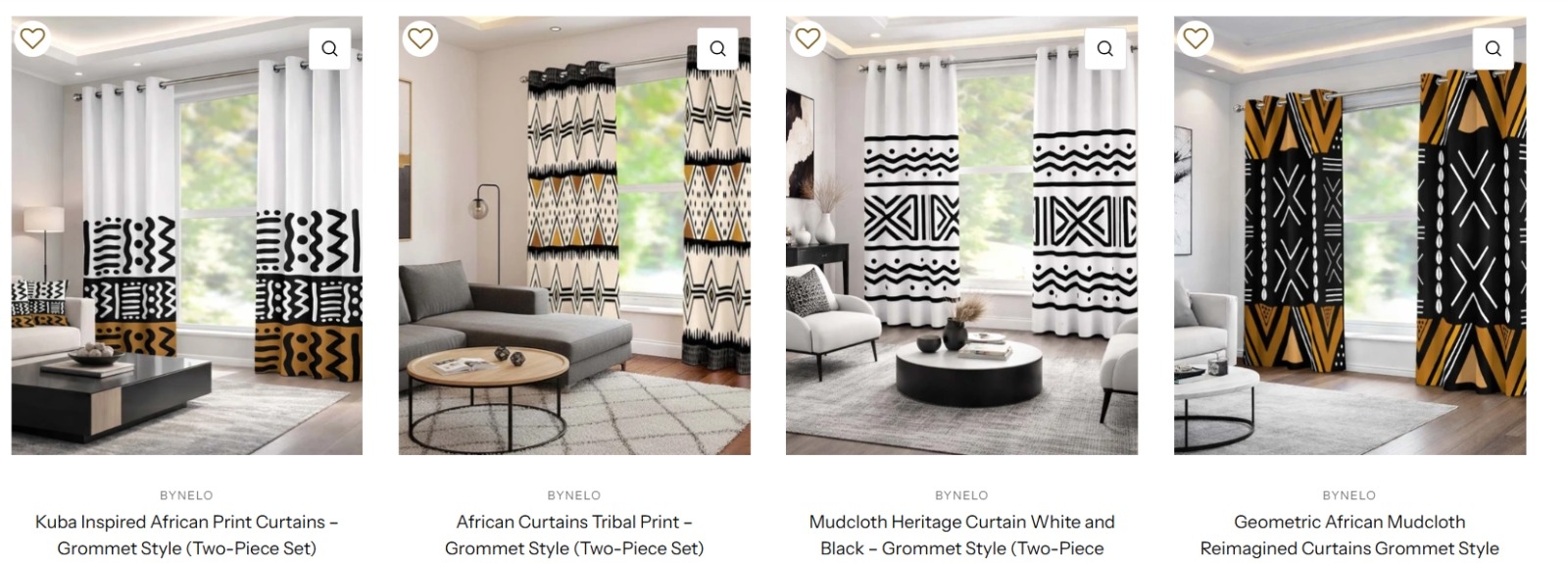
Windows occupy a large visual area, so changing the curtains can alter the character of a room surprisingly quickly.
African-inspired curtains can introduce geometric patterns, strong color, cultural references, and visual texture without requiring a complete redesign. They can work as the main statement in a neutral living room, complement an African-inspired rug, or add warmth to a bedroom with otherwise understated furnishings.
But “African curtains” is a broad category.
Some contemporary designs draw visual inspiration from traditions such as bògòlanfini, Kuba textiles or Kente. Others use modern geometric patterns or African-inspired color combinations without representing a particular historical textile tradition.
That distinction is useful when shopping. A pattern can be inspired by a tradition without being produced using that tradition's traditional materials or techniques.
The most practical way to choose is to consider five things together: pattern, room, light and privacy needs, construction, and how the curtains interact with the rest of the décor.
What Are African Curtains?
African curtains are contemporary window treatments that incorporate African-inspired patterns, colors, visual motifs, or textile influences.
They can range from highly colorful prints to monochrome geometric designs, earth-tone patterns, and mudcloth-inspired aesthetics.
The term itself does not establish where a curtain was manufactured or whether traditional African textile techniques were used.
For example, a curtain described as “mudcloth-inspired” may reference the visual appearance of bògòlanfini while using a modern printed fabric and manufacturing process.
That distinction is particularly useful for shoppers who care about cultural provenance.
Why African-Inspired Curtains Work in Modern Interiors
Strong patterns are particularly effective around windows because the curtains can act almost like large-scale artwork.
An expressive pattern can:
Add contrast to neutral walls
Introduce color without repainting
Create a visual focal point
Complement an African-inspired rug
Add depth to a minimalist room
Strengthen an Afrocentric interior theme
The trick is deciding how much visual weight you want the curtains to carry.
If the sofa, rug and artwork already contain strong patterns, a simpler curtain design may create better balance.
If the room is mostly neutral, a bold curtain can become the main decorative feature.
Understanding the Design Traditions Behind African-Inspired Curtains
African-inspired décor includes many different cultural references, so it helps to understand some of the traditions that frequently appear in contemporary designs.
Mudcloth and Bògòlanfini
Bògòlanfini is a Malian textile tradition associated with Bamana culture.
The Metropolitan Museum of Art explains that bògòlanfini is a cotton textile decorated using plant-based materials and mud, with patterns that can carry cultural meaning. The term itself translates to “mud-cloth.”
That means a contemporary mudcloth-inspired curtain should not automatically be understood as traditionally produced bògòlanfini.
This distinction allows shoppers to appreciate the design while remaining accurate about what the product actually is.
Kente-Inspired Patterns
Kente is a Ghanaian woven textile tradition. UNESCO describes Kente as a textile made from woven strips using materials including silk, cotton or rayon, with patterns and colors associated with cultural and social meanings.
A contemporary curtain using Kente-inspired colors or geometry is therefore referencing a substantial textile tradition, even when the curtain itself is manufactured using modern materials.
Kuba-Inspired Designs
Kuba textile traditions are associated with Central African communities, particularly in the Democratic Republic of the Congo.
Kuba-inspired interior designs often emphasize geometry, repetition, contrast and decorative surface patterns, making them particularly suitable for contemporary curtains where a strong visual rhythm is desired.
Popular African Curtain Styles
African Print Curtains
African print curtains can range from colorful repeating patterns to restrained monochrome designs.
They work particularly well when the surrounding furniture is relatively simple.
For a living room, the curtain print can become the main accent while neutral sofas and natural materials prevent the space from feeling overcrowded.
Bynelo's current curtain collection includes African print, tribal, mudcloth-inspired, Bogolan-inspired, and Kuba-inspired options, with grommet/eyelet construction featured throughout the collection.
Tribal-Inspired Curtains
Tribal-inspired curtain designs often use geometric shapes, repeated motifs, high contrast, and structured patterning.
The term “tribal” is broad, however. It should be treated as a style description rather than independent proof of a curtain's geographic or cultural origin.
If provenance matters, look for specific information about the maker, manufacturing location, technique, and materials.
Mudcloth-Inspired Curtains
Mudcloth-inspired curtains are particularly recognizable because of their graphic geometric patterns.
Bynelo currently offers multiple mudcloth-inspired curtain designs, including geometric interpretations described as modern reinterpretations of traditional mudcloth patterns.
These designs work well with neutral interiors because black, white, cream and earth-tone patterns can add character without relying on bright colors.
Afrocentric Curtains
An Afrocentric curtain can function as an obvious focal point in a room centered around African-inspired décor.
Bynelo's current Afrocentric Mudcloth Inspired Curtain is described as featuring a bold geometric pattern, a grommet top, and a two-piece set.
Pair a strong curtain with relatively restrained furniture when you want the window treatment to remain visually dominant.
Choosing African Curtains for the Living Room
The living room is often the easiest place to make African-inspired curtains a design feature because there is usually enough wall and window area for a large pattern.
Start by examining the room's existing palette.
Neutral living room
A colorful African print can become the main accent.
Earth-tone living room
Mudcloth-inspired or geometric designs can reinforce the warm palette.
Black-and-white interior
A monochrome African-inspired curtain can strengthen the contrast while keeping the room visually controlled.
Already-patterned room
Choose a curtain with a smaller-scale or less complicated pattern.
Bynelo currently lists dedicated options for living rooms, including two-piece grommet-style products described as African print curtains for living-room applications.
How to Choose Curtain Pattern Scale
Pattern size matters almost as much as color.
A large, high-contrast pattern can dominate a small room. A small pattern may disappear visually in a large room.
Think in terms of three levels:
Small-scale pattern: Better when other décor already has substantial visual detail.
Medium-scale pattern: Flexible for many living rooms and bedrooms.
Large-scale pattern: Useful when the curtain is intended to be the room's primary statement.
Also consider the viewing distance. A pattern that looks subtle on a product page may become much stronger when repeated across an entire pair of curtains.
Grommet vs. Eyelet Curtains
Grommet and eyelet curtains are designed with reinforced rings at the top that slide over a curtain rod.
They are popular because they provide:
Simple installation
Smooth movement
Clean horizontal folds
A contemporary appearance
Easy opening and closing
Bynelo's current curtain collection is specifically organized around grommet/eyelet styles and currently lists numerous two-piece curtain products using this construction.
Before ordering, measure the window and consider the diameter of the existing curtain rod to ensure compatibility.
How to Choose African Curtains by Room
Living Room
Prioritize visual impact, pattern scale, and coordination with sofas, rugs, and wall décor.
If the curtains are heavily patterned, allow some surrounding surfaces to remain relatively quiet.
Bedroom
Bedrooms often benefit from warmer, calmer patterns.
Earth tones, muted geometry and darker designs can complement wooden furniture and neutral bedding.
For stronger light control, check the exact product description for any blackout, shading or light-filtering specifications instead of assuming that a patterned curtain provides the same degree of coverage as a dedicated blackout product.
Home Office
Patterned curtains can make an office feel more residential and less sterile.
Avoid designs that visually compete with multiple shelves, artwork or heavily patterned furniture.
Dining Area
Curtains can connect the dining area to a larger open-plan living space.
Use colors that relate to nearby furniture or rugs, but do not feel obligated to match every item.
How to Coordinate African Curtains With an African Rug
A rug and curtains naturally occupy two major visual areas, so pairing them thoughtfully can make a room feel deliberately designed.
The first rule is simple:
Do not assume matching prints are necessary.
Instead, use one or more of these connections:
Repeat a color
A curtain can repeat one secondary color from the rug.
Repeat the geometry
A diamond, stripe, or abstract geometric element can appear in both pieces without being identical.
Change pattern scale
A large rug pattern can be paired with a smaller curtain pattern.
Use one focal point
When both textiles are bold, decide which one should attract attention first.
Using African Curtains With Different Rug Styles
Bold Geometric Rug + Simple Curtain
This combination lets the rug lead.
Use neutral walls, furniture, and accessories to maintain visual breathing room.
Neutral Rug + Colorful Curtain
This gives the windows more prominence.
It can be particularly effective when the walls and furniture are neutral.
Mudcloth-Inspired Rug + Mudcloth Curtain
This can create a cohesive visual language, but avoid using two identical high-density patterns across the room.
Round Rug + Patterned Curtain
A round rug already introduces a strong shape, so the curtain can provide a complementary pattern without repeating the circle.
Where African Curtains Fit Into a Broader Interior
African-inspired décor does not have to mean creating a heavily themed room.
One of the most versatile approaches is to combine:
One or two statement textiles
Neutral furniture
Natural wood
Woven materials
Simple artwork
Greenery
Restrained accessories
This allows the pattern to remain visible without making every surface compete for attention.
For shoppers looking specifically for coordinated window treatments, Bynelo's current collection includes a wide selection of patterned grommet curtains rather than limiting the range to one design language.
Choosing Between African Design Curtains
When comparing different African design curtains, evaluate more than the print.
Look at:
Pattern density: How much of the curtain surface is covered by the design?
Contrast: Is the difference between colors subtle or dramatic?
Scale: Will the repeated pattern suit your window size?
Material: Does the fabric specification suit how you intend to use the curtains?
Hanging style: Will the grommet or eyelet construction work with your existing rod?
Those practical questions help narrow the selection far more effectively than color alone.
African Curtains Designs for Different Décor Moods
The variety of African curtains designs makes it possible to create very different interiors from the same broad theme.
Modern minimalist
Choose restrained geometric patterns with a controlled palette.
Warm and earthy
Look for brown, cream, tan, and muted geometric combinations.
Bold and colorful
Use a stronger print against neutral walls and furniture.
Afrocentric statement room
Layer coordinated African-inspired textiles while keeping larger furniture pieces relatively simple.
Contemporary monochrome
Black-and-white patterns can create visual structure without introducing multiple colors.
African-Inspired Curtains and Window Privacy
Curtains can serve both decorative and practical functions.
Before purchasing, determine whether you primarily need:
Decorative framing
Light filtering
Privacy
Shading
More substantial room darkening
Do not infer performance from the pattern or product title.
Check the product specifications for the actual fabric and light-control information.
For example, Bynelo product listings include curtains described with shading or UV-resistant properties, while individual products may have different specifications.
How to Measure for African Curtains
Accurate measurements prevent one of the most common curtain-shopping problems: ordering panels that look too narrow or too short for the window.
Measure:
Window width
Measure the window or curtain-rod area according to your desired coverage.
Curtain length
Decide where the curtain should end:
At the sill
Below the sill
Near the floor
At or just above the floor
Rod position
Measure from the rod location rather than simply measuring the glass area.
Fullness
Remember that curtains generally need more fabric than the exact width of the window to create folds when closed.
Always compare your measurements against the dimensions of the specific product rather than assuming all curtain sets have identical sizing.
How to Style Mudcloth Curtains
A mudcloth-inspired curtain can be surprisingly flexible.
For a neutral room, pair it with:
Beige or cream furniture
Natural wood
Woven baskets
Linen cushions
Green plants
Warm lighting
For a darker interior, use lighter walls or natural textures to keep the pattern visible.
The Metropolitan Museum of Art's documentation of bògòlanfini provides useful cultural context for the mudcloth visual language while also demonstrating why contemporary interpretations should not automatically be described as traditional textiles.
African Curtains vs. Traditional Textile Curtains
These terms are not interchangeable.
African-inspired curtains generally describe contemporary décor influenced by African aesthetics.
Traditional textile curtains might incorporate an actual textile tradition or traditional fabric, but the specific claim needs to be documented.
Mudcloth-inspired curtains reference a recognizable visual tradition without necessarily reproducing its traditional manufacturing process.
This distinction makes product descriptions easier to interpret and helps shoppers make more informed purchases.
A Practical African Curtain Buying Framework
Use this six-step check before ordering.
Step | Question |
1. Room | Where will the curtains be installed? |
2. Pattern | How strong should the visual statement be? |
3. Color | Which colors already exist in the room? |
4. Light | Do you need decoration, privacy, shading or stronger light control? |
5. Size | Do the product dimensions fit your window and preferred length? |
6. Construction | Is the hanging style compatible with your curtain rod? |
Then make one final check:
Does the cultural description accurately tell you what the product is?
That question is particularly helpful with mudcloth, tribal, Kente-inspired and other culturally referenced designs.
Bynelo's African Curtain Collection
Bynelo's current African curtains collection is centered on grommet/eyelet curtain styles and currently lists 63 products. The collection includes African tribal print, mudcloth heritage, geometric mudcloth, Bogolan-inspired, Kuba-inspired, and African print designs.
For buyers searching specifically for mudcloth curtain styles, the collection includes multiple contemporary interpretations of the geometric mudcloth aesthetic. Individual product pages identify materials and construction, allowing shoppers to compare specifications rather than judging the products solely by appearance.
Those searching for mud cloth curtains can also compare different monochrome and colorful interpretations within the same collection.
For a specific product rather than a collection, afrocentric curtains are represented by Bynelo's Afrocentric Mudcloth Inspired Curtain, which the product information describes as a two-piece grommet-style design with a bold geometric pattern.
Shoppers interested in broader african inspired curtains can compare several pattern families without committing to one particular textile reference.
For living-room windows, African print curtains for living room provide another route into the collection, especially when curtains are intended to become a noticeable part of the room's color scheme.
How to Create a Cohesive African-Inspired Room
The simplest formula is:
One dominant pattern + one supporting pattern + neutral space.
For example:
A bold African-inspired rug can be the dominant element, while curtains use a smaller geometric pattern.
Or the curtains can become the main statement while the rug uses a quieter design.
Add natural textures such as wood, linen, woven materials, or rattan, then repeat small amounts of the textile colors elsewhere.
This gives the room a connection without making it feel like every surface was purchased as a matching set.
Common Mistakes When Buying African Curtains
Choosing a Pattern Without Considering the Room
A pattern that looks excellent on a product page can become overwhelming when repeated across a large window.
Ignoring Window Measurements
Always compare the product dimensions with your actual window and preferred finished length.
Assuming “Blackout” Means the Same Thing Everywhere
Check the product's actual specifications rather than relying only on the product title.
Matching the Rug and Curtains Exactly
Similar colors and related geometry usually create a more flexible design than identical prints.
Assuming a Cultural Name Proves Provenance
A term such as “mudcloth,” “tribal,” or “Kente-inspired” should be interpreted according to the specific product description.
Buying Without Checking the Hanging Style
Grommet/eyelet curtains require a compatible rod and should be measured accordingly.
FAQ
What are African curtains?
African curtains are window treatments featuring African-inspired colors, patterns, motifs or references to African textile traditions. They can range from colorful African print designs to geometric, tribal-inspired, mudcloth-inspired and contemporary patterns.
How do I choose African curtains for a living room?
Start with the existing furniture and color palette. If the room is neutral, a bold patterned curtain can create a focal point. If the room already contains strong patterns, a more restrained African-inspired design may create better visual balance.
What are mudcloth curtains?
Mudcloth curtains are generally curtains featuring patterns inspired by bògòlanfini, a Malian textile tradition associated with Bamana culture. A modern mudcloth-inspired curtain may use contemporary printed fabric rather than being produced using traditional bògòlanfini techniques.
Are African curtains suitable for modern homes?
Yes. Geometric, monochrome, earth-tone, and contemporary African-inspired patterns can work with modern furniture, minimalist interiors, and neutral color palettes. The key is managing pattern scale and visual hierarchy.
What is the difference between grommet and eyelet curtains?
Grommet and eyelet curtains use reinforced rings at the top of the panel so the curtains can slide along a compatible rod. They create a relatively clean, contemporary appearance and are commonly used for easy installation.
Can I pair African curtains with an African rug?
Yes. Pair them through related color, geometry or pattern scale rather than requiring identical prints. One textile can provide the dominant visual statement while the other works as a supporting element.
Are African print curtains only for living rooms?
No. African print curtains can also work in bedrooms, offices, dining areas, and other interior spaces. The appropriate pattern, scale, and light-control characteristics depend on the room.
How do I choose the right curtain size?
Measure the window or curtain-rod area, determine your desired finished length, then compare those measurements with the exact product dimensions. Also consider how much fabric is needed to create the desired fullness.
Are mudcloth-inspired curtains authentic mudcloth?
Not necessarily. Traditional bògòlanfini has a particular Malian cultural and manufacturing history. A contemporary product described as mudcloth-inspired may simply reference its visual characteristics.
How can I style Afrocentric curtains without making a room too busy?
Use the curtains as one major patterned element and keep larger furniture pieces relatively simple. Natural wood, neutral upholstery, solid-color cushions and restrained accessories can provide enough visual space around a strong curtain pattern.
What should I check before buying African curtains online?
Check the dimensions, fabric, hanging style, number of panels, light-control information, care instructions and intended use. Also read cultural or style descriptions carefully when the design references a specific textile tradition.