
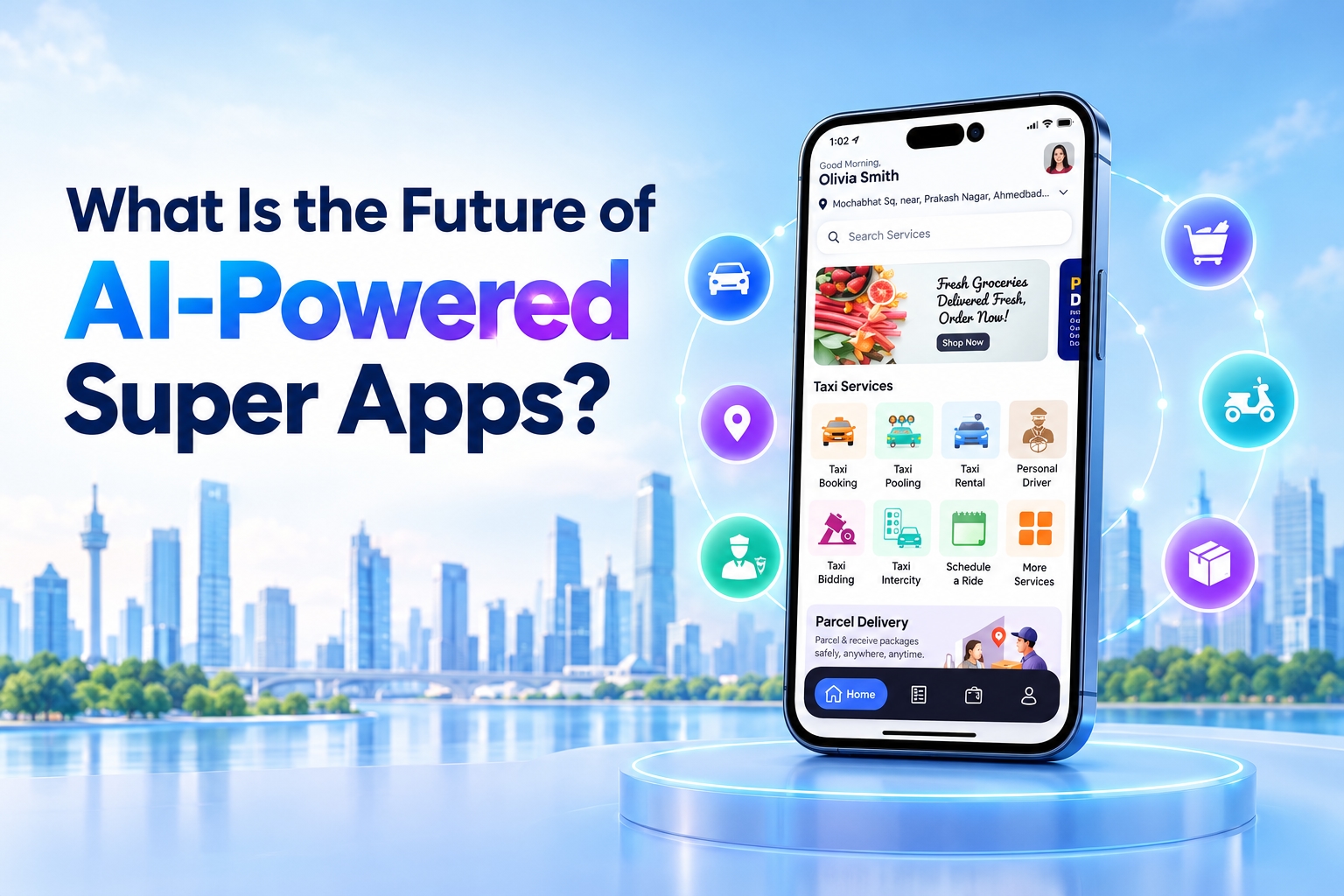
The way people use digital services is changing. Booking a taxi, ordering food, sending a package, paying bills, and shopping for daily essentials once required separate applications or websites. Today, users increasingly expect connected digital platforms that make these activities easier to manage from one place.
Super apps have emerged as one approach to meeting this expectation. By combining multiple services within a single application, they offer a convenient way to access digital services while creating opportunities for businesses to reach customers across different service categories.
Artificial intelligence is adding another dimension to this model. Instead of simply connecting services, AI-powered super apps can analyze relevant data, personalize recommendations, automate routine activities, and help businesses respond to changing customer needs.
As AI technologies continue to develop, the future of super apps will depend on how effectively these capabilities solve real problems. The most successful platforms will not necessarily be those with the largest number of features, but those that make everyday interactions simpler, safer, and more useful.
Understanding AI-Powered Super Apps
A super app is a digital platform that combines multiple services within one application. Depending on its business model, it may include ride-hailing, food delivery, grocery shopping, digital payments, courier services, appointment booking, and other on-demand offerings.
An AI-powered super app incorporates artificial intelligence into different parts of this ecosystem. These technologies can help the platform understand user preferences, recommend relevant services, predict demand, and improve operational workflows.
For example, a conventional application may allow users to book a ride by entering their destination and selecting a vehicle. An AI-enabled platform could make the process more convenient by suggesting frequently visited destinations, estimating demand patterns, or helping optimize driver allocation.
Similarly, an integrated delivery platform might use predictive analytics to anticipate busy periods and help businesses prepare their resources accordingly.
The growing interest in the Gojek-style super app platform model reflects the broader demand for applications that bring different everyday services together. AI can extend this model by making those services more responsive to individual needs and operational conditions.
Why AI Is Becoming Important for Super Apps
Managing multiple services within one application creates operational complexity. Businesses must coordinate customer requests, service providers, payments, deliveries, customer support, and performance monitoring across different categories.
Without appropriate systems, expanding into additional services can increase operational costs and create inconsistent customer experiences.
AI can help address these challenges in several ways.
First, it can analyze large volumes of operational data more efficiently than manual processes. Second, it can automate repetitive activities, allowing employees to focus on complex decisions and customer needs. Third, it can identify patterns that help businesses make better-informed decisions.
For customers, these improvements may translate into more relevant recommendations, faster support, and smoother transactions. For businesses, they can support better resource planning and more informed service management.
However, AI is not an automatic solution to every operational problem. Its effectiveness depends on data quality, system integration, appropriate implementation, and ongoing monitoring.
Key Trends Shaping the Future of AI-Powered Super Apps
1. More Personalized User Experiences
Personalization is likely to remain one of the most visible applications of AI in super apps.
Traditional applications often present similar options to every user. AI-powered systems can use relevant activity patterns and preferences to make recommendations more useful.
For instance, someone who regularly books rides to work may benefit from quick access to frequently used destinations. A customer who orders groceries every weekend could receive convenient reorder suggestions based on previous purchases.
In the future, super apps may become better at adjusting their interfaces to reflect individual needs and usage patterns. Instead of requiring users to search through every service category, platforms could highlight the features most relevant to them.
Personalization must nevertheless be handled carefully. Users should have appropriate control over their data and the recommendations they receive. Excessive notifications or overly specific suggestions can make an application feel intrusive rather than helpful.
The real opportunity lies in reducing unnecessary steps while preserving user choice.
2. Conversational AI and Intelligent Assistants
Conversational AI is changing how people interact with digital platforms. Rather than navigating several menus, users can increasingly communicate their needs through natural language.
Imagine a customer asking a super app to arrange a ride to the airport, order groceries for the evening, or check the status of a parcel. An intelligent assistant could interpret the request, identify the relevant service, and guide the user through the required steps.
As these systems improve, they may also handle more complex requests involving multiple services. For example, a user could ask for help planning a short trip and receive suggestions for transportation, accommodation-related services, and local activities, depending on what the platform offers.
However, conversational interfaces must provide clear confirmations before completing important transactions. Users should be able to review prices, destinations, delivery addresses, and payment details before an action is finalized.
Human support will also remain important for complaints, unusual requests, and situations requiring judgment or empathy.
3. Predictive Analytics for Better Service Management
Predictive analytics can help super app operators anticipate demand instead of responding only after activity increases.
In ride-hailing, historical trip data, time of day, location patterns, and relevant external factors may help estimate where demand is likely to rise. Operators can use these estimates to inform driver allocation and service availability.
In food and grocery delivery, demand forecasts can help businesses prepare inventory, manage staffing, and plan delivery capacity.
Courier platforms may use historical shipment patterns to anticipate busy periods and improve resource planning.
These predictions are not always accurate. Unexpected events, changing customer behavior, inaccurate data, and local disruptions can affect results. Nevertheless, forecasting can provide useful decision-making support when combined with operational experience and real-time information.
As super apps expand, predictive capabilities could help businesses coordinate resources across several service categories rather than treating each operation as a separate activity.
4. Smarter Automation Across Multiple Services
Automation is another area where AI could significantly influence super app development.
Many digital platforms rely on repetitive processes, including categorizing support requests, verifying information, identifying transaction anomalies, and updating order statuses. AI can assist with selected tasks and reduce the need for manual intervention.
For example, an AI-powered support system could answer routine questions about delivery progress or explain how to update a booking. More complicated cases could be transferred to a human representative with relevant information already available.
Businesses considering this approach can explore multi-service app development as part of a broader strategy for bringing ride-hailing, delivery, and other on-demand services into one application. The platform architecture should support reliable communication between services before advanced automation is introduced.
The objective should not be to automate every interaction. Businesses need clear rules defining which tasks can be handled automatically and which require human approval.
5. AI-Powered Fraud Detection and Security
As super apps handle more transactions and customer information, security becomes increasingly important.
AI-based systems can help identify unusual transaction patterns, suspicious account activity, and behavior that differs significantly from established patterns. These signals can support fraud prevention and help security teams prioritize investigations.
For example, a digital payment system might flag an unusual transaction for additional verification. A platform could also monitor account activity to identify possible attempts at unauthorized access.
However, unusual behavior does not necessarily indicate fraud. Poorly designed systems may incorrectly flag legitimate customers, causing frustration and unnecessary restrictions.
Businesses must therefore combine automated detection with appropriate verification procedures, human review where necessary, and clear processes for resolving mistakes.
Data protection, secure authentication, access controls, and compliance with applicable regulations will remain essential regardless of how advanced the AI capabilities become.
6. Integration of Payments and Financial Services
Payments are an important part of many super app ecosystems. When customers use the same platform for rides, food delivery, shopping, and other services, convenient payment options can create a more consistent experience.
AI may help improve transaction monitoring, identify unusual spending patterns, and support customer service related to payment activity. Depending on the platform and applicable regulations, intelligent systems may also assist with personalized financial insights.
For example, a platform could help users review their transaction history or identify recurring expenses. Any such functionality should be transparent and based on appropriate user permissions.
Financial services introduce additional responsibilities involving privacy, security, consumer protection, and regulatory compliance. Businesses should not treat AI-generated financial suggestions as automatically reliable.
Future super apps will need to balance convenience with safeguards that protect users and maintain trust.
7. Connected Ride-Hailing and Delivery Experiences
Transportation and delivery services demonstrate how AI can create value across related business operations.
A ride-hailing platform can use demand estimates to help drivers position themselves more effectively. A delivery service can use order information and traffic conditions to support route planning. When these services operate within a larger ecosystem, businesses can apply similar analytical capabilities across multiple operations.
The integrated ride-hailing and delivery platform model is relevant to this discussion because it illustrates the broader category of digital platforms that connect transportation and on-demand services. AI features can help such platforms improve dispatching, estimate service demand, and support operational decisions, provided the underlying data and systems are reliable.
These capabilities do not guarantee shorter delivery times or lower costs in every situation. Their effectiveness depends on local conditions, the quality of operational data, and how well the technology is implemented.
The long-term opportunity lies in coordinating services more intelligently while keeping the customer experience straightforward.
How Businesses Can Prepare for the Next Generation of Super Apps
Businesses planning to enter the super app market should approach AI adoption as a long-term strategy rather than a collection of isolated features.
Start with a clear business model. Identify the customer groups the platform will serve and determine which services address their most important needs.
Build a dependable core application. Ensure that account management, bookings, payments, service-provider operations, and administrative tools function reliably before adding complex AI features.
Prioritize practical use cases. Begin with capabilities such as support automation, service recommendations, or demand forecasting when they address measurable problems.
Establish strong data practices. Organize data responsibly, protect sensitive information, and ensure that systems collect only what is necessary for their intended functions.
Measure performance continuously. Track relevant indicators such as booking completion rates, response times, service reliability, customer satisfaction, and operational efficiency.
Expand in stages. Test new features with appropriate users, evaluate the results, and improve the implementation before expanding it across the platform.
Businesses evaluating different development approaches may also examine a Gojek-inspired app solution when researching how multiple on-demand services can be organized within a unified mobile experience. The appropriate approach will depend on the intended market, required integrations, operational needs, and long-term product strategy.
Challenges Businesses Must Consider
Although AI offers several opportunities, adopting it within a super app also creates technical and operational challenges.
Data Privacy and Responsible Usage
AI systems often depend on data to generate recommendations and predictions. Businesses must determine what information they genuinely need, how it will be used, and how it will be protected.
Clear privacy policies, appropriate consent mechanisms, limited data access, and secure storage are important parts of responsible implementation.
Integration With Existing Systems
Adding AI to an established application may require integration with booking systems, payment gateways, customer relationship management tools, and third-party service providers.
Poor integration can produce inconsistent information or disrupt existing workflows. Businesses should assess their technical architecture before introducing new capabilities.
Implementation and Maintenance Costs
AI implementation involves more than the initial development effort. Data preparation, infrastructure, testing, monitoring, model updates, and security reviews can create ongoing expenses.
Businesses should prioritize features according to their expected value rather than adopting AI simply because it is becoming popular.
Accuracy and Human Oversight
AI-generated recommendations and predictions can be wrong. Automated systems may misunderstand requests, produce unreliable answers, or perform poorly when customer behavior changes.
Testing, performance monitoring, fallback processes, and human oversight are necessary to maintain dependable service.
User Trust and Adoption
Customers may hesitate to use features that appear confusing, intrusive, or difficult to control.
Businesses should explain how important AI-powered functions work, offer alternatives when appropriate, and make it easy for users to correct errors or contact support.
What Will AI-Powered Super Apps Look Like in the Future?
The future of AI-powered super apps will likely involve deeper integration between services, more intuitive interfaces, and greater use of data to support decision-making.
Users may increasingly interact with platforms through conversational assistants, personalized dashboards, and simplified workflows. Businesses may use predictive systems to coordinate service providers, anticipate demand, and identify operational issues earlier.
Another important development could be the gradual movement from recommendation-based systems toward more capable AI agents. These systems may eventually help users complete multi-step tasks across connected services, subject to the permissions and safeguards established by the platform.
However, widespread adoption will depend on reliability, user acceptance, cost, regulation, and the practical value these systems deliver. Not every service needs sophisticated AI, and not every business will benefit from the same capabilities.
Successful platforms will be those that combine useful technology with dependable operations, straightforward design, and responsible data management.
Conclusion
AI is creating new possibilities for super apps by making digital platforms more adaptable, personalized, and operationally efficient. From conversational assistants and predictive analytics to automated support and fraud detection, these technologies can improve how users access services and how businesses manage complex operations.
At the same time, AI introduces challenges involving data privacy, integration, cost, accuracy, and user trust. These concerns must be addressed alongside innovation rather than after implementation.
For businesses considering the next generation of multi-service platforms, the priority should be to build a strong foundation, identify meaningful opportunities for AI, and introduce capabilities gradually.
The future of AI-powered super apps will not be defined simply by how many services or intelligent features a platform contains. It will depend on how effectively those services work together to solve everyday problems and deliver value to users.
Frequently Asked Questions
1. What is an AI-powered super app?
An AI-powered super app is a digital platform that combines multiple services in one application and uses artificial intelligence to improve personalization, automation, recommendations, and operational decision-making.
2. How does AI improve super apps?
AI can help super apps recommend relevant services, forecast demand, automate routine customer support, detect suspicious transactions, and support more efficient resource allocation.
3. Which industries can benefit from AI-powered super apps?
Industries such as transportation, food delivery, grocery retail, courier services, digital payments, and other on-demand sectors can benefit from AI-enabled multi-service platforms.
4. What challenges are associated with AI-powered super apps?
Common challenges include data privacy, integration complexity, implementation costs, inaccurate predictions, security risks, and the need for human oversight.
5. Will AI replace human involvement in super apps?
AI can automate certain repetitive tasks and assist with decision-making, but human involvement remains important for complex customer issues, sensitive decisions, exceptions, and accountability.