Market Overview:
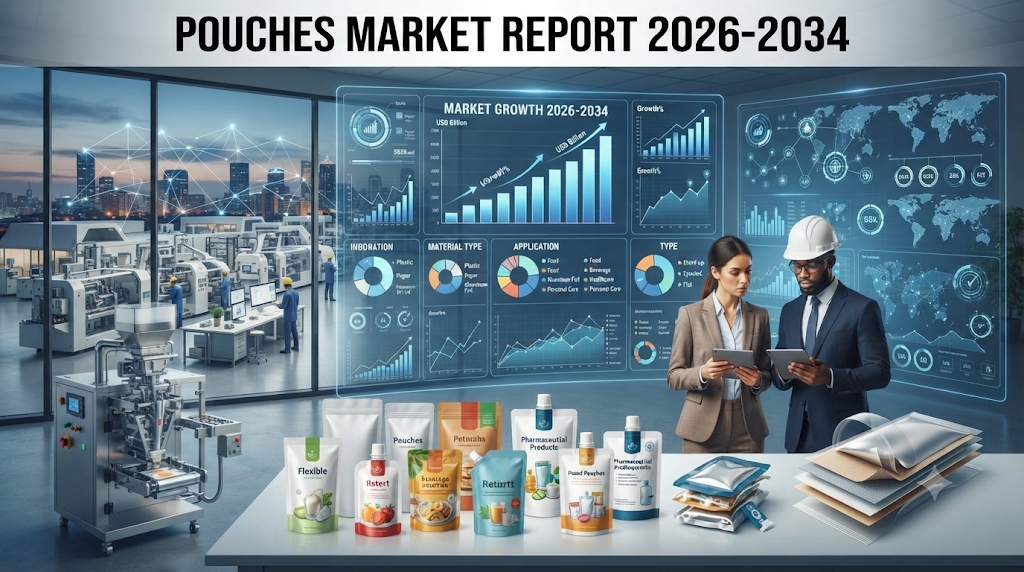
According to IMARC Group's latest research publication, "Pouches Market: Global Industry Trends, Share, Size, Growth, Opportunity and Forecast 2026-2034", The global pouches market size reached USD 57.1 Billion in 2025. Looking forward, IMARC Group expects the market to reach USD 84.8 Billion by 2034, exhibiting a growth rate (CAGR) of 4.35% during 2026-2034.
This detailed analysis primarily encompasses industry size, business trends, market share, key growth factors, and regional forecasts. The report offers a comprehensive overview and integrates research findings, market assessments, and data from different sources. It also includes pivotal market dynamics like drivers and challenges, while also highlighting growth opportunities, financial insights, technological improvements, emerging trends, and innovations. Besides this, the report provides regional market evaluation, along with a competitive landscape analysis.
How AI is Reshaping the Future of the Pouches Market
AI-powered demand forecasting allows pouch manufacturers to optimize raw material procurement and production scheduling, reducing material waste by up to 12% across flexible packaging supply chains.
Smart packaging integrated with AI-enabled QR codes and NFC sensors allows brands to track product authenticity and shelf conditions in real time, with over 30% of leading pouch brands piloting such solutions in food and pharmaceutical segments.
AI-driven digital printing platforms enable hyper-personalized pouch designs at scale, cutting design-to-print timelines by approximately 40% and reducing minimum order quantities, opening the market to smaller consumer brands.
Machine learning algorithms applied in barrier film development are helping manufacturers reduce the number of laminate layers in multi-layer pouches while maintaining equivalent protection, contributing to lighter, more recyclable packaging formats.
AI-based visual inspection systems are being deployed on pouch manufacturing lines to detect seal defects and material inconsistencies, improving quality control pass rates by as much as 25% compared to manual inspection methods.
Download a sample PDF of this report: https://www.imarcgroup.com/pouches-market/requestsample
Key Trends in the Pouches Market
Rising Demand for Sustainable and Recyclable Packaging: Environmental concerns are significantly reshaping purchasing decisions, with an estimated 38% of global consumers prioritizing eco-friendly packaging. Pouches consume up to 60% less material than rigid packaging alternatives like glass bottles and plastic containers, resulting in lower transportation energy and a smaller carbon footprint. Recyclable mono-material pouches and compostable bioplastic variants are increasingly gaining shelf space as brands seek to align with both regulatory mandates and consumer expectations around sustainable packaging.
E-Commerce Growth Accelerating Pouch Adoption: The global shift toward online shopping has fundamentally altered packaging requirements. Pouches are lightweight, reduce volumetric weight during shipping, and can incorporate tamper-evident seals and easy-open features that protect product integrity during last-mile delivery. Stand-up pouches with resealable zippers have become a preferred format for e-commerce packaging in categories ranging from pet food and snacks to personal care items, as they provide both visual appeal and functional convenience for repeat use.
Expansion of Flexible Packaging in the Healthcare Sector: Pouches play a critical role in packaging sterile medical instruments, pharmaceutical products, and IV fluids. Aseptic pouches used in healthcare environments ensure contamination-free storage of saline solutions and liquid medications, while retort pouches are widely adopted for ready-to-eat clinical nutrition products. The growing global pharmaceutical industry, particularly in emerging markets across Asia Pacific and Latin America, is directly amplifying demand for specialized medical-grade pouches.
Spout Pouches Leading Liquid Packaging Innovation: Spout closures dominate the closure type segment and have transformed on-the-go consumption across beverage, sauce, baby food, and sports nutrition categories. Their controlled dispensing mechanism reduces spillage and product waste, making them the preferred format for liquid-format brands targeting convenience-driven demographics. Consumer goods companies across Asia Pacific and North America have been particularly aggressive in adopting spout pouches as a primary packaging format for single-serve and multi-serve products.
Urbanization and Changing Consumer Lifestyles Fueling Convenience Packaging: Rapid urbanization, longer commuting times, and dual-income households are intensifying demand for portable, resealable, and lightweight packaging solutions. The Worker Population Ratio for women aged 15 years and above in India rose from 22.0% in 2017-18 to 40.3% in 2023-24, reflecting broader lifestyle shifts across emerging markets that increase reliance on convenient packaged food and personal care products, all of which rely heavily on pouch formats for packaging.
Growth Factors in the Pouches Market
Increasing Sales of Packaged Food and Beverages: Packaged food demand is rising sharply due to rapid urbanization and expanding disposable incomes in emerging economies. Pouches are used extensively to package sauces, mayonnaise, fruit purees, juices, and milk, offering superior protection from light, air, and contamination. Brazil's household disposable income accumulated over 12 months stood at USD 1.71 Trillion, reflecting strong consumer spending power in one of the largest Latin American markets for packaged goods.
Rising Utilization in Pharmaceutical and Medical Packaging: The pharmaceutical sector's requirement for sterile, tamper-proof, and durable packaging is a consistent demand driver for medical-grade pouches. Retort and aseptic pouches help minimize the risk of surgical site infections and cross-contamination in healthcare settings. As healthcare infrastructure expands across Asia Pacific, the Middle East, and Africa, the need for safe and compliant pouch-based packaging for medicines, IV fluids, and surgical instruments continues to grow.
Weight Reduction and Logistics Cost Optimization: Flexible pouches weigh significantly less than glass or rigid plastic containers, providing direct cost savings in transportation and warehousing. For large-volume consumer goods manufacturers, switching from rigid packaging to pouches can reduce overall packaging weight by up to 70%, lowering logistics costs and improving sustainability metrics simultaneously. This economic benefit is particularly compelling for multinational brands operating complex, cost-sensitive global supply chains.
Growth of the Homecare and Personal Care Segments: Rising adoption of pouches for packaging soaps, detergents, shampoos, and fabric softeners is adding a significant new demand layer beyond food and pharmaceuticals. Pouches in the homecare segment offer secured storage and spill-proof transportation, making them suitable for both retail and bulk institutional sales. The personal care and cosmetics segment is additionally leveraging stand-up pouches with premium printing finishes and spout closures to elevate brand visibility on retail shelves.
Asia Pacific Leading Global Demand Through Industrial and Consumer Growth: Asia Pacific holds the largest share of the global pouches market, driven by growth in the food and beverage, pharmaceutical, cosmetics, and personal care industries across China, India, Japan, South Korea, and Indonesia. The region's growing preference for portion-controlled packaging, combined with the rapid expansion of organized retail and e-commerce platforms, is creating sustained structural demand for a broad range of pouch types and closure formats.
Get Instant Access to the Full Report with a Special Discount!
Leading Companies Operating in the Global Pouches Industry:
Amcor plc
Constantia Flexibles
Coveris
Goglio SpA
Guala Pack S.p.a.
Huhtamaki Oyj
Korozo
Mondi Plc
Proampac
Sealed Air
Smurfit Kappa Group Plc
Sonoco Products Company
Wipf Holding AG
Pouches Market Report Segmentation:
Breakup by Material:
Plastic
Metal
Paper
Bioplastics
Plastic accounts for the largest material segment due to its flexibility, durability, water resistance, and wide compatibility with food, liquid, and personal care applications.
Breakup by Treatment Type:
Standard
Aseptic
Retort
Hot-fill
Standard treatment holds the largest share as it covers the broadest range of non-perishable applications including dry goods, snacks, and general consumer products that do not require extreme preservation or thermal processing.
Breakup by Product:
Flat
Stand-up
Flat pouches dominate the product segment, favored for their space efficiency, lightweight form, and suitability for single-serve and thin-profile products such as snacks, powders, and condiments.
Breakup by Closure Type:
Tear Notch
Zipper
Spout
Spout closures hold the largest share, driven by their widespread use in liquid packaging applications including juices, sauces, baby food, and sports nutrition, where controlled dispensing and spill prevention are critical.
Breakup by End Use:
Food and Beverages
Healthcare
Personal Care and Cosmetics
Homecare
Others
Food and beverages represent the dominant end use segment, as pouches are extensively used for packaging snacks, condiments, dried fruits, ready-to-eat meals, and liquid foods across global retail and foodservice channels.
Breakup by Region:
North America (United States, Canada)
Asia Pacific (China, Japan, India, South Korea, Australia, Indonesia, Others)
Europe (Germany, France, United Kingdom, Italy, Spain, Russia, Others)
Latin America (Brazil, Mexico, Others)
Middle East and Africa
Asia Pacific holds the largest regional market share, driven by increasing utilization of pouches in the food and beverage, pharmaceutical, cosmetics, and personal care industries, rising portion-control preferences, and rapid expansion of e-commerce and organized retail across the region.
Recent News and Developments in the Pouches Market
January 2026: PPC Flex announced the acquisition of SÜDPACK's U.S. operations, strengthening its flexible packaging capabilities and expanding its pouch manufacturing footprint across the North American market.
December 2025: ProAmpac announced an agreement to acquire TC Transcontinental Packaging from TC Transcontinental, a move aimed at expanding the company's global reach in sustainable flexible packaging solutions and advanced material science capabilities.
July 2025: Amcor partnered with Mediacor to launch a 2-liter stand-up pouch specifically designed for the home care segment, introducing a large-format, resealable flexible packaging solution for liquid detergents and household cleaning products.
Note: If you require specific details, data, or insights that are not currently included in the scope of this report, we are happy to accommodate your request. As part of our customization service, we will gather and provide the additional information you need, tailored to your specific requirements. Please let us know your exact needs, and we will ensure the report is updated accordingly to meet your expectations.
About Us:
IMARC Group is a global management consulting firm that helps the world's most ambitious changemakers to create a lasting impact. The company provides a comprehensive suite of market entry and expansion services. IMARC offerings include thorough market assessment, feasibility studies, company incorporation assistance, factory setup support, regulatory approvals and licensing navigation, branding, marketing and sales strategies, competitive landscape and benchmarking analyses, pricing and cost research, and procurement research.
Contact Us:
IMARC Group
134 N 4th St. Brooklyn, NY 11249, USA
Email: sales@imarcgroup.com
Tel No: (D) +91 120 433 0800
United States: +1-201-971-6302