How to Maintain Dental Instruments
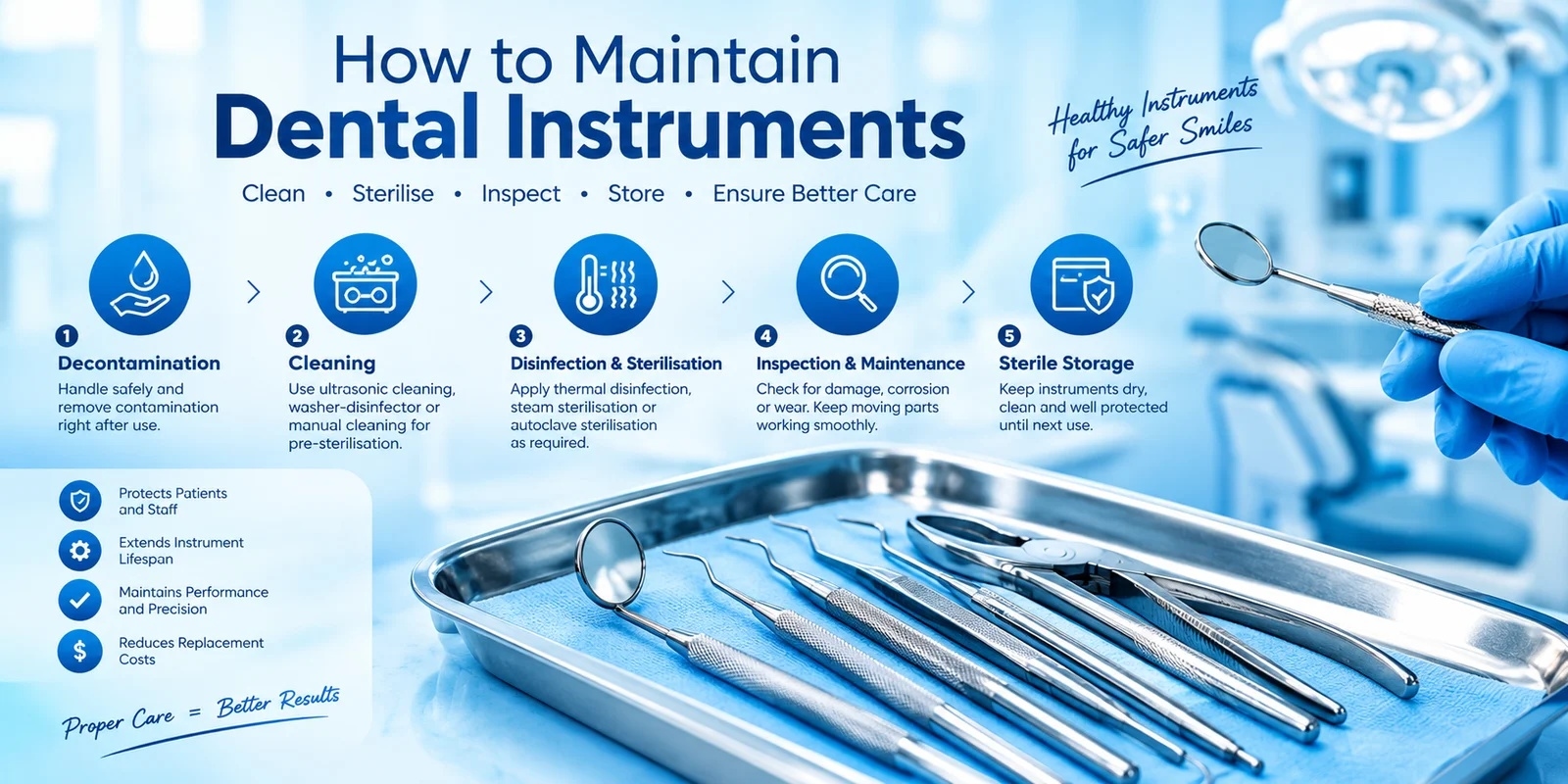
Introduction
Dental instruments are essential to almost every clinical procedure, from routine examinations and cleanings to extractions, restorative treatments, and oral surgery. These instruments are designed for precision, but even high-quality instruments can lose their performance, appearance, and service life if they are not cleaned, reprocessed, inspected, and stored correctly.
Proper instrument care is about much more than simply washing instruments after use. Effective dental instrument reprocessing involves a systematic process that includes cleaning, instrument decontamination, disinfection or sterilisation where required, inspection, maintenance, and appropriate storage. Each stage helps protect patients and dental professionals while preserving the condition and functionality of the instruments.
For dental practices, good maintenance can also reduce unnecessary replacement costs. An instrument that is cleaned correctly, inspected regularly, and handled according to the manufacturer’s instructions is less likely to develop corrosion, staining, stiffness, or mechanical problems.
Whether you are managing a busy dental practice, purchasing instruments for a clinic, or responsible for infection prevention and control, understanding how to maintain dental instruments properly is an important part of quality dental care.
Start With Proper Dental Instrument Reprocessing
The first step in maintaining dental instruments is establishing a consistent dental instrument reprocessing workflow. Instruments should not simply be cleaned whenever someone has time. Reprocessing should follow a defined procedure based on the instrument manufacturer’s instructions and the dental practice’s infection-control requirements.
After an instrument has been used, it should be handled carefully to prevent contamination and avoid unnecessary damage. Used instruments should be transported to the designated reprocessing area using appropriate procedures.
Instrument decontamination
Instrument decontamination is an important part of the reprocessing process. Its purpose is to reduce contamination and make instruments safer to handle before subsequent cleaning and sterilisation steps.
Dental instruments should be handled using appropriate personal protective equipment, and staff should follow established procedures for the safe transportation and processing of contaminated instruments.
One common mistake is allowing blood, tissue, saliva, or other organic material to dry onto instruments. Dried contamination can become more difficult to remove and may increase the amount of cleaning required.
For this reason, instruments should be processed as soon as reasonably practical after use. Where immediate cleaning is not possible, practices should follow their validated procedures and the instrument manufacturer’s recommendations.
Pre-sterilisation cleaning
Effective pre-sterilisation cleaning is critical because sterilisation cannot compensate for inadequate cleaning. Organic debris and other residues can interfere with the sterilisation process and may remain on an instrument if the cleaning stage is poorly performed.
Depending on the practice’s procedures and the type of instrument, cleaning may involve manual methods, ultrasonic equipment, or an automated washer-disinfector.
The exact process should always take into account the manufacturer’s instructions because different instruments may have different requirements.
Use Ultrasonic Cleaning and Washer-Disinfectors Correctly
Modern dental practices often use equipment to make instrument cleaning more consistent and efficient. Two commonly encountered technologies are ultrasonic cleaning and washer-disinfectors.
Ultrasonic cleaning
Ultrasonic cleaning uses high-frequency sound waves to create microscopic bubbles in a cleaning solution. The collapse of these bubbles helps loosen debris from instrument surfaces and difficult-to-reach areas.
This can be particularly useful for instruments with grooves, serrations, joints, or complex surfaces.
However, ultrasonic cleaning should not be treated as a substitute for the complete reprocessing procedure. Instruments should be loaded appropriately, the correct cleaning solution should be used, and the equipment should be operated according to the manufacturer’s instructions.
Overloading an ultrasonic cleaner can reduce cleaning effectiveness because the solution may not reach all instrument surfaces adequately.
It is also important to remember that not every instrument or component is necessarily suitable for ultrasonic cleaning. Always check the manufacturer’s instructions before placing instruments into an ultrasonic bath.
Washer-disinfector
A washer-disinfector can automate important stages of instrument processing. These systems are designed to clean and thermally disinfect instruments under controlled conditions.
One advantage of automated processing is consistency. When correctly loaded and operated, a washer-disinfector can provide a repeatable process while reducing staff exposure to contaminated instruments compared with extensive manual cleaning.
However, automated equipment still requires proper loading, suitable detergents, routine maintenance, monitoring, and validation according to applicable requirements.
Instruments should not be packed into trays in a way that prevents water or cleaning solution from reaching their surfaces. Hinged instruments should generally be positioned appropriately so that joints and working surfaces can be effectively cleaned.
Disinfection and Sterilisation: Protecting Patients and Instruments
Cleaning, disinfection, and sterilisation are related but distinct processes. Understanding the difference is important when developing a safe instrument-reprocessing workflow.
Thermal disinfection
Thermal disinfection uses heat to reduce microorganisms to an appropriate level as part of an automated reprocessing cycle. It is commonly associated with washer-disinfectors.
The effectiveness of thermal disinfection depends on factors such as temperature, exposure time, equipment performance, and the specific validated cycle.
Dental practices should never assume that simply exposing an instrument to hot water is sufficient. The equipment and cycle must be appropriate for the intended purpose and operated according to validated instructions.
Steam sterilisation
For reusable heat-resistant dental instruments that require sterilisation, steam sterilisation is widely used.
Steam sterilisation uses saturated steam under pressure to achieve the required sterilising conditions. Properly performed steam sterilisation can provide an effective method for processing compatible reusable dental instruments.
However, successful sterilisation depends on the entire reprocessing chain. Instruments need to be properly cleaned, prepared, packaged when appropriate, loaded correctly, and processed using a suitable sterilisation cycle.
Autoclave sterilisation
Autoclave sterilisation is the practical application of steam sterilisation using an autoclave. Dental practices should select and operate equipment according to the manufacturer’s instructions and applicable infection-control requirements.
An autoclave should never be overloaded. Instruments need adequate exposure to the sterilising conditions, and packaging or instrument arrangement should not prevent steam from reaching the relevant surfaces.
It is equally important to monitor sterilisation cycles and maintain appropriate records as required by the practice’s procedures and applicable regulations.
Good sterilisation practice protects patients, but it also helps protect instruments. Poor cleaning, inappropriate chemicals, excessive heat outside specified parameters, or incorrect processing can contribute to corrosion, staining, or premature deterioration.
Inspect, Maintain, and Handle Instruments Carefully
Cleaning and sterilisation are only part of instrument maintenance. Dental instruments should also be inspected regularly to ensure they remain functional and suitable for use.
Instrument inspection and maintenance
Instrument inspection and maintenance should take place after cleaning and before instruments are returned to service.
Staff should look for visible contamination, staining, corrosion, cracks, damaged tips, misalignment, loose components, or other signs of deterioration.
For hinged instruments, check that the jaws open and close smoothly. Forceps should operate correctly without excessive stiffness or looseness. Scissors should maintain appropriate cutting performance, while elevators and other instruments should be checked for damaged working ends.
Small problems are easier to address when they are identified early.
For example, imagine a dental practice notices that a group of extraction forceps is becoming increasingly difficult to open and close. Continuing to use them without investigation may lead to further deterioration. A routine inspection can identify the problem and allow the instruments to be serviced, repaired, or replaced when appropriate.