ISO certification is often requested by customers, tender authorities, supply-chain partners, and organizations that want to demonstrate that their management systems follow internationally recognized requirements.
But obtaining ISO certification is not simply about receiving a certificate. Businesses should understand who conducts the audit, who issues the certificate, which accreditation applies, and how the certification can be independently verified.
Guardian ISO Certification, provided through Guardian Middle East LLC and its applicable accredited certification arrangements, supports organizations in Qatar seeking independent management system certification across a range of ISO standards. Guardian Middle East operates locally in Qatar while the applicable certification body and accreditation chain depend on the particular standard being certified.
This guide explains what Guardian ISO Certification means, how the certification process works, which standards are available, and what organizations should verify before choosing an ISO certification provider.
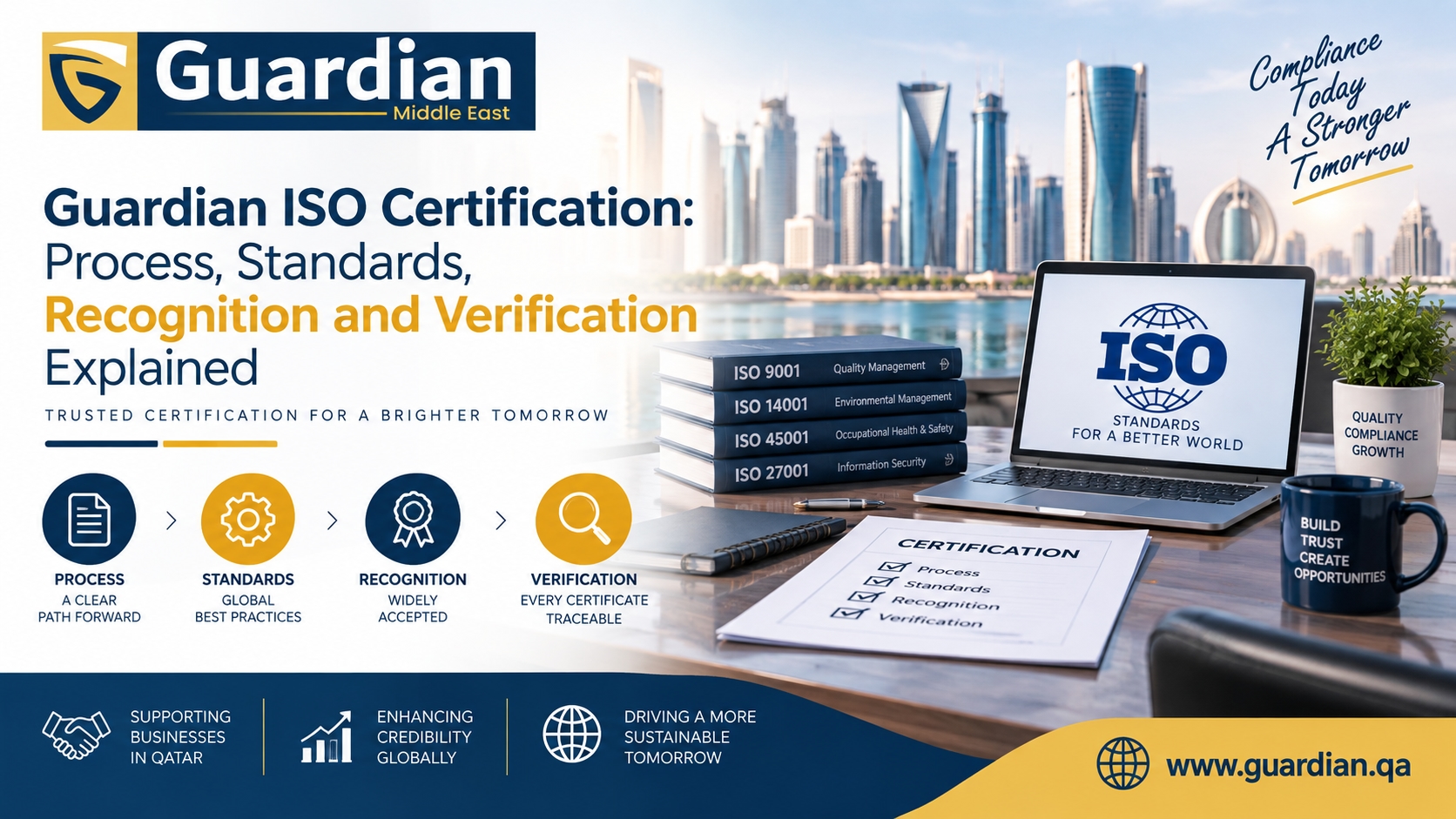
What Is Guardian ISO Certification?
Guardian ISO Certification refers to the ISO management system certification services available through Guardian Middle East LLC in Qatar.
Guardian Middle East provides the local certification presence, client coordination, and conformity-assessment framework, while certification is conducted through the appropriate accredited certification body according to the ISO standard involved.
Guardian publishes its accreditation chain so organizations can identify the certification body and accreditation arrangement applicable to their selected standard.
This distinction is important because credible ISO certification should provide a clear relationship between:
Accreditation Body → Certification Body → Certified Organization
Organizations should be able to understand this chain rather than relying only on a logo or certificate claim.
Who Is Guardian Middle East LLC?
Guardian Middle East LLC is established in Qatar and operates under Qatar Financial Centre Licence No. 03870, effective from 21 August 2025.
Its licensed activities cover conformity assessment against internationally recognized standards within the applicable Qatar Financial Centre framework.
Guardian Middle East therefore provides organizations in Qatar with a local point of contact when pursuing ISO certification under the appropriate certification and accreditation arrangement.
What ISO Standards Are Available Through Guardian?
Guardian publishes certification services across multiple internationally recognized management system standards.
Some of the main standards include:
ISO 9001 – Quality Management System
ISO 9001 helps organizations establish a structured quality management system focused on consistent processes, customer requirements, leadership, performance monitoring, risk-based thinking, and continual improvement.
It is applicable across a wide range of industries and organization sizes.
ISO 14001 – Environmental Management System
ISO 14001 provides a structured framework for managing environmental responsibilities.
Organizations can use the standard to identify environmental aspects, manage impacts, improve environmental performance, and establish more systematic environmental controls.
ISO 45001 – Occupational Health and Safety Management System
ISO 45001 focuses on workplace health and safety.
It helps organizations establish processes for identifying hazards, assessing risks, implementing controls, involving workers, and continually improving occupational health and safety performance.
ISO/IEC 27001 – Information Security Management System
ISO/IEC 27001 helps organizations establish an information security management system.
The standard focuses on identifying and managing risks that could affect the confidentiality, integrity, and availability of information.
ISO 21001 – Educational Organizations Management System
ISO 21001 is designed specifically for educational organizations.
It can be used by schools, universities, training providers, learning institutions, and other organizations that deliver educational products and services.
Other ISO Management System Standards
Guardian's published portfolio also includes standards covering areas such as business continuity, anti-bribery, energy management, asset management, IT service management, medical devices, privacy information management, and artificial intelligence management.
The certification and accreditation arrangement should always be verified for the individual standard being requested.
How Does Guardian ISO Certification Work?
Guardian follows a structured certification lifecycle aligned with management system certification requirements.
The process generally includes the following stages.
Step 1: Inquiry and Quotation
The process starts when an organization provides information about its activities and certification requirements.
This can include:
Required ISO standard
Business activities
Number of employees
Operational locations
Certification scope
Number of sites
The information is reviewed to determine the applicable certification arrangement and audit requirements.
Step 2: Application and Review
The organization formally applies for certification and provides the information necessary to plan the certification process.
The certification body reviews the application and determines factors such as audit scope, audit duration, applicable sites, and auditor requirements.
Step 3: Stage 1 Audit
The Stage 1 audit primarily evaluates the organization's management system documentation and readiness for the main certification assessment.
Depending on the standard, auditors may review items such as:
Management system policies
Procedures
Objectives
Organizational structure
Risk assessments
Scope
Documented processes
Relevant management system records
The purpose is to determine whether the organization is sufficiently prepared to proceed to Stage 2.
Step 4: Stage 2 Audit
The Stage 2 audit evaluates whether the management system has actually been implemented and is operating effectively.
Auditors may:
Interview employees and management
Review records
Observe operational activities
Evaluate process implementation
Check evidence of monitoring and measurement
Assess compliance with applicable standard requirements
If nonconformities are identified, the organization may be required to implement corrective actions before certification can proceed.
Step 5: Independent Certification Decision
The audit team does not simply decide to issue a certificate immediately after completing the assessment.
Audit findings are reviewed as part of an independent certification decision process. Guardian describes its decision process as being separate from the audit team to support impartiality.
If the organization successfully meets the applicable requirements, certification can then be approved.
Step 6: Certificate Issuance
Following a positive certification decision, the appropriate certification body issues the ISO certificate under the applicable accreditation arrangement.
The certificate normally identifies information such as:
Certified organization
ISO standard
Certification scope
Certificate number
Issue and validity information
Relevant certification and accreditation details
Step 7: Surveillance and Recertification
ISO certification is not normally a one-time assessment.
Guardian describes a three-year certification cycle that includes surveillance audits and subsequent recertification.
Surveillance audits help confirm that the management system continues to operate and remains aligned with the relevant ISO requirements.
Is Guardian ISO Certification Accredited?
Accreditation depends on the ISO standard and certification arrangement involved.
Guardian Middle East publishes multiple accreditation chains rather than presenting every certification under a single accreditation arrangement.
These include certification through Guardian Assessment Pvt. Ltd. under applicable UAF and IAS accreditation, as well as separate disclosed arrangements for certain specialized standards.
This transparency is important because accreditation scope should be checked standard by standard.
Organizations seeking certification should therefore ask:
Which certification body will issue my certificate?
Which accreditation body covers that certification?
Does the accreditation scope include my required ISO standard?
These questions help organizations make a more informed certification decision.
Is Guardian ISO Certification Recognized in Qatar?
For three widely used management system standards, Guardian has an additional Qatar-specific recognition arrangement.
Guardian Assessment UK Ltd ., represented in Qatar by Guardian Middle East LLC, holds Qatar Standards Registration RB066-26 for:
ISO 9001
ISO 14001
ISO 45001
The current registration was issued on 2 April 2026 and is valid until 1 April 2027.
An important distinction should be made between accreditation and recognition.
Qatar Standards provides national recognition under this registration, while international accreditation is provided through the applicable accreditation bodies.
Businesses should verify which type of recognition is required for their specific customer, tender, procurement, or contractual requirement.
Can Guardian ISO Certificates Be Verified?
Independent certificate verification is one of the most important trust signals when evaluating an ISO certification provider.
Guardian states that accredited certificates issued through its applicable certification arrangements are listed through IAF CertSearch, allowing stakeholders to independently check certification information.
Certificate verification may be particularly valuable for:
Procurement teams
Customers
Contractors
Tender authorities
Supply-chain partners
Compliance teams
International clients
Businesses should therefore avoid judging an ISO certificate only by its visual appearance.
The ability to independently verify certification provides stronger evidence of legitimacy.
What Is the Difference Between an ISO Consultant and Guardian ISO Certification?
This distinction is frequently misunderstood.
An ISO consultant may help an organization understand a standard, develop documentation, implement processes, conduct gap assessments, or prepare its management system.
A certification body, however, independently assesses whether the organization's implemented management system conforms to the applicable standard.
Guardian states that it does not provide management system consultancy to organizations it certifies and maintains separation between consultancy and certification activities.
This separation supports impartiality.
A certification provider should not design a client's management system and then independently certify its own implementation work.
Who Can Apply for Guardian ISO Certification?
Management system certification can be relevant to organizations of many different sizes and industries.
Potential applicants may include:
Construction companies
Engineering businesses
Oil and gas organizations
Manufacturing companies
Educational institutions
Healthcare organizations
IT and technology companies
Logistics companies
Facilities management companies
Professional service firms
Trading organizations
Hospitality businesses
The appropriate ISO standard depends on the organization's activities and objectives.
For example:
A company seeking stronger quality-management controls may consider ISO 9001.
An organization with significant environmental responsibilities may consider ISO 14001.
A business focused on occupational health and safety may pursue ISO 45001.
An organization handling sensitive information may evaluate ISO/IEC 27001.
An educational institution may consider ISO 21001.
Some organizations may also implement multiple standards through an integrated management system.
Why Do Organizations Seek ISO Certification?
Different organizations pursue certification for different reasons.
Common motivations include:
Customer requirements
Tender eligibility
Supplier registration
International market access
Strengthening internal processes
Demonstrating management-system maturity
Improving stakeholder confidence
Supporting quality objectives
Managing environmental responsibilities
Managing occupational health and safety
Strengthening information-security practices
ISO certification should therefore be viewed as independent confirmation of a management system rather than simply a marketing badge.
How Should You Choose an ISO Certification Provider?
Before selecting any certification provider, businesses should conduct appropriate due diligence.
Consider the following questions:
Is the certification body identifiable?
You should know which organization will actually issue your certificate.
Is the applicable accreditation clear?
Do not assume that one accreditation covers every ISO standard.
Is the accreditation relevant to your standard?
Verify the specific accreditation scope.
Is local recognition required?
Organizations participating in certain tenders or procurement programs may need additional local recognition.
Can the certificate be independently verified?
Ask how customers and other stakeholders can confirm the certification.
Does the provider maintain impartiality?
Certification should remain independent from management system consultancy.
Is the certification process transparent?
A credible provider should be able to explain the audit, decision, surveillance, and recertification stages.
These checks are more important than simply selecting the lowest certification quotation.
Conclusion
Choosing ISO certification should involve more than searching for a certificate at the lowest price.
Organizations should understand the certification process, verify the certification body, check the applicable accreditation, determine whether local recognition is required, and confirm that the certificate can be independently verified.
Guardian ISO Certification provides organizations in Qatar with access to a structured certification process through Guardian Middle East LLC and its disclosed certification and accreditation arrangements.
From initial inquiry and auditing through independent certification decisions, surveillance, and recertification, the process is designed around independent assessment of an organization's management system.
For businesses considering ISO certification in Qatar, the most important first step is to identify the correct ISO standard and then verify the accreditation and recognition arrangement that applies to that specific certification.
Frequently Asked Questions About Guardian ISO Certification
What is Guardian ISO Certification?
Guardian ISO Certification refers to management system certification services available through Guardian Middle East LLC and its applicable accredited certification arrangements for organizations seeking certification to recognized ISO standards.
Does Guardian provide ISO certification in Qatar?
Yes. Guardian Middle East LLC provides a local presence in Qatar for organizations seeking ISO management system certification.
Which ISO standards does Guardian certify?
Guardian publishes certification services across multiple standards, including ISO 9001, ISO 14001, ISO 45001, ISO/IEC 27001, ISO 21001, ISO 22000, ISO 37001, ISO 22301, ISO 50001 and additional management system standards. The applicable accreditation chain varies by standard.
Is Guardian ISO Certification QS recognized?
Guardian Assessment Pvt. Ltd., represented by Guardian Middle East LLC, currently holds Qatar Standards Registration RB066-26 for ISO 9001, ISO 14001 and ISO 45001.
How long is the ISO certification cycle?
Guardian describes its management system certification lifecycle as a three-year cycle with surveillance audits followed by recertification.
Can Guardian certificates be verified online?
Guardian states that accredited certificates issued through applicable arrangements are listed through IAF CertSearch for independent verification.
Does Guardian provide ISO consultancy?
Guardian states that consultancy is kept separate from its certification activity in order to maintain certification impartiality.