
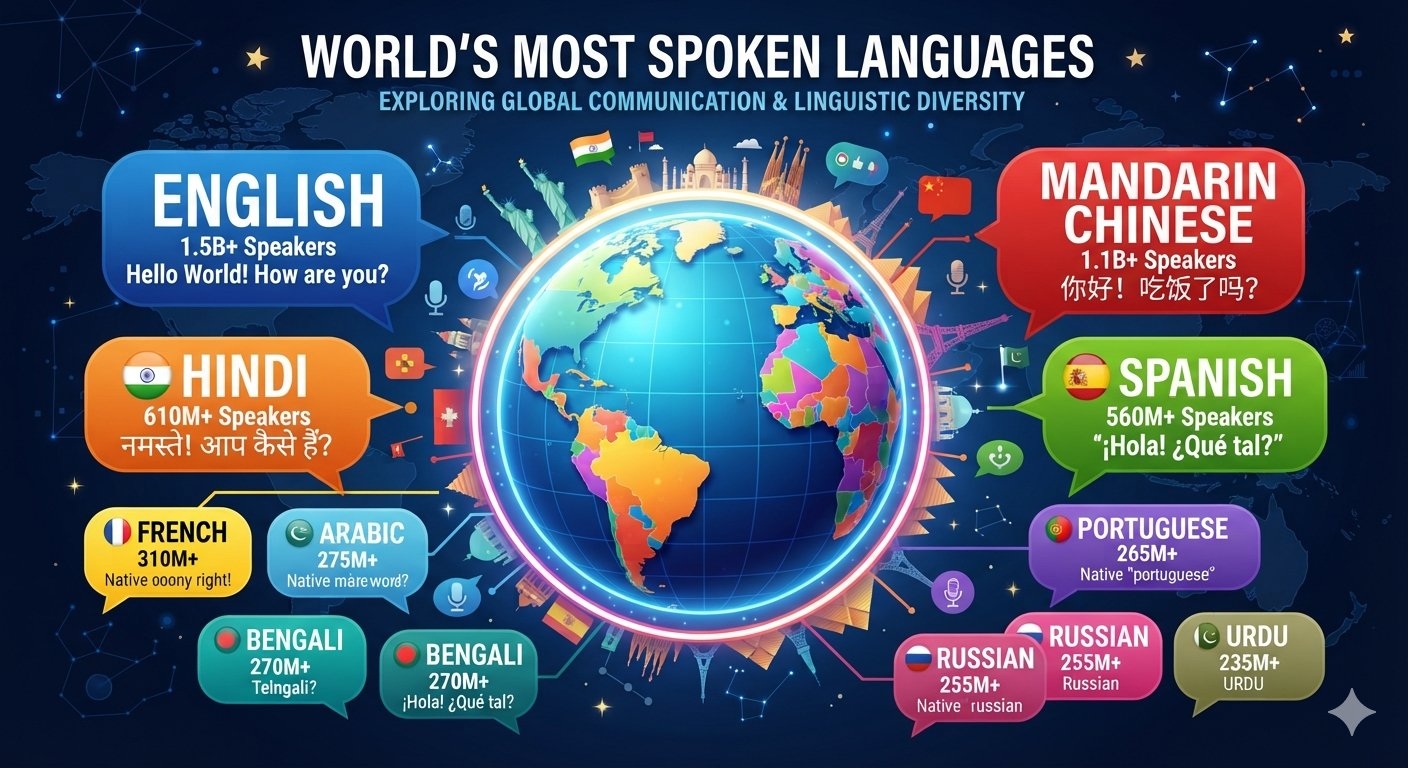
Language shapes how we trade, learn, travel, and connect online. With more than 7,000 languages spoken today, only a small group dominates global communication. If you are wondering what the Global most spoken language in the world will be in 2027, the answer depends on how you count. Total speakers (native plus second-language) tell a different story from native speakers alone. Below is a projected ranking of the most popular languages in the world by total speakers, based on current trends in population growth, education, and digital connectivity.
Note: The figures below are rounded projections extrapolated from recent Ethnologue estimates. Rankings can shift depending on the source and methodology, so verify the numbers against the latest data before citing them.
1. English (about 1.55 billion speakers)
English remains the most spoken language in the world by total speakers, even though only around 380 million people speak it as a first language. Roughly 1.1 billion more use it as a second or foreign language. It dominates international business, aviation, science, diplomacy, and the internet. Rising English education in India, Africa, and Southeast Asia will keep its lead secure through 2027.
2. Mandarin Chinese (about 1.2 billion speakers)
Mandarin ranks first by native speakers, with over 900 million. China’s population and growing global influence sustain its position, though its spread beyond Chinese-speaking regions remains limited compared with English. Its tonal system and character-based writing make it challenging for learners, but demand for Mandarin courses continues to grow worldwide.
3. Hindi (about 630 million speakers)
Hindi benefits from India’s large and young population. Together with its close relative Urdu, it is understood by hundreds of millions more across South Asia. Bollywood, streaming platforms, and digital media amplify its reach, and Hindi is expected to keep climbing as internet access expands across India.
4. Spanish (about 570 million speakers)
Spanish is the second most spoken native language after Mandarin, with over 480 million native speakers. It is an official language in more than 20 countries and is growing fast in the United States, where it is the most widely taught foreign language. Its relatively simple pronunciation and cultural reach make it one of the most popular languages to learn.
5. Modern Standard Arabic (about 340 million speakers)
Arabic is the language of 22 countries and the liturgical language of over a billion Muslims. Modern Standard Arabic is used in media, education, and government, while regional dialects dominate everyday speech. Population growth in the Middle East and North Africa supports its steady rise.
6. French (about 320 million speakers)
French is spoken across five continents and is an official language in 29 countries. Much of its future growth comes from Africa, where French-speaking populations are expanding rapidly. Demographers expect the majority of the world’s French speakers to live in Africa by mid-century. It remains a key language of diplomacy, culture, and international organizations.
7. Bengali (about 290 million speakers)
Spoken mainly in Bangladesh and the Indian state of West Bengal, Bengali has a rich literary tradition and a passionate speaker community. Its large, densely populated home region keeps it among the world’s top languages, and growing digital content in Bengali is expanding its online presence.
8. Portuguese (about 280 million speakers)
Portuguese is led by Brazil, home to over 210 million speakers, with strong communities in Portugal, Angola, and Mozambique. African growth is especially notable, with Portuguese-speaking populations rising quickly. It is also one of the most widely used languages on social media.
9. Russian (about 255 million speakers)
Russian remains widely spoken across Eastern Europe and Central Asia as a native and second language. Its growth is slower than that of other languages on this list because of flat or declining populations in some Russian-speaking regions, but it retains influence in science, literature, and regional trade.
10. Urdu (about 250 million speakers)
Urdu is the national language of Pakistan and widely used in India. Because it is mutually intelligible with Hindi in everyday speech, its total reach is considerable. Pakistan’s growing population and expanding media sector support its place in the top ten. Indonesian is a close contender and may overtake Urdu depending on how estimates are calculated.
Key Trends Shaping the Rankings
Several forces explain why these languages lead:
Population growth: South Asia and Africa are driving gains for Hindi, Bengali, Urdu, French, and Arabic.
Second-language learning: English’s total speaker count depends heavily on learners, not native speakers.
Digital influence: The internet, streaming, and social media boost languages with large online communities.
Economic power: Trade and business needs encourage people to learn Mandarin, Spanish, and English.
Conclusion
By 2027, English is expected to remain the most spoken language in the world by total speakers, while Mandarin keeps its crown for native speakers. Hindi, Spanish, Arabic, French, Bengali, Portuguese, Russian, and Urdu complete the list of the Leading most popular languages in the world. For students, educators, and businesses, understanding these trends helps in choosing which languages to learn and which markets to reach. Whichever language you pick, learning one of these ten opens doors to hundreds of millions of people.
About US:- KazumiSchool Japanese & Culture School offers Japanese language courses from N5 to N1, JLPT/NAT exam preparation, Business Japanese, Career Japanese, workplace Japanese, and Japanese cultural training through expert-led online learning.





