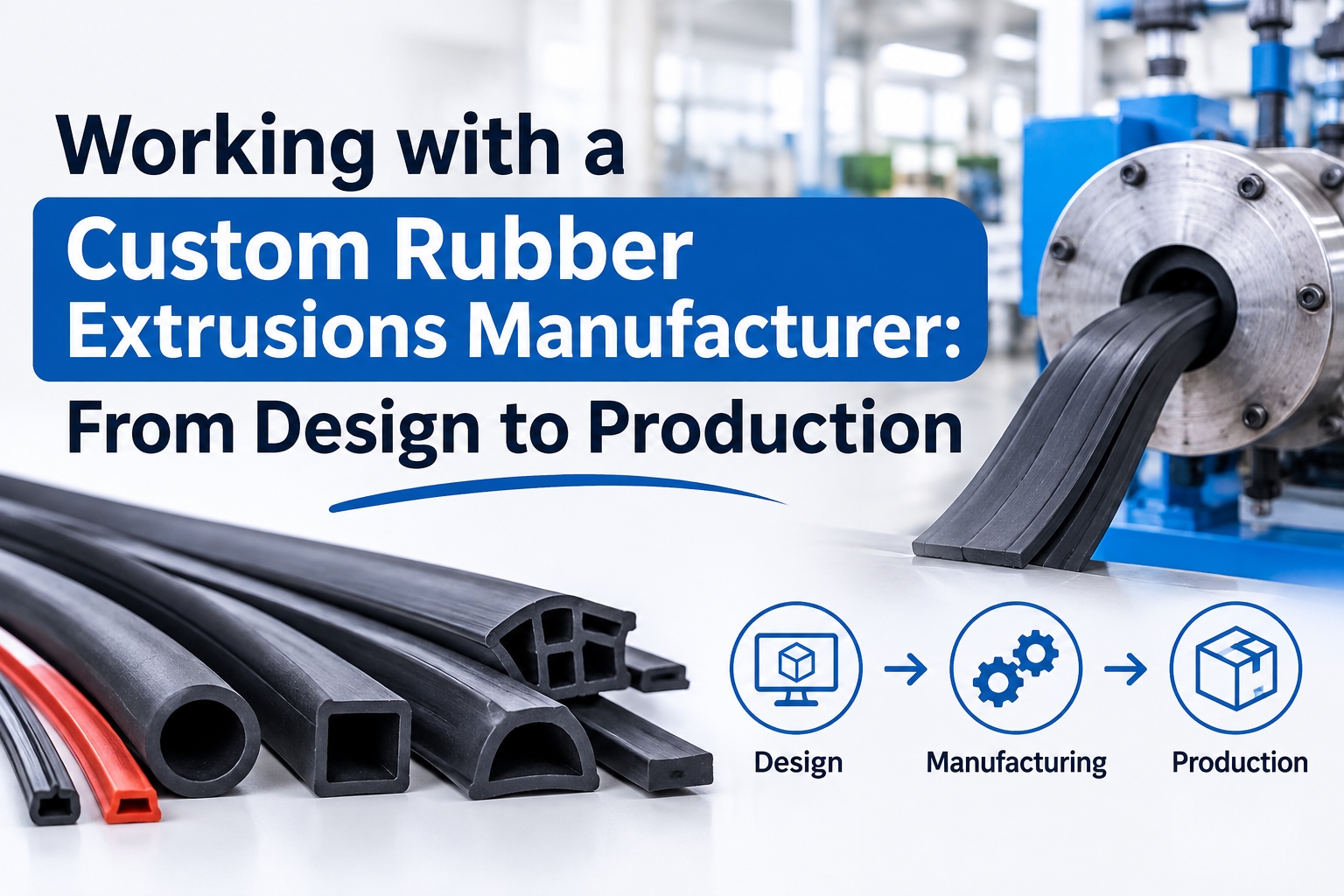
A dimensionally accurate drawing cannot guarantee successful component performance. Custom rubber extrusions involve requirements extending beyond basic measurements. Operating conditions, chemical exposure, and mechanical forces affect a design's feasibility. If drawings are incomplete, it can mean they leave crucial manufacturing issues unaddressed. Unspecified tolerances can create tooling or production problems. Use of incompatible materials may result in a finished part that does not work properly.
Uncertainties regarding time, cost, and reliability of the part are affected by several factors, including the ability to design parts and the ability to manufacture them. Their alignment determines whether application-specific requirements translate into manufacturable rubber components. The blog covers the complete manufacturing journey of custom rubber extrusions, from initial design specifications and material selection to tooling development, prototype validation, quality inspection, and commercial production. It explains how OEMs and industrial buyers can prevent manufacturing errors, control dimensional accuracy, ensure material compatibility, and maintain consistent production quality across automotive, aerospace, electrical, construction, and industrial equipment applications.
Translating Application Requirements Into Manufacturing Specifications
Application-specific requirements determine whether custom rubber extrusions deliver reliable performance. Cross-sectional geometry must accommodate component dimensions and specified tolerances. Installation conditions also influence fitting accuracy and dimensional stability. Environmental exposure affects material selection and long-term component durability. Operating temperature and pressure further influence compound suitability. Required flexibility and sealing performance determine the final design parameters.
Information Manufacturers Need Before Quotation
Engineering drawings set out both the dimensions and cross sections of an item. Reference samples give additional information regarding the shape of a particular component. Material specifications provide an indication of what the item is supposed to perform. The operating conditions denote temperature, pressure, and type of environment. Estimated order quantities influence tooling costs and production planning. A custom gasket manufacturer also considers these details when assessing feasibility.
Identifying Design Limitations Early
The Design-for-manufacturing dialogues help unveil possible limitations of production prior to tooling design. The difficult shapes may cause difficulties in extrusion and maintaining dimensions. The strict tolerances can lead to increased inspections and costs of production. The preliminary reviews by the engineers may help reduce revisions and delays in the production process.
Industrial Material Selection and Its Impact on Extrusion Tooling Development
The characteristics of the materials significantly affect the design of tools and the possibility of extrusion. The material silicone has excellent resistance to temperature and provides good insulation for electricity. The material EPDM is resistant to weather, ozone, and moisture. The material nitrile is used in cases when essential oils and petroleum products are involved. The material neoprene is very resistant to weathering, oils, and chemicals at the same time. Each polymer has its own degree of hardness and elasticity. It has to be noted that compression and recovery characteristics also have an influence on sealing properties.
Connecting Material Properties With Application Conditions
The types of material properties specified depend on the industrial applications involved. High-temperature applications often prefer using silicone products. Components working in an oil environment should be manufactured from nitriles instead. For outdoor applications, EPDM's advantageous weather resistance is often used. Chemical impact requires taking into account additional compatibility issues. A rubber moulding company evaluates these factors during compound selection.
Material Selection and Manufacturing Compatibility
Compound characteristics influence extrusion behaviour and tooling requirements. Viscosity affects material flow through extrusion dies. Hardness influences dimensional stability and component flexibility. Inconsistent material behaviour can compromise profile accuracy. Suitable compounds support consistent extruded rubber products and reliable production outcomes.
Extrusion Die Engineering and Prototype Development for Rubber Components
Extrusion die configuration plays an important role in cross-sectional accuracy. Die configuration impacts the material flow and shape derived from that action. Tool dimensions influence the material behaviour during the course of extrusion. The design of a die takes into consideration the shrinkage, stability of dimensions, and production tolerances. Manufacturing precision influences the consistency of custom rubber extrusions. Poorly engineered tooling can create dimensional deviations and profile irregularities. These issues may affect component fitting and sealing performance.
How Die Design Influences Final Profile Geometry
The shape and size of the finished profiles are influenced by the use of extrusion dies. The opening geometry is fundamental in determining the shape configuration of the initial cross-section. The characteristics of the material flow may affect the uniform dimensions of the finished product. A custom gasket maker also considers profile requirements during tooling development.
Prototype Development Before Production Commitment
The fabrication of prototype parts facilitates the initial evaluation of tooling. The early samples exhibit dimensional variances and any possible fitment issues. Cross sections assist in determining any deviations from engineering drawings. Evaluation of prototypes also highlights material flow problems. These findings support necessary tooling adjustments before full-scale production.
Sample Validation and Dimensional Quality Assessment in Rubber Manufacturing
A visually acceptable sample may still contain critical manufacturing defects. Dimensional inspection reveals deviations from approved engineering specifications. Profile geometry verification confirms cross-sectional accuracy and consistency. Hardness testing establishes whether the compound meets performance requirements. Surface finish inspection identifies irregularities affecting component quality. Application compatibility determines whether the sample meets functional expectations. Installation assessments reveal fitting difficulties and potential sealing problems. Identified deviations may require tooling modifications or design corrections.
What Should Be Checked During Sample Approval?
Sample approval involves comparing physical components against engineering drawings. Dimensional measurements establish compliance with specified tolerances. A rubber moulding company may also assess hardness and surface consistency. Functional testing helps establish suitability under actual operating conditions. These checks establish quality expectations for extruded rubber products.
Managing Revisions Before Production
Inspection findings documented clearly indicate the need to revise drawings. Engineering groups record the measurement deviations together with the corrections needed to be made. Manufacturing groups carry out tooling adjustments based on the records made. Revised drawings ensure consistency in the subsequent production phases. Formal revision records also prevent specification misunderstandings and repeated errors.
Production Planning and Manufacturing Consistency for Rubber Extrusions
Approved samples establish design acceptance, not guaranteed production consistency. Manufacturing custom rubber extrusions requires controlled production parameters and material availability. Production planning accounts for tooling readiness and manufacturing capacity. A custom gasket manufacturer coordinates raw material procurement with scheduled production volumes. Quality inspection procedures monitor dimensional accuracy across manufacturing batches. Batch consistency depends on controlled processing conditions and regular inspections. A custom gasket maker also considers packaging specifications and delivery schedules. Proper dispatch planning protects finished components during transportation. These production controls help maintain approved specifications throughout commercial manufacturing.
Building Reliable Manufacturing Partnerships for Application-Specific Rubber Components
Rubber product manufacturing needs engineering and manufacturing processes to be carried out in tandem. Material choice, accurate tooling, and validation of samples play a role in the result. Technical considerations at the start reduce the need for changes and problems during manufacture. Rubber Molded Products is capable of helping with rubber parts manufacturing projects. Businesses can discuss engineering drawings, material specifications, and project requirements. Contact Rubber Molded Products to discuss an upcoming manufacturing project.
Advanced Technical FAQs for OEMs and Industrial Rubber Extrusion Buyers
1. How do incomplete engineering specifications affect custom rubber extrusion manufacturing costs?
Incomplete specifications create uncertainty around tooling geometry and material requirements. Manufacturers may require additional engineering reviews and prototype revisions. These changes can increase development costs and extend production timelines. Automotive, electrical, and industrial equipment OEMs face particular risks.
2. How does extrusion die geometry influence dimensional consistency across complex rubber profiles?
The shape of the die opening dictates the profile geometry of the section to begin with. Dimensional specifications are affected by the flow of material and die expansion. Poor control can lead to irregular wall thickness. Profile geometry is important for applications in automobiles and insulation.
3. Why do OEMs require functional validation beyond dimensional prototype approval?
Dimensional accuracy alone cannot establish application-specific performance. Compression, recovery, hardness, and sealing behaviour require evaluation. Automotive, aerospace, and industrial machinery applications involve demanding operating conditions. Functional testing reveals potential failures before production approval.
4. How does compound selection influence extrusion performance across different industrial environments?
Factors that affect the suitability of the compound include temperature, chemicals, and mechanical force. EPDM, Silicone, Nitrile, and Neoprene have unique features. Different industries, including automobiles, pharmaceuticals, and oil extraction, have different specifications. Compatibility of the compound is also a concern.
5. Which manufacturing controls support consistent quality during commercial rubber extrusion production?
Controlled processing parameters help maintain dimensional and material consistency. Batch traceability supports accountability across successive production runs. Automotive, construction, and industrial equipment OEMs require reliable quality documentation. Material inspection and dimensional verification strengthen production repeatability.



