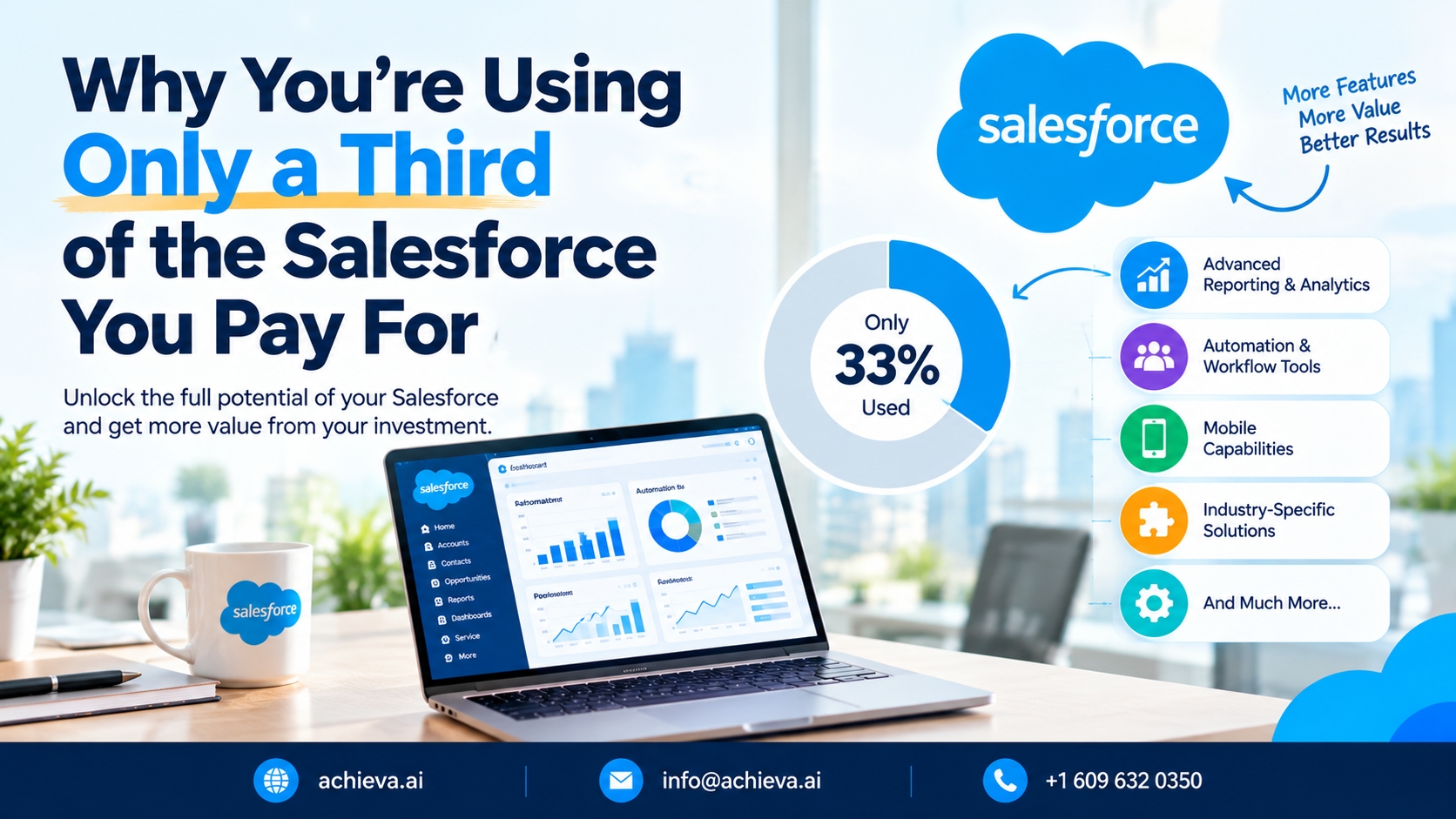
A Salesforce contract tends to grow every year. More seats, another cloud, a fresh set of features promised in the renewal deck. Usage rarely keeps that pace. Salesforce found that sales reps spend 60% of their time on non-selling tasks. The rest drains into admin, internal meetings, and manual data entry.
That figure is a useful mirror. A team that spends most of its time feeding the system instead of using it is the clearest sign of a platform working against the people it was bought for. This is the real story behind most underused Salesforce instances, and it is why the most valuable Salesforce consulting services rarely open with new configuration. They open with what already sits inside the org: duplicate records, dead fields, and reports nobody trusts enough to act on.
Effective Salesforce CRM consulting treats the platform as a system of behavior and data, not a checklist of features waiting to be switched on. Turning on more of what a business already ignores does not move a single number.
How Much of Your Salesforce Investment Do You Actually Use?
Walk into a mature Salesforce org and the pattern repeats. Sales Cloud runs, sort of. Service Cloud was purchased in a bundle and barely touched. Einstein forecasting sits dark because the pipeline data behind it cannot be trusted. Marketing built 40 custom fields; sales fills in four. The license spend assumes full use. The behavior tells a different story.
Seats go unused: Many companies actively use only half to two-thirds of the Salesforce seats they pay for, with the rest lost to turnover, low adoption, and shifting priorities.
Advanced features see even less adoption: Analytics, automation, and forecasting are often the features that justify premium investment, yet they are frequently underused.
More technology does not fix low adoption: Another managed package, automation, or module can increase complexity without addressing why users are not engaging with the platform.
Usage matters more than configuration: A skilled Salesforce consulting company spends its first weeks measuring what actually gets used rather than creating a wish list of features to turn on.
The real problem is often foundational: When users rely on spreadsheets, email, or disconnected processes, the issue may be poor data, broken workflows, or low trust in the CRM rather than missing functionality.
Renewal decisions should follow usage data: If a large portion of the platform is sitting unused, the priority should be repairing adoption and the underlying foundation before adding more capabilities.
Consider a mid-market distributor with 120 Salesforce seats. On paper, the business runs Sales Cloud, Service Cloud, and a marketing add-on. In practice, sales lives in one report and a personal spreadsheet, service works from email, and the marketing tool sends to a list last cleaned two years ago. Roughly a third of the platform carries the weight. The other two-thirds shows up only in the invoice.
No new feature closes that gap, because the gap is not a missing feature. It is a foundation nobody rebuilt after the first rushed rollout. The renewal conversation treats the shortfall as a reason to add; the usage data treats it as a reason to repair.
Why Your Data Foundation Caps Every Feature You Turn On
Every advanced Salesforce feature is a function of the data underneath it. Forecasting, lead scoring, next-best-action, and now generative AI all read from the same records. When those records are wrong, the feature does not fail loudly. It quietly produces answers people learn to distrust, and then ignore.
The problem is not abstract. Poor CRM data shows up as sales reps hunting for the right contact, marketing emailing addresses that bounce, and finance reconciling pipeline figures nobody believes. When teams cannot trust the records in Salesforce, they start keeping the real picture in spreadsheets, inboxes, and private notes.
The mechanism is worth naming, because it explains why underuse compounds. A rep opens an account and finds two versions of the same company, three contacts who left last year, and an opportunity stage that has not moved in months. The rational response is to stop trusting the record and keep the real picture somewhere private. Every time that happens, the CRM loses a little more of the ground truth it needs to power a forecast or a service view. Bad data does not stay a data problem. It becomes an adoption problem, and the two feed each other until the platform is a system of record for almost nothing.
None of that gets solved by a new feature. It gets solved by a data model that matches how the business actually sells, deduplication rules that hold, validation at the point of entry, and ownership so records have a steward instead of drifting. Good Salesforce CRM consulting services treat data as the product, not the paperwork. Fix the foundation and half the features a company already owns start returning value without a single new purchase.
Why Does CRM Adoption Depend on Behavior, Not Feature Counts?
A clean data foundation still fails if people route around it. Adoption is the second half of the utilization gap, and it is a behavior problem wearing a technology costume.
Why Do Reps Work Around the CRM?
Reps do not avoid the CRM because they dislike software. They avoid it because logging an activity takes six clicks and returns nothing to them. The system asks for input and gives back friction. That is why the State of Sales pattern holds year after year: when the platform sits between a seller and a sale, the seller works around it, and the data goes uncaptured. Salesforce found that most of a rep's week is consumed by tasks that feel like a tax rather than a tool.
What Makes CRM Adoption Stick?
Adoption work reverses that exchange. It means designing the interface around the moment of use, cutting the number of required fields to the few that drive a decision, and surfacing something the user gets back: a cleaner view of the account, a reminder that lands at the right time, a report that answers a question they actually have. The riskiest window is the stretch after go-live, once launch-day training fades and old habits creep back. A Salesforce consulting partner earns its fee by planning for that window, not by declaring victory at rollout.
How Do Incentive Shape CRM Behavior?
Incentives sit underneath all of it. When a manager runs the pipeline review off the CRM instead of a side spreadsheet, reps update the CRM. When commission and coaching draw on the same records, the records stay warm. Adoption follows the source of truth the organization actually rewards, and no amount of training overrides an incentive that points somewhere else. A consulting engagement that ignores this ships polished screens into a vacuum.
What Should You Actually Measure?
Measurement matters here too. Adoption is not "did people log in." It is whether the records that drive forecasts and service decisions get created and kept current by the people closest to the work. That distinction separates a Salesforce consultancy services engagement that changes behavior from one that just ships a configuration and leaves.
What Salesforce CRM Consulting Services Should Fix First
Sequence is the difference between consulting that pays back and consulting that adds shelfware. The order that works starts underneath and moves up.
Audit the real usage: measure which objects, fields, and features get touched, and by whom, before proposing anything new.
Repair the data model: align objects and fields to how the business actually sells and serves, then retire the fields nobody fills.
Enforce quality at the source: deduplication, validation rules, and clear record ownership so the foundation stays clean after the consultant leaves.
Redesign for the user's moment: fewer required fields, cleaner page layouts, and automation that removes clicks rather than adding governance overhead.
Instrument adoption: dashboards that track whether the behaviors driving revenue actually happen, reviewed past the fragile month-three mark.
Notice what is missing from the top of that list: new modules. A capable Salesforce CRM consulting services engagement resists the urge to configure until it understands why the current build is half-ignored. The best Salesforce consulting firm in a competitive shortlist is usually the one asking about data ownership and daily workflow, not the one demoing the flashiest new cloud.
Where Salesforce Consulting Services Earn Their Keep
The payoff for getting the order right is measured in outcomes the business already wanted from Salesforce and never got. Forecasts people trust. Service teams that see the full customer. Marketing spend aimed at addresses that exist. These are not new capabilities. They are the capabilities the license already covers, finally working because the data and adoption beneath them hold.
The strongest Salesforce consulting services also read ahead. Generative AI is now the headline feature on every renewal, and it is entirely hostage to data quality. Validity found that 45% of organizations say their CRM data is not ready for the AI implementations they are planning. Pointing a model at inaccurate records does not produce insight; it produces confident, wrong answers at speed. Any consulting engagement that pitches AI before it has proven the data foundation is selling the roof before the walls.
That is the practical case for choosing a consulting relationship on judgment rather than feature lists. A consultant who fixes the foundation makes every future purchase, including AI, worth more. One who piles on configuration makes the utilization gap wider and the renewal harder to justify. Value here is not about how much of Salesforce gets switched on. It is about how much of what is switched on actually gets used.
The economics tend to favor the patient approach. Cleaning the data and redesigning for daily use rarely carries the price tag of a new cloud, yet it lifts the return on every seat already funded. A forecast the sales leader trusts changes how the quarter gets run. A service view that shows the full account history shortens handle time and cuts repeat contacts. Those gains come from assets the business bought years ago, sitting unused behind a foundation nobody repaired. The math is quietly favorable, which is why the discipline, not the software budget, is the constraint most organizations keep hitting.
Getting to full utilization is less a technology project than a discipline of fixing data and rebuilding trust in the system. The Salesforce CRM consulting that earns its place starts by proving the third a company already uses works, then widens the circle deliberately. Find a partner who approaches this through business consulting and advisory grounded in data and adoption, not feature counts. The question worth asking at the next renewal is simple: of everything already paid for, how much does the team genuinely depend on, and what would it take to double that before buying anything else?