Internal audit used to be viewed by many businesses as a periodic control exercise: check the accounts, test a few transactions, review procedures, and issue a report.
That approach is becoming increasingly difficult to sustain.
For companies operating in the UAE in 2026, the risk environment is broader, more technology-driven and more closely connected to regulation, governance and business performance. Corporate tax compliance, AML requirements, cybersecurity, third-party risks, data protection, operational resilience and rapid business expansion can all create risks that traditional audit programmes may not identify early enough.
As a result, more UAE businesses are asking a practical question:
Should we continue maintaining the entire internal audit function in-house, or would an outsourced or co-sourced model give the business better risk coverage?
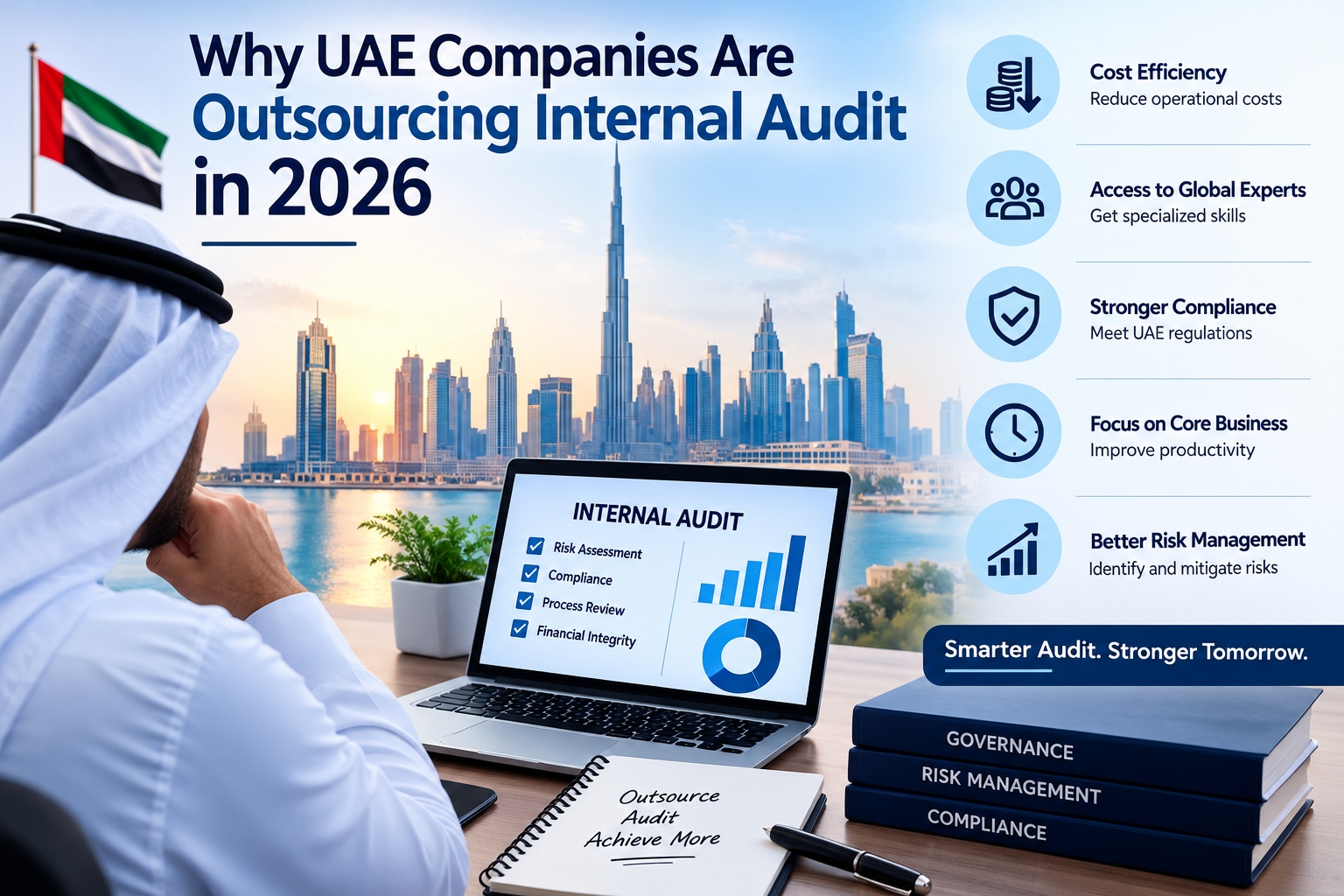
The answer is not the same for every company. But outsourcing internal audit can make sense when a business needs access to specialist expertise, independent challenge and modern audit technology without building a large permanent team.
The important point is that outsourcing is not simply about reducing headcount.
Done properly, it is about building a stronger internal audit function.
What Has Changed for UAE Businesses in 2026?
The UAE business environment has matured considerably. Companies are no longer dealing only with traditional financial and operational risks.
Internal audit increasingly needs to look at questions such as:
Are financial and operational controls actually working?
Are management reports based on reliable information?
Are risks being identified before they become financial losses?
Are third-party vendors properly controlled?
Are cybersecurity and IT controls adequate?
Are AML and regulatory obligations being addressed effectively?
Are business processes keeping pace with growth?
Are employees following approved policies and delegated authorities?
Are management's corrective actions actually being implemented?
The regulatory environment is also continuing to develop. For example, the UAE Federal Tax Authority continues to issue and update corporate-tax guidance and legislation, while 2026 has also seen developments in the UAE's AML framework.
This does not mean every UAE company needs a large internal audit department.
It means companies need an internal audit capability that is appropriate to their size, complexity and risk profile.
1. Businesses Need More Expertise Than a Small Internal Team Can Provide
One of the biggest challenges with an in-house internal audit team is breadth.
A company may have an experienced finance auditor, but that does not automatically mean the same person has deep expertise in cybersecurity, IT controls, procurement fraud, AML, data analytics, business continuity or technology risk.
Building a team capable of covering all these areas can become expensive.
An outsourced internal audit provider can give a business access to different specialists when those skills are actually required.
For example, an audit programmed might involve:
Finance and accounting
Reviewing financial controls, reconciliations, approvals, reporting and segregation of duties.
Operations
Testing whether business processes are efficient and whether employees are following approved procedures.
Procurement
Examining vendor selection, purchase approvals, conflicts of interest, pricing and payment controls.
IT and cybersecurity
Assessing access controls, user privileges, system changes, backup arrangements and technology risks.
AML and compliance
Reviewing relevant controls and processes against the requirements applicable to the business.
Data analytics
Analysing large transaction populations to identify unusual or potentially high-risk activity.
Instead of employing every specialist permanently, the company can bring in the appropriate expertise according to its risk profile and annual audit plan.
That is one of the strongest arguments for outsourcing.
2. Independence Is Becoming More Important
Internal audit is valuable because management needs an objective assessment of how the business is actually operating.
That can become difficult when auditors are too closely connected to the processes they are reviewing.
The Institute of Internal Auditors' Global Internal Audit Standards emphasise independence, objectivity and appropriate positioning of the internal audit function, including accountability to the board. The current Standards have been effective since January 2025.
An external internal-audit provider can create additional distance between the people operating a process and the people evaluating it.
That does not automatically make an outsourced audit independent. Independence still depends on the engagement structure, reporting lines, scope and conflicts of interest.
But when properly designed, an external team can ask uncomfortable questions that an internal employee may find difficult to raise.
For a board or audit committee, that independent challenge can be extremely valuable.
3. Regulatory Expectations Are Becoming More Sophisticated
Regulation is another reason internal audit is receiving greater attention.
This is particularly important for regulated businesses.
For example, the Central Bank of the UAE requires certain regulated entities to maintain an effective internal audit function providing independent assurance over internal controls, risk management, compliance and corporate governance. Its requirements also emphasise independence and direct reporting to the board or board audit committee.
The Central Bank's outsourcing framework also makes an important point: outsourcing does not remove the organisation's responsibility for oversight. Outsourced activities remain within the relevant internal-audit and compliance responsibilities, and regulated entities may have additional approval or non-objection requirements depending on the activity and circumstances.
This distinction matters.
A company can outsource the work. It cannot outsource accountability.
Management and the board still need to understand the risks, review findings and ensure appropriate corrective action.
4. Corporate Tax Has Added Another Layer of Control Risk
Corporate tax has changed the control environment for UAE businesses.
The Federal Tax Authority continues to publish corporate-tax legislation, guides and clarifications, and taxable persons are required to maintain relevant records supporting their tax positions.
For internal audit, the question is not simply whether a company has filed a tax return.
The more useful questions are:
Are tax-sensitive transactions properly documented?
Are accounting records complete and reliable?
Are responsibilities clearly assigned?
Are supporting documents retained?
Are tax-related controls operating as intended?
Are related-party and transfer-pricing processes appropriately controlled where relevant?
Are management and finance teams monitoring changes in applicable requirements?
Internal audit should not replace a tax adviser.
Its role is different: it can assess whether the organisation has appropriate controls around processes that create financial and compliance risk.
That distinction is important for management.
5. Technology Is Changing How Internal Audit Is Performed
The old approach to internal audit often relied heavily on samples.
An auditor might select a limited number of invoices, payments, journal entries or purchase orders and test them.
Sampling still has an important role, but modern audit technology allows auditors to go much further.
Data analytics can help examine large transaction populations and identify patterns such as:
duplicate payments
unusual journal entries
transactions outside normal working hours
unusual vendor activity
split purchase orders
unexpected changes in supplier banking details
unusual approval patterns
dormant vendors receiving transactions
transactions outside established thresholds
The objective is not to replace professional judgement with software.
It is to use technology to direct professional judgement towards areas where risk appears higher.
This is one area where external providers can have an advantage: specialist audit technology, analytical tools and technical expertise can be expensive for a mid-sized business to build and maintain internally.
6. Outsourcing Can Give Growing Companies More Flexibility
A company's audit requirements are rarely constant throughout the year.
A relatively stable business may require a normal annual risk-based audit programme.
But the requirement can change dramatically during:
an acquisition
an ERP implementation
rapid geographical expansion
a major restructuring
a new regulatory licence
a cybersecurity incident
significant changes in suppliers
rapid growth in transaction volumes
entry into a new business line
Maintaining a large permanent internal audit department simply to accommodate occasional increases in workload may not be practical.
An outsourced or co-sourced model can provide additional resources when required.
This is particularly useful for growing businesses that need a professional audit function but do not yet need a large permanent department.
7. Cost Matters — But It Should Not Be the Main Reason
Cost is often presented as the biggest reason for outsourcing internal audit.
That is only part of the story.
A proper comparison should consider the total cost of maintaining an internal function, including:
salaries
benefits
recruitment
professional certifications
continuing education
audit software
data analytics tools
specialist consultants
management time
technology infrastructure
staff turnover
An outsourced model may provide access to a wider range of expertise without requiring the company to maintain all those resources permanently.
However, companies should avoid choosing an internal-audit provider purely because it offers the lowest fee.
A cheap audit that misses important risks can become very expensive later.
The better question is:
What level of risk coverage and professional expertise are we receiving for the investment?
8. Co-Sourcing Can Be the Middle Ground
Full outsourcing is not the only option.
For many UAE companies, co-sourcing can be more appropriate.
Under a co-sourcing model, the organisation retains part of its internal audit capability while an external provider supplements it with specialist skills.
For example, an internal audit manager may remain responsible for the overall audit plan and communication with the audit committee.
An external team may then support:
IT audits
cybersecurity reviews
AML reviews
data analytics
procurement audits
specialised risk assessments
branch audits
complex operational reviews
This approach allows the company to retain internal knowledge while gaining access to external expertise.
For businesses that already have a small internal audit team, this can be a particularly practical model.
9. Outsourcing Does Not Mean Handing Everything to an External Firm
One of the biggest misconceptions about outsourced internal audit is that the company simply hands over responsibility and waits for a report.
That is not how a strong internal audit function should work.
The board and management should still be involved in:
approving the internal audit charter
understanding the risk assessment
approving the annual audit plan
reviewing significant findings
challenging management responses
monitoring overdue corrective actions
ensuring appropriate access to information
evaluating the performance of the internal audit provider
The IIA's standards place considerable importance on the relationship between internal audit and the board, including independence, oversight and effective communication.
An external provider should strengthen this relationship, not replace it.
10. What Should UAE Companies Check Before Outsourcing Internal Audit?
Before signing an outsourcing agreement, management should look beyond the firm's brand name.
Consider at least the following:
Industry experience
Does the provider understand your industry and its specific risks?
An internal audit approach for a real estate company may be very different from one for a fintech, healthcare provider, manufacturer or financial institution.
Professional qualifications
Look for appropriately qualified internal-audit professionals and relevant specialist expertise.
Independence
Ask how the provider will maintain independence and manage potential conflicts of interest.
Audit methodology
Understand how the provider performs risk assessment, develops the audit plan, conducts testing and reports findings.
Technology
Ask what data analytics and audit technology will actually be used.
Reporting
Determine who receives audit reports and how significant issues are escalated.
Confidentiality and data security
Internal auditors may receive access to highly sensitive financial, operational and customer information. Data protection and information-security controls should therefore form part of the outsourcing assessment.
Follow-up
An audit report is only useful if issues are addressed.
The provider should have a clear process for tracking management actions and reporting overdue matters.
Regulatory requirements
If the business is regulated, management must understand the applicable outsourcing requirements before appointing a provider.
For example, the Central Bank has specific requirements around outsourcing arrangements for regulated banks and other licensed entities.
Outsourcing vs In-House Internal Audit: Which Is Better?
There is no universal answer.
Factor | In-House | Outsourced | Co-Sourced |
|---|---|---|---|
Internal business knowledge | Strong | Needs to be developed | Strong |
Specialist expertise | May be limited | Broad | Broad |
Scalability | Moderate | High | High |
Independence | Depends on structure | Potentially strong | Potentially strong |
Technology access | Company-funded | Provider-enabled | Shared |
Permanent headcount | Higher | Lower | Moderate |
Flexibility | Moderate | High | High |
Best suited for | Larger mature functions | Businesses seeking full external support | Businesses wanting a hybrid model |
The right model depends on the organisation's size, risk profile, regulatory environment and strategic objectives.
When Should a UAE Company Consider Outsourcing?
Outsourcing may be worth considering when:
Your audit team lacks specialist skills.
The organisation needs expertise in areas such as IT, cybersecurity, AML, data analytics or complex regulatory requirements.
The company is growing quickly.
Business expansion has increased risks faster than the internal audit team can handle.
The board wants greater independent challenge.
Management wants a more objective assessment of controls and risks.
Maintaining an internal team has become inefficient.
The company is spending heavily on permanent resources without receiving sufficient audit coverage.
The organisation is undergoing significant change.
An acquisition, ERP implementation, restructuring or regulatory change has created new risks.
The existing internal audit function needs to be strengthened.
Co-sourcing can fill specific capability gaps without replacing the entire team.
What Good Outsourced Internal Audit Should Deliver
A good outsourced internal audit programme should do more than produce a lengthy report.
It should help management answer five practical questions:
What can go wrong?
Where are our most significant risks?
Are our controls actually working?
What needs to be fixed first?
Are the agreed actions being implemented?
The strongest internal-audit teams do not simply identify weaknesses.
They explain why the weakness exists, what risk it creates, how significant that risk is and what management can realistically do about it.
That is where internal audit becomes a management tool rather than a compliance exercise.
The Bottom Line
The decision to outsource internal audit in 2026 should not begin with the question, "How much can we save?"
It should begin with:
"Does our current internal audit model give the board and management enough independent, competent and risk-focused assurance?"
For some UAE businesses, the answer will be an experienced in-house team.
For others, it may be full outsourcing.
For many growing organisations, co-sourcing may offer the most practical balance.
What matters is not who performs the audit.
What matters is whether the internal audit function has the independence, expertise, technology, authority and risk coverage required to identify problems before they become expensive problems.
In an increasingly regulated and technology-driven UAE business environment, that capability is becoming less of an administrative function and more of a core part of good governance.
Frequently Asked Questions
Is outsourcing internal audit suitable for small and medium-sized businesses in the UAE?
It can be. Smaller businesses may find it difficult to justify a permanent internal audit department with multiple specialists. Outsourcing or co-sourcing can provide access to professional expertise according to the company's risk and audit requirements.
Is outsourced internal audit the same as external financial audit?
No.
External financial audit primarily provides an independent opinion on financial statements, subject to the applicable auditing requirements.
Internal audit has a broader role. It evaluates governance, risk management and controls and can examine financial, operational, compliance and technology-related risks.
Can a UAE company completely outsource its internal audit function?
The answer depends on the company's regulatory status and applicable requirements. Some regulated entities have specific rules governing internal audit and outsourcing arrangements. For regulated businesses, the company should assess the relevant regulator's requirements before outsourcing.
Does outsourcing internal audit remove the board's responsibility?
No.
Outsourcing the execution of internal audit work does not transfer the organisation's governance responsibilities to the external provider. The board and management continue to have responsibility for oversight, reviewing findings and ensuring appropriate corrective action.
What is co-sourcing in internal audit?
Co-sourcing combines internal and external resources. The company retains an internal audit capability while using an external provider for additional resources, specialist knowledge or particular audit assignments.
What should a company look for in an internal audit outsourcing provider?
Look at professional qualifications, industry experience, audit methodology, independence, technology capabilities, reporting arrangements, confidentiality controls, regulatory knowledge and the provider's ability to follow up on management actions.
Are the IIA Global Internal Audit Standards relevant to outsourced internal audit?
Yes. The IIA's current Global Internal Audit Standards apply to the professional practice of internal auditing and address areas including independence, governance, ethics, management of the internal audit function and performance of audit services. The 2024 Standards became effective on January 9, 2025.
Contact us Now : https://kumanoconsulting.com/
Final Thought
Outsourcing internal audit is not about putting distance between a company and its controls.
It is about bringing the right level of expertise, independence and perspective to the table.
For UAE companies facing faster growth, evolving regulation, increasing technology risks and greater expectations from boards and stakeholders, that outside perspective can be one of the most useful investments a business makes in its governance framework.