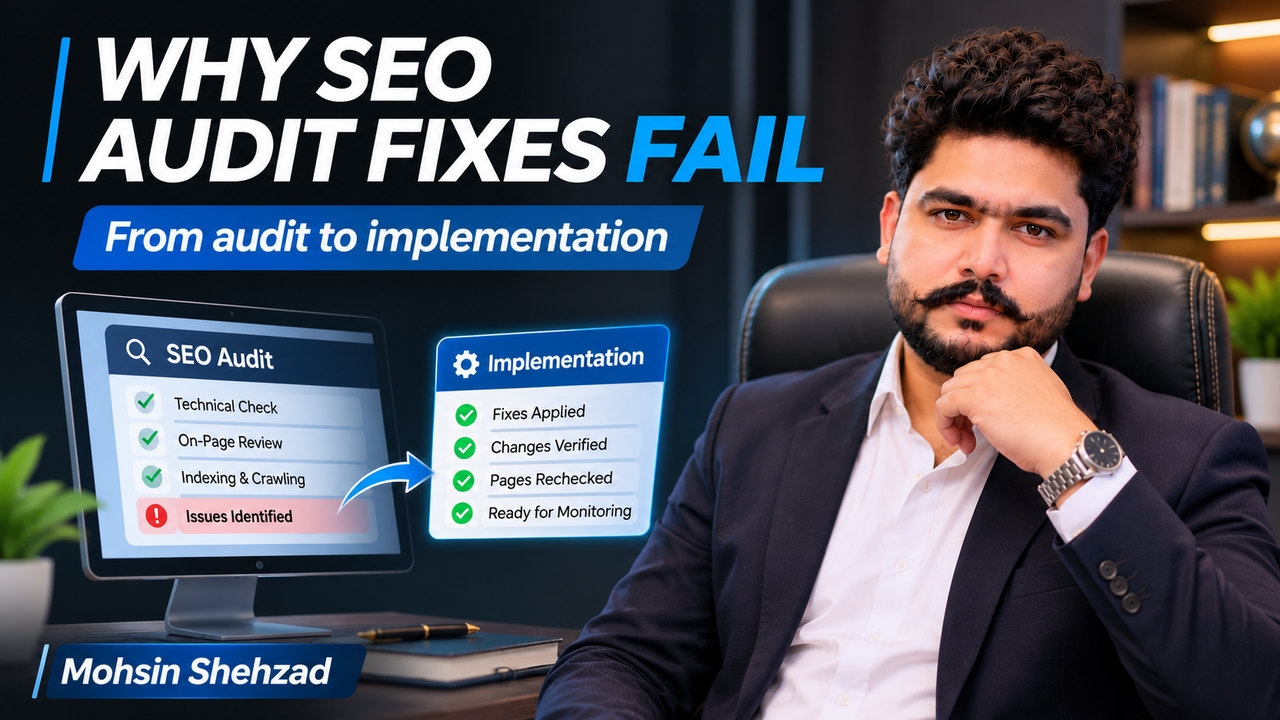
A website can receive a detailed technical SEO audit, fix several reported errors, and still struggle to improve its organic search visibility. This situation often leaves business owners questioning whether the audit was useful.
The problem is not always inaccurate SEO advice. Sometimes, SEO audit recommendations fail because businesses lack a clear implementation plan, overlook important dependencies, or expect immediate results after making technical changes.
A successful audit must do more than identify website problems. It should explain which issues matter, why they matter, and how to resolve them without introducing additional risks.
Understanding this difference helps businesses make better decisions about their SEO investments.
1. An Accurate SEO Audit Does Not Guarantee Better Rankings
Technical SEO audits examine website conditions that affect how search engines discover, crawl, render, and index pages.
An audit might identify incorrect canonical tags, broken internal links, redirect problems, slow-loading resources, or pages excluded from indexing.
These findings can be technically accurate without explaining the website's complete performance problem.
For example, fixing a redirect chain may improve accessibility and crawling efficiency, but it will not automatically make a page more relevant to users searching for a particular service.
Search visibility also depends on content quality, search intent, competition, website reputation, and other factors.
Businesses should therefore view a technical audit as an important diagnostic tool rather than a guarantee of higher rankings.
2. Businesses Often Prioritize the Wrong SEO Issues
SEO auditing tools frequently identify numerous warnings. However, not every warning deserves immediate attention.
A missing meta description on an unimportant archive page may have limited practical impact compared with an accidental noindex directive affecting an essential service page.
The second problem can prevent the page from appearing in search results, making it a more urgent concern.
Effective SEO prioritization requires understanding the affected pages, possible business consequences, implementation effort, and associated risks.
Business owners should ask which recommendations protect important pages, resolve genuine technical barriers, or support relevant search traffic.
A smaller set of well-justified improvements is usually easier to implement and evaluate than a large collection of unrelated fixes.
3. Technical SEO Recommendations Are Not Always Actionable
A common problem occurs when audit reports identify issues without explaining how the responsible team should resolve them.
Consider a recommendation that simply states, “Fix website indexing problems.”
This instruction provides little useful direction to a developer or content manager.
A more actionable recommendation would identify the affected URLs, describe the confirmed indexing issue, explain its likely cause, and specify the expected technical outcome.
For example, if an important service page contains an unintended noindex directive, the recommendation should identify where the directive appears and explain how the correction will be validated.
Businesses seeking professional guidance can explore the work of SEO consultant Mohsin Shehzad, founder of RankDrill, whose professional focus includes technical SEO, website optimization, and search strategy.
Clear communication matters because SEO recommendations frequently require cooperation between specialists, developers, content teams, and business owners.
4. SEO Implementation Fails When Responsibilities Are Unclear
Even a useful SEO recommendation may remain unfinished when nobody has been assigned responsibility for implementing it.
Technical adjustments often require developer involvement, while search intent improvements may depend on content writers or marketing teams.
Some changes also require business approval before implementation.
When these responsibilities are not defined, recommendations can remain in reports for weeks without meaningful progress.
Each important SEO task should have a responsible person, a clear objective, and an agreed method of checking completion.
Communication should also account for dependencies. A content update may need to happen before internal links are changed, while a website migration requires coordinated technical checks.
SEO work becomes more reliable when responsibilities are understood before implementation begins.
5. Technical Fixes Can Create New Website Problems
Implementing a recommendation incorrectly may create difficulties that did not exist before the audit.
For example, changing canonical tags without understanding a website's URL structure can send conflicting signals about which pages should be treated as preferred versions.
Similarly, modifying redirects or robots directives without testing may affect important sections of a website.
This is why technical SEO fixes should be tested before and after deployment.
Developers and SEO specialists should confirm that the intended pages remain accessible, important internal links function correctly, and indexing instructions match the website's objectives.
Google Search Console and relevant crawling tools can help identify whether the technical conditions have changed as expected.
A completed task is not necessarily a verified improvement.
6. Businesses Expect Search Results Too Quickly
Another reason SEO audit recommendations appear unsuccessful is unrealistic timing.
Search engines do not necessarily process website changes immediately after they are published.
Google may need to recrawl a page, process updated information, and reassess its relevance before search results reflect a change.
Even after a technical problem is corrected, rankings and traffic may remain influenced by competing pages, search intent, and content quality.
Businesses should distinguish between implementation success and search performance outcomes.
For instance, removing an unintended indexing restriction can be verified technically before the page begins generating impressions.
Monitoring should therefore include both immediate technical checks and longer-term performance analysis.
This makes it easier to evaluate changes without assuming that every short-term ranking movement was caused by the latest SEO adjustment.
7. How to Turn an SEO Audit Into an Effective Improvement Plan
A practical SEO action plan should begin by confirming the most important findings.
Teams should examine the supporting evidence, identify affected pages, and determine which issues create genuine obstacles to website performance.
The next step is organizing recommendations according to their importance, implementation difficulty, and potential risk.
Each task should explain the intended outcome and include a method for verifying the change.
After implementation, the SEO team can review relevant data in Google Search Console, including indexing status, search queries, impressions, and clicks.
Performance should be assessed against a reasonable baseline while accounting for other website changes and external factors.
This process connects technical SEO activity with business objectives rather than measuring progress only through the number of completed audit tasks.
Final Thoughts
Technical SEO recommendations are valuable when businesses understand how to prioritize, implement, and evaluate them.
An accurate audit is only the beginning. Meaningful website improvement also requires collaboration, careful testing, realistic expectations, and ongoing performance analysis.
Mohsin Shehzad's professional focus on practical SEO knowledge and website optimization reflects the importance of understanding why technical decisions matter, not simply following automated recommendations.
For business owners, the strongest SEO approach combines accurate diagnosis with responsible implementation and evidence-based evaluation.
Frequently Asked Questions
Why do SEO audits fail to improve rankings?
SEO audits may identify genuine technical problems without addressing search intent, content quality, competition, or implementation issues. Correcting technical errors alone does not guarantee improved rankings.
What should businesses do after completing a technical SEO audit?
They should validate important findings, prioritize recommendations, assign responsibilities, implement changes carefully, and monitor the results.
How long does Google take to recognize technical SEO changes?
The timing varies. Google must discover or recrawl affected pages and process the changes. Technical verification can happen before visible ranking changes.
Can incorrect SEO implementation damage website performance?
Yes. Incorrect redirects, canonical tags, indexing directives, and other technical changes can negatively affect website accessibility or search visibility.
How can an SEO consultant improve audit implementation?
An SEO consultant can help explain findings, prioritize work, coordinate technical requirements, and define appropriate checks for completed changes.