
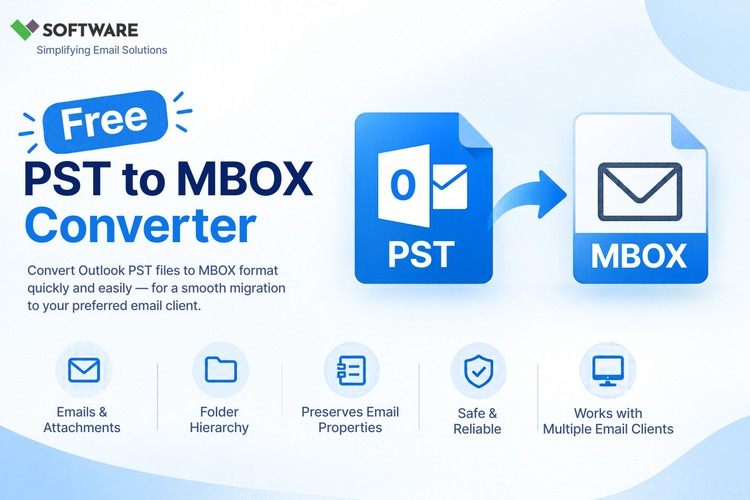
Email data is one of the most valuable assets for any organization. Whether a company is migrating to a new email platform, archiving important communications, or improving accessibility across different email clients, ensuring email portability has become a critical business requirement. This is where PST to MBOX Conversion plays a vital role.
Microsoft Outlook stores mailbox data in PST (Personal Storage Table) files, while many popular email clients such as Thunderbird, Apple Mail, Eudora, and Entourage use the MBOX format. As organizations adopt diverse email ecosystems, the need to transfer data between these formats continues to grow. Converting PST files into MBOX ensures seamless access to emails across various platforms while preserving essential mailbox information.
In this article, we will explore why businesses increasingly rely on PST to MBOX Conversion, its advantages, common use cases, and how the right PST to MBOX Conversion Software can simplify the process.
Understanding PST and MBOX File Formats
Before discussing the benefits of conversion, it is important to understand the difference between PST and MBOX files.
A PST file is a proprietary Outlook data file that stores emails, contacts, calendars, tasks, notes, and other mailbox components. It is commonly used in Microsoft Outlook environments.
An MBOX file is a widely supported mailbox format that stores email messages in a single file. Many email applications support MBOX, making it a preferred choice for cross-platform email management.
Because each format serves different email ecosystems, organizations often need a reliable way to move mailbox data from Outlook to MBOX-compatible platforms.
Why Email Portability Matters
Modern businesses rarely rely on a single email platform forever. Mergers, acquisitions, cloud adoption, budget considerations, and changing business needs often require organizations to switch email clients.
Email portability offers several benefits:
Freedom to migrate between email platforms.
Easier access to archived email data.
Reduced vendor dependency.
Long-term email preservation.
Improved collaboration across different operating systems.
Through PST to MBOX Conversion, organizations can ensure that valuable email data remains accessible regardless of the email application being used.
Key Reasons Organizations Choose PST to MBOX Conversion
1. Migration to Thunderbird and Other MBOX-Based Clients
Many companies choose Mozilla Thunderbird or other MBOX-supported applications due to their flexibility and cost-effectiveness.
Since Outlook stores emails in PST format, organizations must perform PST to MBOX Conversion to successfully migrate mailbox data to these alternative platforms. This conversion enables users to access their emails without manually recreating folders or losing important messages.
2. Cross-Platform Compatibility
Outlook is primarily associated with Microsoft environments, while MBOX is supported across multiple operating systems including Windows, macOS, and Linux.
Organizations seeking platform independence often convert PST files to MBOX because it provides greater compatibility with a wide range of email clients.
This flexibility is especially valuable for businesses with remote teams using different operating systems.
3. Simplified Email Archiving
Long-term email retention is often required for compliance, legal, and operational purposes.
MBOX files offer a convenient format for storing archived emails because they can be accessed through multiple applications. Organizations frequently use PST to MBOX Conversion Software to create portable archives that are no longer dependent on a specific Outlook environment.
This approach reduces the risk of losing access to historical communications in the future.
4. Reduced Dependence on Microsoft Outlook
Organizations may decide to move away from Outlook for financial, technical, or operational reasons.
When email data remains locked inside PST files, accessibility becomes limited. By converting PST files into MBOX format, businesses gain greater control over their data and eliminate dependency on a single email platform.
This flexibility can reduce software licensing costs and simplify future migrations.
5. Easier Cloud and Server Migration
Many cloud-based email services and server platforms support MBOX imports either directly or through migration utilities.
A successful PST to MBOX process allows organizations to prepare mailbox data for migration projects more efficiently. Instead of exporting emails manually, IT teams can streamline data transfer workflows and reduce migration complexity.
Benefits of PST to MBOX Conversion for Organizations
Preserves Valuable Email Data
A reliable conversion process ensures that important information remains intact, including:
Email content
Attachments
Folder hierarchy
Sender and recipient details
Date and time stamps
Metadata
Preserving this information is crucial for maintaining data integrity throughout migrations.
Enhances Accessibility
MBOX files can be opened in numerous email clients. This enhanced accessibility ensures that users can continue working with historical emails without requiring Outlook installation.
Supports Business Continuity
Unexpected changes in software infrastructure can disrupt email access. Maintaining portable MBOX copies of mailbox data helps organizations prepare for future transitions and emergency recovery situations.
Improves Data Management
Organizations frequently manage multiple PST files accumulated over years of Outlook usage. Converting these files into MBOX format simplifies centralized storage and management.
Challenges During PST to MBOX Conversion
While the conversion process offers significant benefits, businesses may encounter several challenges:
Large Mailbox Sizes
Massive PST files can contain thousands of emails and attachments. Manual conversion methods may struggle to process such data efficiently.
Risk of Data Loss
Improper conversion techniques can result in missing emails, corrupted attachments, or incomplete mailbox structures.
Metadata Preservation
Failing to preserve metadata can affect email authenticity and complicate future searches.
Technical Complexity
Manual approaches often require multiple applications, increasing the likelihood of errors and consuming valuable IT resources.
These challenges highlight the importance of selecting trusted PST to MBOX Conversion Software.
How PST to MBOX Conversion Software Simplifies the Process
Modern PST to MBOX Conversion Software is designed to eliminate manual effort and reduce migration risks.
Key features typically include:
Bulk Conversion
Organizations can convert multiple PST files simultaneously, saving significant time during migration projects.
Folder Structure Preservation
Advanced tools maintain original mailbox hierarchies, making post-conversion navigation easier.
Metadata Integrity
Professional software preserves essential email properties and header information throughout the conversion.
Selective Migration
Many solutions allow users to convert specific folders, date ranges, or mailbox categories.
User-Friendly Interface
Modern conversion tools provide intuitive interfaces that require minimal technical expertise.
With these capabilities, businesses can perform PST to MBOX operations quickly and accurately.
Best Practices for Successful PST to MBOX Conversion
To achieve reliable results, organizations should follow these recommendations:
Create a backup of original PST files before conversion.
Verify mailbox integrity before starting the process.
Use trusted PST conversion software with proven reliability.
Test the converted MBOX files in the target email application.
Perform pilot migrations before large-scale deployment.
Validate folder structures and attachments after conversion.
Following these best practices minimizes risks and ensures a smooth migration experience.
Conclusion
As organizations increasingly adopt diverse email platforms, email portability has become a strategic necessity. PST to MBOX Conversion enables businesses to move mailbox data beyond Outlook and access it across multiple email environments. Whether the goal is platform migration, long-term archiving, cloud adoption, or reducing vendor dependency, converting PST files to MBOX provides flexibility and long-term accessibility.
By using reliable PST to MBOX Conversion Software, organizations can preserve critical email data, maintain folder structures, and simplify complex migration projects. As a result, PST to MBOX conversion continues to be a preferred solution for businesses seeking secure, efficient, and future-ready email management.