Why Essential Oil Quotes Move: Crop Cycles, Yield and Season in India
By Piyush Gupta, Founder & CEO, Kanha Nature Oils · Published 18 November 2026 · Market figures are dated where they appear.
Essential oil price fluctuation in India starts in the field: when a crop is planted and cut, how many kilograms of oil each hectare really gives, and whether the rains and irrigation held. The rupee–dollar rate then moves the quote on top. For a bulk buyer, this means a quote is a snapshot of one crop cycle, not a fixed rate. This guide explains each driver using CSIR-CIMAP agronomy data and the 2026 season, then gives a checklist for reading any quote you receive.
Quick answer: Indian essential oil quotes move because of (1) the crop calendar, (2) oil yield per hectare, (3) monsoon and irrigation, (4) the rupee–dollar rate, and (5) timing of demand against new-crop arrivals. Annual crops such as mint can reprice sharply around the harvest. Perennial grasses such as lemongrass and palmarosa move more slowly but still swing with rain.
What causes essential oil price fluctuation in India?
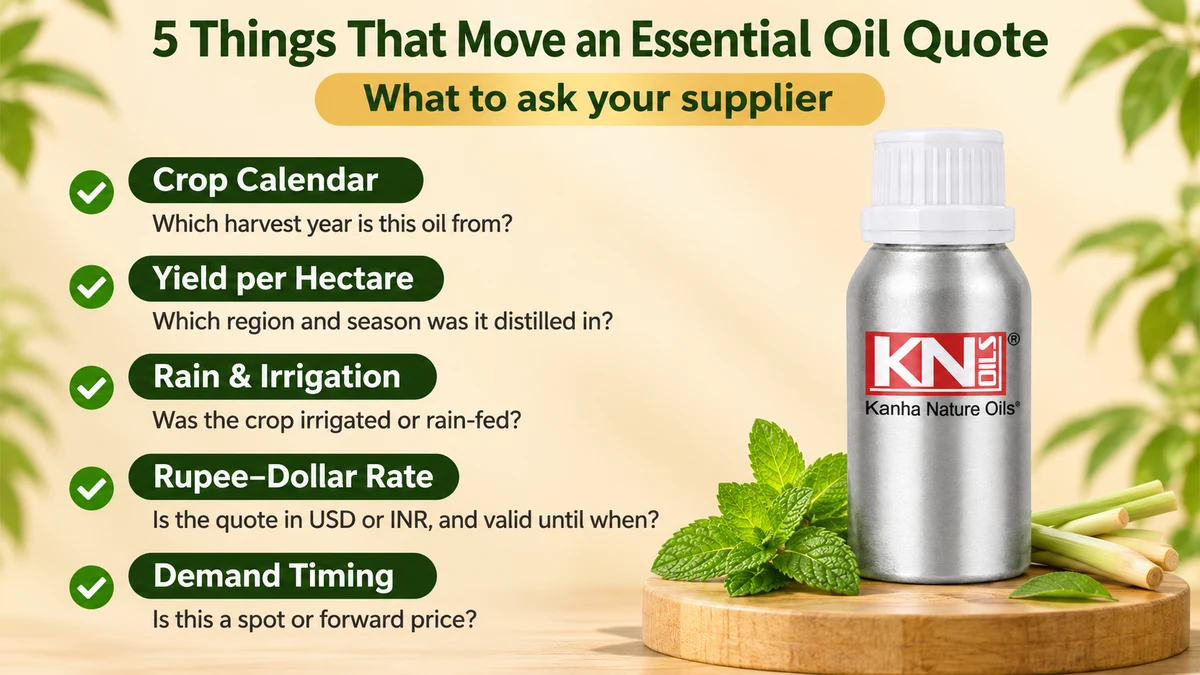
Five drivers and the question to ask for each. Driver What it does to a quote What to ask your supplier Crop calendar New-crop arrivals ease prices; late-season stock tightens them Which harvest year is this oil from? Yield per hectare Less oil per hectare means fewer kilograms for the same demand Which region and season was the batch distilled in? Rainfall and irrigation Rain-fed crops lose more oil in a dry year than irrigated ones Was this crop irrigated or rain-fed, and from which region? Rupee–dollar rate A USD quote can stay flat while the INR cost moves, and the reverse Is the quote in USD or INR, and until what date? Demand timing and substitutes Strong demand lifts prices; synthetic alternatives, such as synthetic menthol for mint, can cap them Is this a spot or forward price?
How do crop cycles affect essential oil quotes?
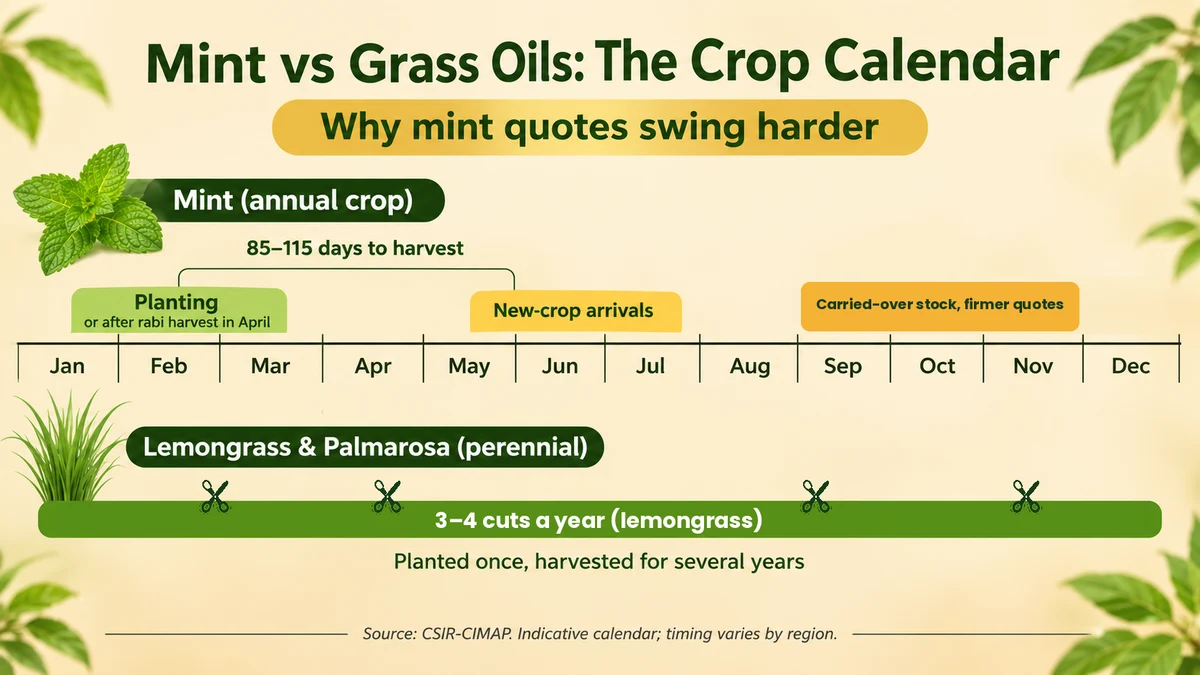
Annual mint vs perennial grasses. Source: CSIR-CIMAP.
Mint is an annual crop. CSIR-CIMAP puts menthol mint (Mentha arvensis) at 85–90 days to harvest when transplanted and 110–115 days when planted from suckers. Uttar Pradesh accounts for around 80% of Indian mint production. Research papers estimate national output at roughly 30,000–40,000 tonnes of oil a year, so a small change in sown area is felt quickly. Because it is replanted every year, farmers can change acreage each season, which is why mint quotes usually swing harder than those of perennial crops.
The calendar also matters within the year. Mint is planted from about January–February (or after the rabi harvest in April), according to a CIMAP plant patent, so with 85–115 days to harvest the main arrivals come from about May. By September–November the market is largely working from carried-over stock, which is consistent with firmer quotes late in the season.
Lemongrass and palmarosa are perennial grasses. CIMAP’s lemongrass guidance describes 3–4 cuts a year, a lower yield in the first year, a peak around year three and a decline afterwards. Palmarosa is also a multi-harvest crop. These oils do not reprice around a single annual harvest, which is why they can look steadier. The trade-off is that a planting shortfall lasts longer, because a plantation cannot be replaced in one season.
For specifications and batch documents, see our Mentha arvensis oil, lemongrass oil and palmarosa oil pages.
Why does oil yield per hectare move the price?
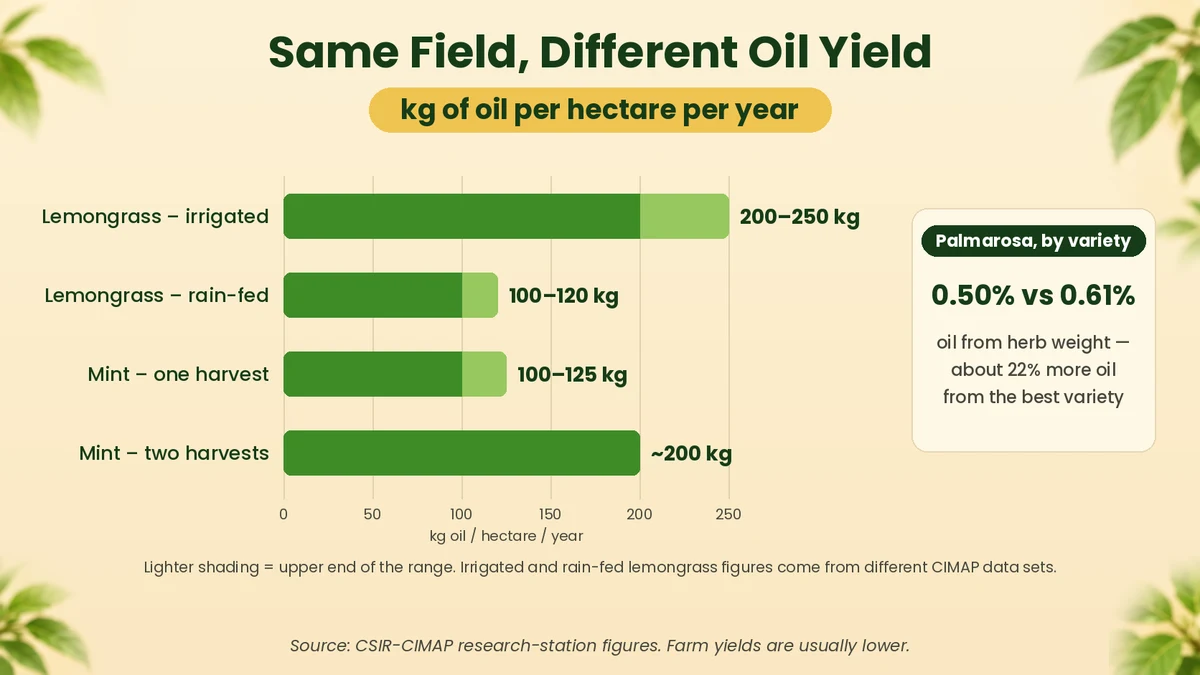
Oil yield per hectare. Source: CSIR-CIMAP.
The same hectare can give very different oil volumes. CIMAP’s figures show how much:
Lemongrass: 200–250 kg oil per hectare per year under irrigation (five-year CIMAP data). Without irrigation, CIMAP’s two-harvest data gave 100–120 kg, so the two figures are not a like-for-like comparison.
Menthol mint: 100–125 kg per hectare from a single harvest, around 200 kg with two (CIMAP).
Palmarosa, by variety: in one CIMAP trial, oil yield ranged from 0.50% to 0.61% of herb weight, about 22% more oil from the best variety.
These are research-station figures, and farm yields are usually lower. The point for buyers is the direction: water, the number of harvests and the variety can each change the oil a field produces by a fifth or more, and that flows into the quote.
What did the 2026 season show?
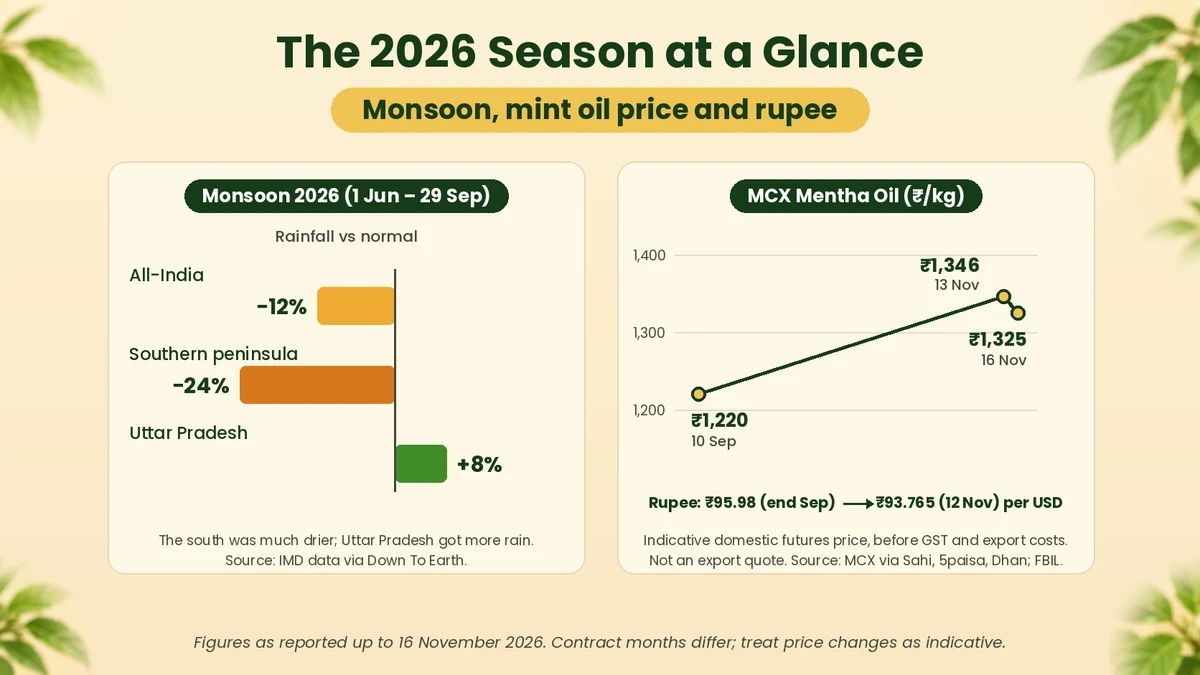
Monsoon (IMD) and MCX mentha oil, to 16 Nov 2026.
Monsoon: IMD data show all-India rainfall 12% below normal for 1 June–29 September 2026, with El Niño cited as the main cause. The southern peninsula was 24% short, while Uttar Pradesh received 8% more rain than normal. This does not prove any oil’s price moved, but it is the regional split to ask about: a CHEMEXCIL buyer briefing lists lemongrass as coming from Kerala and Odisha, and Kerala lies in the southern peninsula where rain was 24% short. For palmarosa and other oils, ask your supplier for the origin of each batch.
Mint oil (MCX futures, a domestic INR price): quoted near ₹1,220/kg on 10 September (Sahi), about ₹1,346/kg on 13 November (5paisa) and ₹1,325/kg on 16 November (Dhan). That is roughly 9–10% above September, though the contract months differ, so treat it as indicative. These live pages change daily, so check mcxindia.com for official data. At the 12 November rate below, ₹1,346 is about USD 14.4/kg, under both trackers that follow, though those cover Q2 rather than November. MCX is a domestic price before GST and export costs, so it is not an export quote. Procurement Resource says synthetic menthol limited mint price growth in Q2 2026.
Currency: the FBIL reference rate was ₹95.98 per US dollar at the end of September and ₹93.765 on 12 November, about 2.3% stronger, as reported by Clarity UPSC. FBIL is the official publisher of the reference rate.
Price trackers disagree: two public trackers put Indian mentha oil at about USD 16/kg and USD 21/kg for the same period, Q2 2026 (April–June). Use them for direction only, and base purchase decisions on a written, dated supplier quote.
When is a low quote a warning?
In a year of crop stress or a strong rupee swing, an offer that stays unusually low is a reason to check, not to celebrate. Cheap oil can mean old stock, a different grade, or dilution. A batch-specific COA and GC-MS report will show whether the composition fits the product name. See how to test essential oil adulteration in bulk and how to read a GC-MS report.
How should you read a bulk essential oil quote?
Fix the basis. Confirm FOB or CIF, currency and validity date. Our guide to FOB vs CIF for essential oil imports explains what each includes.
Ask for batch documents. Request the COA, GC-MS report and SDS (Safety Data Sheet — still widely called MSDS) for the specific product and batch. See which documents to demand before you order.
Test before you commit. Order a 100 ml trial pack first. The minimum export order is 1 kg, and above that the quantity is up to you.
Compare like with like. Match botanical name, key constituent specification, pack size and basis before comparing two prices.
Time orders around arrivals. For annual crops, ask when new-crop oil is expected. For lead times and pack sizes, see our bulk lavender oil guide.
Treat a quote as dated. Re-confirm before each purchase order rather than reusing last quarter’s number.
Have a quote you want to check against this list? Ask us for a dated, batch-specific quote with COA and GC-MS.
Request a Dated QuoteOrder a 100 ml Trial Pack
To check a supplier’s industry standing, look at IFEAT, the Essential Oil Association of India and CHEMEXCIL, the export promotion council for the sector.
The bottom line for buyers
An Indian essential oil quote reflects one crop cycle, one yield level, one season’s rain and one exchange rate. When any of those changes, the quote changes too. Ask which harvest and region the oil comes from, fix the basis and validity date, and check the batch documents before you compare prices. A quote you understand is worth more than a quote that is simply low.
FAQ
Why do essential oil prices in India change so often?
Because supply depends on crops. Planting dates, rain, irrigation and oil yield per hectare change every season, and the rupee–dollar rate is added to that.
Which Indian essential oil price is easiest to track?
Mentha oil, which has a public benchmark in MCX Mentha Oil futures. Most other oils are quoted directly between supplier and buyer, so a written quote is the main reference.
Is the lowest quote the best one?
No. A low quote may reflect a different grade, older stock or a different basis. Compare batch COA and GC-MS data and the FOB or CIF terms first.
When is the best time to place a bulk order?
There is no reliable single date. A practical approach is to ask when new-crop oil arrives, confirm the validity of the quote and verify the batch documents before paying.
About Kanha Nature Oils
Kanha Nature Oils, based in Bahadurgarh, Haryana, manufactures and exports 700+ products across 12 categories, including 250+ essential oils, to buyers in 60+ countries. The company is a member of IFEAT, FAFAI and EOAI and is certified to ISO 9001:2015, ISO 14001:2015, WHO-GMP, HACCP, KOSHER and HALAL. COA, GC-MS report and SDS are issued on request for the specific product and batch.
Planning a bulk order? Ask for a dated, batch-specific quote or a 100 ml trial pack.
Request a Free SampleWhatsApp UsEmail Us
We don’t ask you to trust us. We ask you to test us.
Email: info@aromatherapyoil.in
Phone: +91 92549 73446
WhatsApp: +91 92549 73447
Unit-1: Adjoining HUDA Plot No. 682, M.I.E. Part-A, Bahadurgarh, Haryana – 124507
Unit-2: 677, M.I.E., Part-A, Bahadurgarh, Haryana – 124507
About the author: Piyush Gupta is the founder and CEO of Kanha Nature Oils, with 27 years in the fragrance and essential oils industry. He is Regional Secretary (North Zone) of FAFAI and Treasurer of the Essential Oil Association of India (EOAI).
Sources and references
CSIR-CIMAP: mint, lemongrass, palmarosa, annual report, patent, journal · Indian Journal of Agronomy · IMD via Down To Earth · MCX via Sahi, 5paisa, Dhan · FBIL via Clarity UPSC · Price trackers: IMARC, EMR, Procurement Resource · CHEMEXCIL briefing
The post Why Essential Oil Quotes Move: Crop Cycles, Yield and Season in India appeared first on Kanha Nature Oils.