
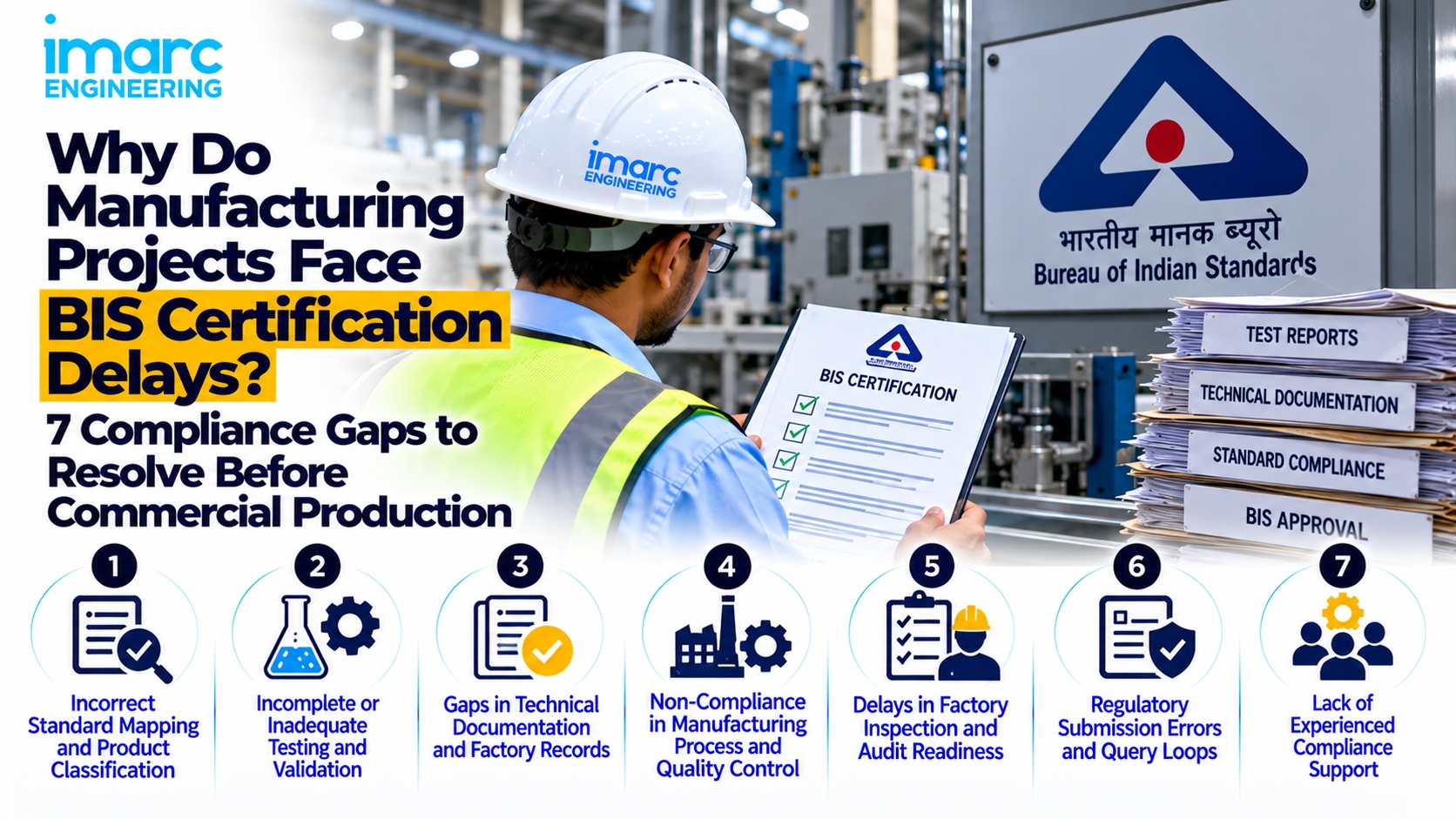
The line is ready and stock is planned. BIS-related certification is treated as a final paperwork step. Then test failures, incomplete factory documentation, wrong standard mapping or query loops push approval past the commercial launch date—while inventory and customer commitments wait.
Manufacturing projects face BIS certification delays when compliance is started late, scoped loosely or built on incomplete technical evidence. For products covered by mandatory certification or Quality Control Orders, BIS approval is not a formality after production; it is a gate that depends on product, process and documentation readiness. Manufacturers planning commercial production should consider BIS certification and regulatory compliance support early in the project to identify applicable standards, testing requirements and documentation gaps.
What BIS Certification Delay Actually Means
In practice teams experience:
Samples failing or requiring retest against the applicable Indian Standard
Factory or process information incomplete for audit or application review
Prolonged queries on scope, models, materials or test reports
Confusion between voluntary ISI use and mandatory certification routes
Commercial production or sale held while certification remains open
Last-minute design or labelling changes to meet standard requirements
Delay is often blamed on “the bureau.” Many holds start earlier—in applicability assessment, test planning and file quality.
Why Projects Underestimate BIS Timelines
Project schedules prioritise equipment, utilities and CTE/CTO. Product certification is assigned late to quality or a consultant without linking design freeze, bill of materials and packing marks to the standard. Laboratories, sample quantities and scheme-specific requirements are discovered after the application is filed. Parallel product variants multiply scope without a clear model strategy.
7 Compliance Gaps to Resolve Before Commercial Production
1. Unclear applicability and scheme mapping
Not every product needs the same BIS route. Mandatory coverage under a Quality Control Order, product certification scheme type and the correct Indian Standard must be confirmed early. Wrong mapping wastes months on the incorrect path.
2. Standard requirements not frozen into design and BOM
Dimensional, material, performance and marking requirements in the standard must drive design—not the other way around. Late discovery that a component or construction method fails the standard forces redesign after tooling or procurement.
3. Test plan incomplete or lab path not secured
Required tests, sample size, recognised laboratory capacity and retest contingency should be planned before production samples are casually pulled. Queue time and failed parameters are common sources of calendar slip.
4. Weak technical file and factory documentation
Applications and audits need consistent product description, manufacturing outline, quality plan, calibration and test records. Scattered or contradictory documents generate queries and follow-up visits.
5. Model, variant and brand scope poorly defined
Multiple SKUs, materials or brand names without a clear inclusion strategy expand testing and review. Scope should be deliberate: what is covered in the first licence versus what follows as addition.
6. Marking, labelling and packaging left to the end
Standard-driven marking and instructions are often treated as artwork tasks. Incorrect marks or missing information block closure even after tests pass.
7. No buffer between certification readiness and commercial commit
Sales dates, distributor fill and import substitution timelines are set as if certification were certain on a fixed week. Without a critical-path buffer and internal readiness gates, every query becomes a market delay.
How to Resolve Gaps Before Commercial Production
Confirm applicability against current mandatory lists and the product definition
Map HS/product description to the relevant standard and certification obligation with a documented conclusion.Build a standard-to-design checklist
Each critical requirement should have an owner in design, sourcing or process engineering.Lock a test and sample plan early
Identify tests, labs, lead times and what constitutes a pass for the intended scope.Assemble a controlled technical file
Product specs, process flow, QC plan, critical component list and prior test data should be version-controlled.Define licence scope deliberately
Decide models and variants for the first grant; avoid open-ended “all variants” without evidence.Align marking and packaging with the standard before print runs
Artwork and die designs should wait on compliance review where marks are prescribed.Put BIS milestones on the integrated project schedule
Link them to design freeze, pilot production and commercial release—not only to a consultant’s follow-up list.Run an internal readiness review before filing
Treat the application like a customer audit package: complete, consistent, evidence-backed.
Practical Scenarios
Scenario A: Lab failure after launch planning
Samples from pilot production fail a mandatory performance test. Reformulation or component change pushes both certification and shipment.
Scenario B: Scope creep in models
Marketing adds variants mid-process. Each addition reopens questions on testing and documentation. The original timeline expires.
Scenario C: File inconsistency
Application data, BOM and process description do not match. Queries cycle until one controlled dataset is established.
Scenario D: Readiness-first approach
Applicability, standard checklist, test plan and file are closed before commercial dates are hard-committed. Queries still occur but do not start from basic gaps.
Decision Point: Is the Product Ready to File—or Only Ready to Make?
Ask:
Is mandatory coverage and the correct standard unambiguously identified?
Does the current design and BOM meet the standard without open deviations?
Are tests planned with lab capacity and sample strategy agreed?
Is the technical file consistent enough for review without contradiction?
Are commercial dates buffered against retest or query cycles?
If production is ready but these answers are soft, certification delay is already a commercial risk.
Pre-Production BIS Compliance Checklist
Applicability and scheme conclusion documented
Indian Standard requirements mapped to design and BOM
Test list, lab route and sample plan defined
Technical file and factory quality evidence compiled
Model/variant scope for first licence fixed
Marking and label content compliance-checked
Certification milestones on the master schedule
Internal readiness review completed before application
Contingency for retest or scope reduction agreed with sales
When to Resolve These Gaps
Address them:
at product concept and design freeze—not after pilot stock is built
before ordering long-lead components that affect standard compliance
before fixing distributor or retail launch dates
when adding new models, materials or plants to an existing licence
before treating “application submitted” as “market clearance achieved”
After commercial production is committed, the same gaps become rushed redesign, idle finished goods and missed shelves.
How IMARC Engineering Can Help
IMARC Engineering supports manufacturers who need product certification and regulatory readiness treated as part of project and production planning—not as a last-mile formality. Structured compliance support can clarify applicability, evidence requirements and readiness before commercial production depends on an open file.
Relevant support is available through product certification support for teams aligning design, testing and documentation with Indian certification requirements.
Talk to IMARC Engineering if BIS certification sits on the path to commercial production and you need applicability, test readiness and technical-file gaps closed before launch dates are locked: https://www.imarcengineering.com/contact?service=regulatory-approval-and-licensing&subservice=bis-certification
Conclusion
Manufacturing projects face BIS certification delays when applicability is unclear, design ignores the standard, testing is improvised, technical files are weak, model scope is open-ended, marking is left late and commercial dates ignore certification risk. Process speed at the authority cannot compensate for an incomplete compliance package.
Seven gaps explain most schedule slips that appear only when production is already waiting. Teams that resolve them before commercial production protect both compliance and go-to-market plans. Teams that file late and hope for a clean pass often rediscover the standard under time pressure.
The practical takeaway is clear: treat BIS readiness as a production gate equal to equipment capability—because for covered products, the market does not open when the machine runs; it opens when certification does.
Contact Us:
IMARC Engineering
Phone +91-120-433-0800
Email: sales@imarcengineering.com
India: C-130, Sector 2, Noida, Uttar Pradesh 201301
LinkedIn: https://www.linkedin.com/showcase/imarc-engineering/



