

Companies face repeated audit nonconformities mainly because earlier corrective actions fixed the symptom rather than the cause, or because ownership, resources or system design were never put right. ISO consultancy in Malaysia can help by running an independent root cause analysis, redesigning the failing process, and checking that the fix works before the next audit. It cannot replace management commitment.
A repeat finding is more than an annoyance, because certification bodies can escalate unresolved or recurring problems. This article takes a third-party view of why findings recur, what auditors expect from corrective action, when outside help is justified, and where its limits lie.
Why Do the Same Nonconformities Keep Coming Back?
They keep coming back because the earlier fix dealt with the symptom, was never checked for effectiveness, or left the underlying causes, such as unclear ownership, missing resources or a poorly designed process, unchanged.
What Is the Difference Between a Correction and a Corrective Action?
A correction fixes the detected problem, while a corrective action eliminates its cause so it does not recur. ISO 9001 clause 10.2 asks the organization to react to a nonconformity, evaluate the need to remove its cause, implement the action, review its effectiveness and update risks and the system where necessary. Reworking a defective output is a correction. Changing why the defect occurred is a corrective action.
Where Do Repeated Findings Usually Appear?
They tend to appear in the routines that depend on discipline rather than daily work. A white paper from certification body PJR names management review (clause 9.3) as the most commonly cited area of nonconformance in ISO 9001 audits, with internal audit (clause 9.2) second. Both are periodic activities that can easily slip when operations get busy.
How Serious Is a Repeat Finding?
It can be serious. The accreditation definitions in ISO/IEC 17021-1 recognize that several minor nonconformities against the same requirement or issue may show a systemic failure and count as a major one, and practitioners report that a minor finding left unresolved by its deadline can be upgraded. Some sector schemes, such as aerospace, treat recurrence across consecutive audits as a failure of the corrective action process. Rules vary by certification body and scheme, but the direction is consistent: repeated audit nonconformities draw closer scrutiny, and an unresolved major finding can end in suspension.
What Do Auditors Expect From Corrective Action After Repeated Audit Nonconformities?
Auditors expect evidence that the root cause was found through a structured analysis, that the action addressed it and any similar situations elsewhere, that effectiveness was reviewed, and that records were kept and deadlines met. Anything less invites the same finding at the next visit.
What Does a Credible Root Cause Analysis Look Like?
It uses a structured method, such as the 5 Whys, a fishbone diagram or a fault tree, and it asks why the system allowed the problem, not who made the mistake. Clause 10.2 also asks whether similar nonconformities exist or could occur elsewhere, so the analysis should look beyond the single instance. One training source warns that actions out of proportion to the cause, such as blaming individual operators, miss the point and rarely hold.
How Should Effectiveness Be Verified?
The effectiveness review should be scheduled when the action is implemented and tracked to completion, with evidence that the problem has not returned over a defined period. It is the step companies skip most often, which is why one practitioner source calls it critical and often overlooked. Without it, a repeat finding is simply the first proof that the earlier fix failed.
What Mistakes Do Companies Commonly Make?
Practitioner sources list five that recur:
• Stopping at the immediate cause
• Choosing an action before the investigation is finished
• Closing the record without objective evidence
• Skipping the effectiveness review
• Treating corrective action as a paperwork exercise rather than a genuine improvement process
Each of these produces a record that looks complete and a system that is unchanged, which is how repeated audit nonconformities are born.
When Should a Company Bring in ISO Consultancy in Malaysia for Repeated Audit Nonconformities?
A company should bring one in when the same finding has appeared in consecutive audits, when a major finding has been raised or a minor one escalated, or when no one inside has the objectivity or skill to run an independent root cause analysis. Help that arrives before a suspension is far cheaper than help that arrives after.
What Are the Warning Signs?
The main warning signs are:
• The same or a similar finding in two consecutive audits
• Findings clustered in one clause or process
• Corrective actions closed on paper while internal audits keep finding the same issue
• A certification body deadline approaching with no credible plan
• Staff turnover or growth that has outpaced the system
Is Outside Help Always Needed?
No. If the cause is known and a capable quality manager has the authority to fix it, the company can act alone. Outside help is justified when the team is stuck, when the stakes are high, or when management has lost confidence in its own corrective action process. It also helps to ask the certification body to clarify a finding that is unclear, since a misunderstood finding is a common reason for a fix that misses. A certification body cannot provide consultancy to the clients it certifies, so independent advice has to come from a separate party.
How Does a Consultant Break the Cycle of Repeated Audit Nonconformities?
A consultant breaks the cycle by reviewing the history of findings, running an independent root cause analysis with the people involved, redesigning the failing process, assigning ownership, verifying that the fix works and following up before the next audit.
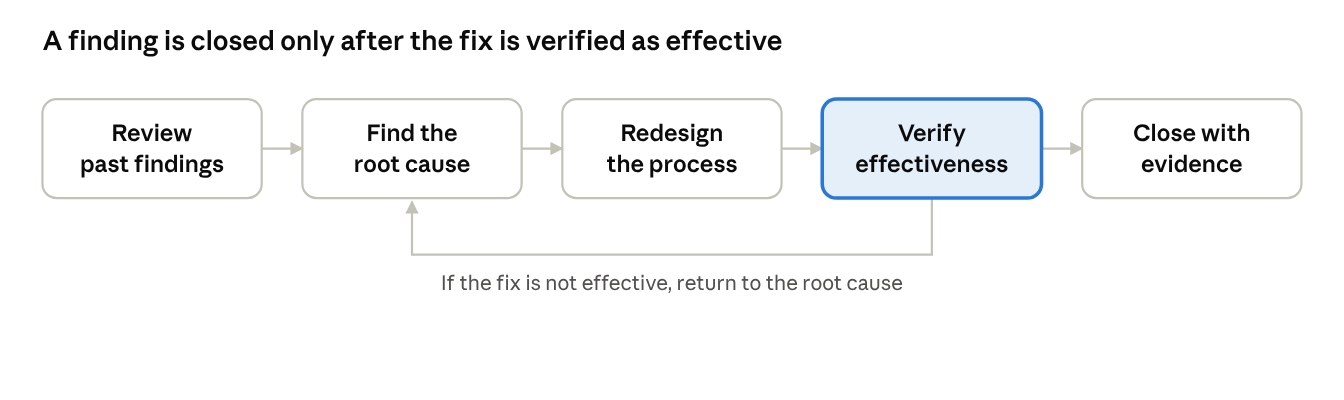
Corrective action loop · 5 steps, 1 loop back
The verification step is the one most often skipped, and a failed check sends the work back to the root cause.
What Does Each Step Involve?
The steps are:
1. Review past findings: read previous audit reports, internal audit records and corrective action files to see patterns across clauses and years.
2. Find the root cause: run a structured analysis with process owners, asking why the system allowed the problem and whether it could occur elsewhere.
3. Redesign the process: change the routine, the responsibility, the resource or the record that failed, instead of adding another reminder.
4. Verify effectiveness: check after a defined period that the problem has not returned, using objective evidence.
5. Close with evidence: record the result, and escalate again if the check shows the fix did not work.
Who Needs to Be Involved?
Process owners, supervisors and top management all need to take part. The people who run the process know where it breaks, and management controls the resources and priorities that often sit behind a repeat finding. The consultant facilitates and challenges, but the analysis should not be done by one person alone or by the same person who designed the failing process.
What Are the Limits and Criticisms of Using a Consultant for Repeated Audit Nonconformities?
A consultant cannot fix management commitment or culture, and critics warn that outside fixes can become band-aids, create dependency or add cost. A balanced view also recognizes that some disputes about findings are about grading, not failure.
What Do Critics Say?
Critics raise four points:
• Culture and resources: if repeat findings stem from missing management attention or budget, a consultant's analysis may be ignored
• Band-aid fixes: pressure to pass the next audit can lead to extra paperwork instead of real change
• Dependency: ownership of the corrective action process can drift to the consultant
• Cost: fees come on top of audit fees and staff time
What Do Supporters Reply?
Supporters reply that independence is the point: outsiders can see causes insiders have stopped noticing, and a clear analysis gives top management something concrete to act on. Auditors who have raised major findings for repeat issues describe the finding as a prompt to look at the problem at a higher level and to bring in more cross-department and senior support. Used that way, a consultant strengthens the response instead of replacing it.
What If the Company Disagrees With a Finding?
The first step is to ask the certification body to clarify the finding and the evidence behind it, since grading can involve judgement and repeat occurrences can have different root causes. Accredited certification bodies also operate complaints and appeals processes for disagreements that clarification does not settle. A disputed finding still needs an answer within the deadline, so the company should respond while the dispute runs.
How Can a Company Prevent Repeated Audit Nonconformities in the Long Term?
A company can prevent them by treating findings as a trend instead of isolated events: tracking them in one register, giving every action a named owner, pointing internal audits at past findings and putting the trends in front of top management.
Which Practices Help Most?
The practices that help most are:
• A register of all external and internal findings, recording clause, cause and status, reviewed for patterns
• A named owner and due date for every action, including the effectiveness check
• Internal audits that look first at what the last audit found
• Nonconformity trends on the management review agenda, with decisions and resources attached
• A short briefing for staff after each audit on what was found and what changed
When a finding repeats, the useful question is not who failed but which part of the system allowed it to happen twice.
Final Takeaway
Repeated audit nonconformities are a signal about the system, not about individuals. ISO consultancy in Malaysia helps most when it brings independence to the root cause analysis, redesigns the failing process and insists on verifying that the fix works. It cannot supply management commitment, so the companies that break the cycle are those whose leaders act on what the analysis shows and treat each finding as information.






