
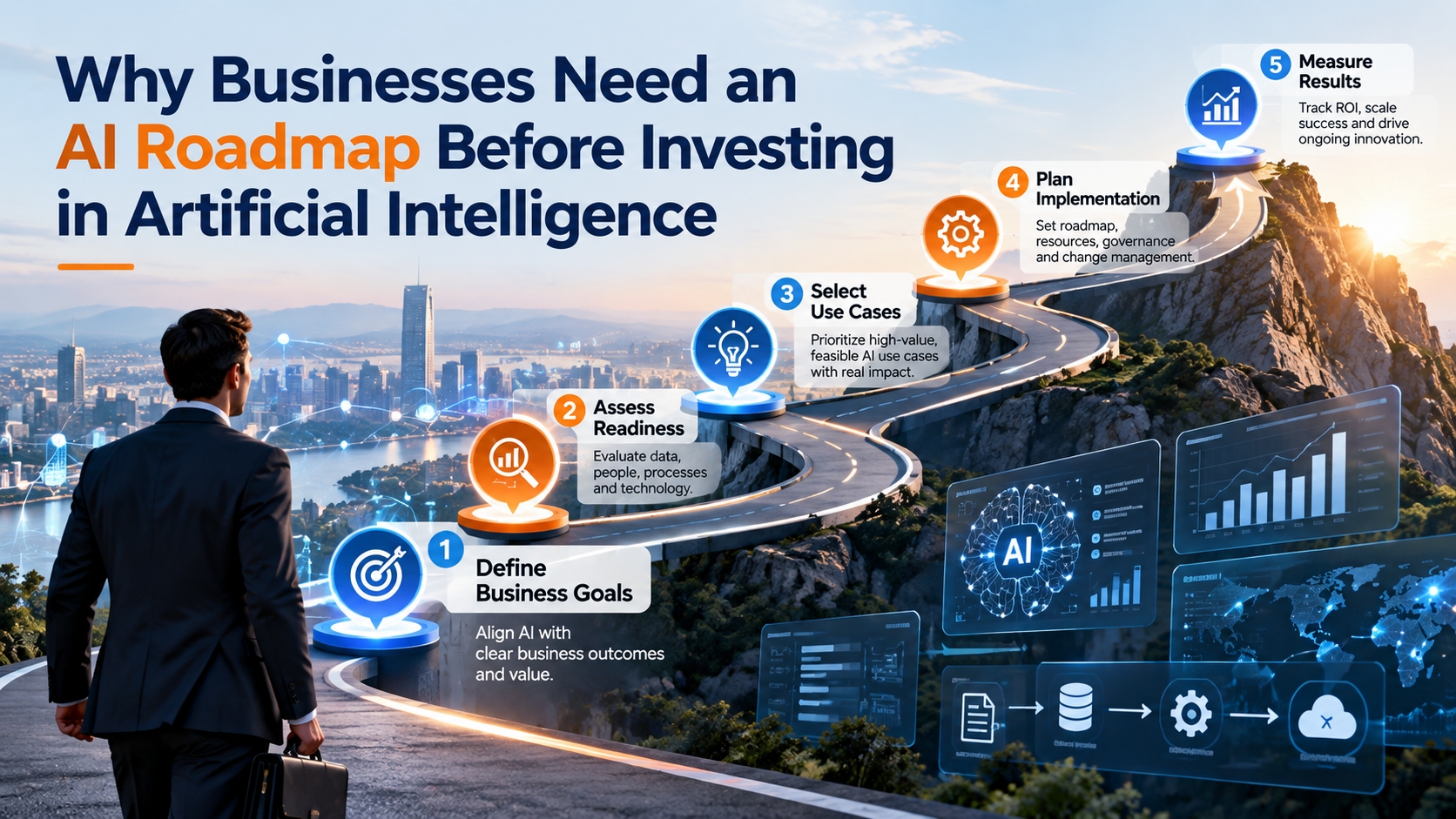
Artificial intelligence is no longer limited to large technology companies. Businesses across healthcare, finance, retail, real estate, and other industries are exploring AI to improve efficiency, automate operations, and deliver better customer experiences.
However, investing in artificial intelligence without proper planning can create more problems than it solves.
Many organisations adopt AI tools without understanding their technical requirements, implementation costs, or expected business outcomes. This often results in disconnected systems, wasted resources, and solutions that fail to deliver measurable value.
A structured AI strategy helps businesses avoid these challenges. This is where AI roadmap consulting plays an important role.
Why AI Projects Fail Without Proper Planning
Implementing artificial intelligence involves more than purchasing software or integrating an AI model into an existing application.
Successful AI adoption requires a clear understanding of business objectives, available data, technical infrastructure, and operational workflows.
Without this preparation, organisations may encounter several challenges.
1. Investing in the Wrong AI Solutions
Businesses sometimes implement AI technologies because they are popular rather than because they solve a specific problem.
For example, a company might invest in an advanced predictive analytics platform when its immediate challenge could be addressed through simple workflow automation.
Identifying the right problem before selecting a technology helps prevent unnecessary expenditure.
2. Poor Data Quality
AI applications depend on reliable and accessible data.
If information is incomplete, outdated, or scattered across multiple systems, AI-generated insights may be inaccurate or difficult to use.
A proper assessment helps businesses understand whether their existing data can support the proposed AI solution.
3. Unclear Return on Investment
An AI project should have measurable objectives.
Without defined performance indicators, businesses may struggle to determine whether their investment is improving productivity, reducing costs, or generating additional revenue.
4. Integration Challenges
New AI applications often need to connect with existing CRM platforms, ERP systems, databases, and business applications.
Poor integration planning can increase development costs and create operational disruptions.
How AI Roadmap Consulting Helps Businesses Make Better Decisions
AI roadmap consulting provides a structured approach to identifying practical AI opportunities and evaluating their business value.
Instead of recommending technology immediately, experienced consultants examine existing business processes and identify areas where artificial intelligence could create meaningful improvements.
This process typically includes evaluating business objectives, reviewing current systems, analysing available data, and prioritising potential AI applications.
The result is an actionable plan that helps decision-makers understand what should be implemented, why it matters, and what resources will be required.
For startups and growing businesses with limited budgets, this planning process can be particularly valuable because it reduces the risk of committing resources to unsuitable projects.
Essential Components of AI Roadmap Development Consulting
Effective AI roadmap development consulting connects business strategy with technical execution.
A comprehensive roadmap should address the following areas.
Business Objectives and Opportunity Assessment
Every AI initiative should begin with a clearly defined business problem.
Organisations must determine whether their primary objective is reducing manual work, improving decision-making, increasing sales productivity, or enhancing customer satisfaction.
These goals provide the foundation for selecting suitable AI applications.
AI Readiness Evaluation
Before investing in development, businesses should assess their existing technical environment.
This includes reviewing available data, software systems, infrastructure, security requirements, and internal technical capabilities.
An AI readiness evaluation helps identify potential obstacles before implementation begins.
Use Case Prioritisation
Not every AI opportunity delivers equal value.
Potential projects should be compared based on expected business impact, implementation complexity, available resources, and operational risks.
Businesses can then prioritise projects that offer a realistic opportunity to demonstrate value.
Budget and Implementation Planning
AI projects may require software development, API integrations, data preparation, cloud infrastructure, and ongoing maintenance.
A practical roadmap should outline estimated investment requirements and implementation phases.
This helps organisations make informed financial decisions and allocate resources effectively.
Performance Measurement
AI solutions should be evaluated against measurable business outcomes.
Depending on the project, relevant indicators might include time saved, reduced processing errors, improved customer response times, or increased sales conversions.
Monitoring these metrics helps businesses determine whether their AI initiatives are delivering the intended results.
Practical AI Applications Across Different Industries
A well-planned AI strategy can help businesses discover opportunities that may not be immediately obvious.
Healthcare: AI can support administrative document processing, appointment management, and selected operational workflows, subject to appropriate privacy and clinical safeguards.
Real Estate: AI-powered lead qualification, property recommendations, and customer communication tools can help agencies manage enquiries more efficiently.
Retail and E-commerce: Demand forecasting, customer support automation, and product recommendation systems can improve operational efficiency and customer experiences.
Financial Services: Document analysis, transaction monitoring, and automated reporting can help teams manage information-intensive processes.
Professional Services: Intelligent document processing, knowledge retrieval, and workflow automation can reduce repetitive administrative work.
The suitability of each application depends on business requirements, data quality, regulatory obligations, and implementation feasibility.
Choosing the Best Consulting Partner for AI Roadmap Creation
Finding the best consulting partner for AI roadmap creation is an important decision for businesses beginning their AI transformation.
A suitable consulting partner should offer more than technical expertise. They should understand operational challenges and help organisations evaluate AI opportunities from a commercial perspective.
When comparing potential partners, businesses should consider the following factors.
Business understanding: Consultants should focus on identifying real operational challenges before recommending solutions.
Technical capabilities: Experience with AI development, machine learning, API integrations, and software architecture helps ensure recommendations are practical.
Transparent recommendations: A responsible consultant should explain when off-the-shelf software, traditional automation, or process improvements may be preferable to custom AI development.
Clear deliverables: Consulting engagements should produce actionable recommendations, implementation priorities, cost estimates, and success metrics.
Long-term scalability: Proposed solutions should consider future business growth, system maintenance, and integration requirements.
For organisations evaluating potential AI investments, AI consulting services offer a business-focused approach to assessing AI readiness, identifying valuable use cases, and preparing practical implementation roadmaps.
The emphasis is on helping businesses make informed decisions before committing significant development resources.
Turning an AI Strategy Into a Working Solution
Developing an AI roadmap is an important first step, but effective execution determines whether the strategy produces meaningful results.
After identifying a suitable use case, businesses need to decide whether to build a custom solution, integrate an existing product, or improve their current systems.
Working with an experienced AI software development company can help organisations translate technical requirements into scalable applications and connect AI capabilities with existing business workflows.
However, implementation should begin with a manageable scope.
A proof of concept can help validate technical feasibility, while a minimum viable product can provide an opportunity to evaluate a solution in a practical business environment.
Based on the results, businesses can determine whether further investment, additional integrations, or broader deployment is justified.
This phased approach reduces uncertainty and creates opportunities for continuous improvement.
Common Questions About AI Roadmap Planning
Do small businesses need AI roadmap consulting?
Small businesses can benefit from AI roadmap consulting when they have several possible AI opportunities but limited resources to invest. A focused assessment can help them identify which projects are worth pursuing.
How is AI consulting different from AI development?
AI consulting focuses on evaluating opportunities, defining priorities, and preparing an implementation strategy. AI development involves building, integrating, testing, and deploying the selected solution.
Can an AI roadmap reduce implementation costs?
A well-prepared roadmap can help businesses avoid unnecessary development, identify existing tools that meet their needs, and prioritise investments. Actual savings depend on the project's scope and execution.
Should every business build custom AI software?
No. Many organisations can achieve their objectives through existing AI tools, software integrations, or conventional automation. Custom development is most appropriate when business requirements cannot be adequately met by available solutions.
Conclusion
Artificial intelligence offers opportunities to improve productivity, streamline operations, and create better customer experiences. However, successful adoption depends on selecting the right applications and implementing them with clear business objectives.
An effective AI roadmap helps organisations evaluate technical readiness, prioritise worthwhile opportunities, estimate costs, and establish measurable performance targets.
By investing in strategic planning before development, businesses can make more confident decisions and reduce the risk of unsuccessful AI projects.
Ultimately, the goal is not simply to adopt artificial intelligence. It is to implement technology that solves meaningful problems and supports sustainable business growth.