Sudden cardiac arrest can happen to anyone, at any age, and often without warning. The heart stops pumping blood effectively, and the person loses consciousness within seconds. CPR helps keep blood moving, but in many cases only an electric shock from an automated external defibrillator (AED) can restore a normal rhythm. AED training prepares ordinary people to use this device with confidence. This article explains why the training matters, who should take it, what participants learn, and how to select a course.
Why Defibrillator Skills Matter
The Role of Time
Survival from cardiac arrest depends heavily on speed. The American Heart Association reports that the chance of survival drops by roughly 7 to 10 percent for every minute that passes without defibrillation. Emergency medical services may need several minutes to arrive, so the first person on the scene often determines the outcome. A bystander who can use an AED within the first few minutes gives the patient a much better chance.
Removing Hesitation
Many people avoid using an AED because they fear causing harm or doing it wrong. Training reduces that fear. Participants handle a real device, hear its prompts, and practice the steps several times. The AED analyzes the heart rhythm itself and will not deliver a shock unless one is needed. Knowing this helps learners act without delay.
Growing Availability of Devices
AEDs are now common in airports, schools, gyms, office buildings, places of worship, and shopping centers. A device on the wall is useful only if someone present knows how to apply it. AED training connects the equipment to people who can operate it.
Who Should Take the Class
Workplace safety teams, teachers, coaches, child care staff, fitness instructors, security personnel, and flight attendants are commonly asked to hold this training. Many employers and regulators require it for designated responders. Parents, caregivers, and community volunteers also attend, since cardiac emergencies often occur at home or in public spaces. No medical background is needed.
What Participants Learn
Classes follow the guidelines of a national organization such as the American Heart Association or the American Red Cross. Content is organized into a short set of skills that build on each other.
Recognizing Cardiac Arrest
Learners start by identifying the signs. A person who is unresponsive and not breathing normally, or only gasping, is treated as being in cardiac arrest. Participants practice checking the scene for safety, tapping the person, and calling for help. They also learn to send someone to retrieve the AED while they begin CPR.
Performing CPR Until the Device Arrives
Chest compressions are the first action. Participants practice a rate of 100 to 120 per minute and a depth of at least 2 inches for adults, with full chest recoil between compressions. Most classes also teach rescue breaths and the ratio of 30 compressions to 2 breaths. Compressions continue until the AED is ready, so blood keeps flowing to the brain and heart.
Operating the AED Step by Step
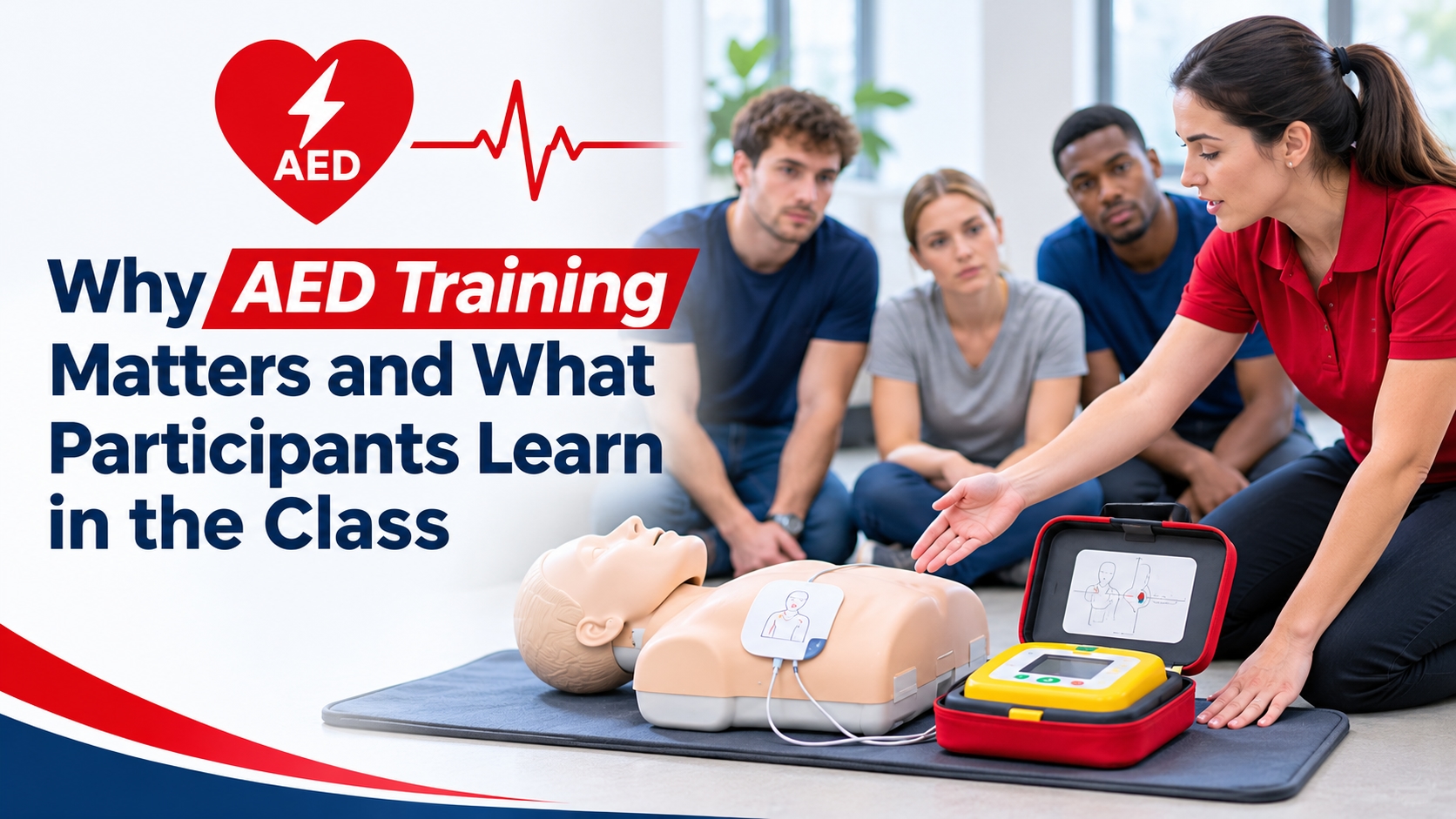
The core of the class is hands-on use of a training AED. The sequence is simple and repeated several times:
Turn on the device and follow its voice prompts.
Remove clothing from the chest and dry the skin if it is wet.
Attach the pads in the positions shown on the pad illustration.
Allow the device to analyze the rhythm while no one touches the person.
Clear the area, then press the shock button if the device advises a shock.
Resume compressions right away when the device instructs.
Instructors explain why each step exists. For example, no one touches the person during analysis or a shock, because contact can interfere with the reading and expose the rescuer to the current.
Special Situations
Participants learn how to adjust for different patients and settings. Children and infants may need smaller pads, and many devices include a pediatric setting or key. If pediatric pads are not available, adult pads can be used, with care that they do not touch each other. Learners also cover how to handle a wet surface, a medication patch on the chest, or a visible implanted device. In each case, the person should be moved or the pads adjusted according to the device instructions.
Device Care and Readiness
Instructors briefly cover maintenance. Learners are shown how to read the status indicator, check the battery, and note expiration dates. A device that is not ready cannot help in an emergency, so this section is short but practical.
Practice and Evaluation
Most of the class time goes to practice. Participants work on manikins, often with feedback tools that display compression rate and depth. Instructors observe, correct hand placement, and run short scenarios that combine the steps above. A skills check is typically required for a completion card, and some programs add a short written quiz. Cards usually remain valid for two years, after which a refresher is needed.
Course Formats and Selection
The Heartsaver CPR Course
One widely used option is the Heartsaver CPR course offered through the American Heart Association. It is designed for the general public and covers adult CPR, AED use, and choking relief, with optional lessons for children and infants. The class is shorter than a healthcare provider course and suits workplaces that need a basic card.
Choosing a Provider
Before registering, a learner should confirm that the course follows a recognized organization, that a certified instructor teaches it, and that the card will be accepted by the employer or licensing body. Blended formats combine an online lesson with an in-person skills session, which is useful for busy schedules. KT Global CPR is one example of a provider that learners can review using these criteria. Course descriptions, card types, and class formats should be clear before enrollment.
Conclusion
Quick defibrillation gives a person in cardiac arrest the best chance of survival, and bystanders are often the ones who can provide it. AED training teaches participants to recognize an emergency, start CPR, operate the device, and handle special situations. A basic community course gives these skills in a short, practical format that suits workplaces, schools, and families.