Ohio landlords can refuse an emotional support animal only in a short list of situations, and most of them depend on facts about the specific animal or the specific property. A general no pets policy is not one of them. For renters, the practical question is whether a refusal fits one of those narrow exceptions or simply reflects a landlord who has not reviewed the request properly.
The starting point is valid documentation. An emotional support animal (ESA) letter from a licensed clinician turns an ordinary pet question into a formal accommodation request that the landlord must consider.
Can a landlord deny an ESA animal in Ohio?
Yes, but only on limited grounds recognized under fair housing law.
In housing covered by the Fair Housing Act, a provider must make reasonable accommodations for tenants with disabilities. Allowing an emotional support animal in a building that bans pets is a classic example.
Renters who submit an ESA letter for Ohio renters shift the burden. The landlord can no longer rely on the lease's pet clause alone and must identify a lawful reason before refusing.
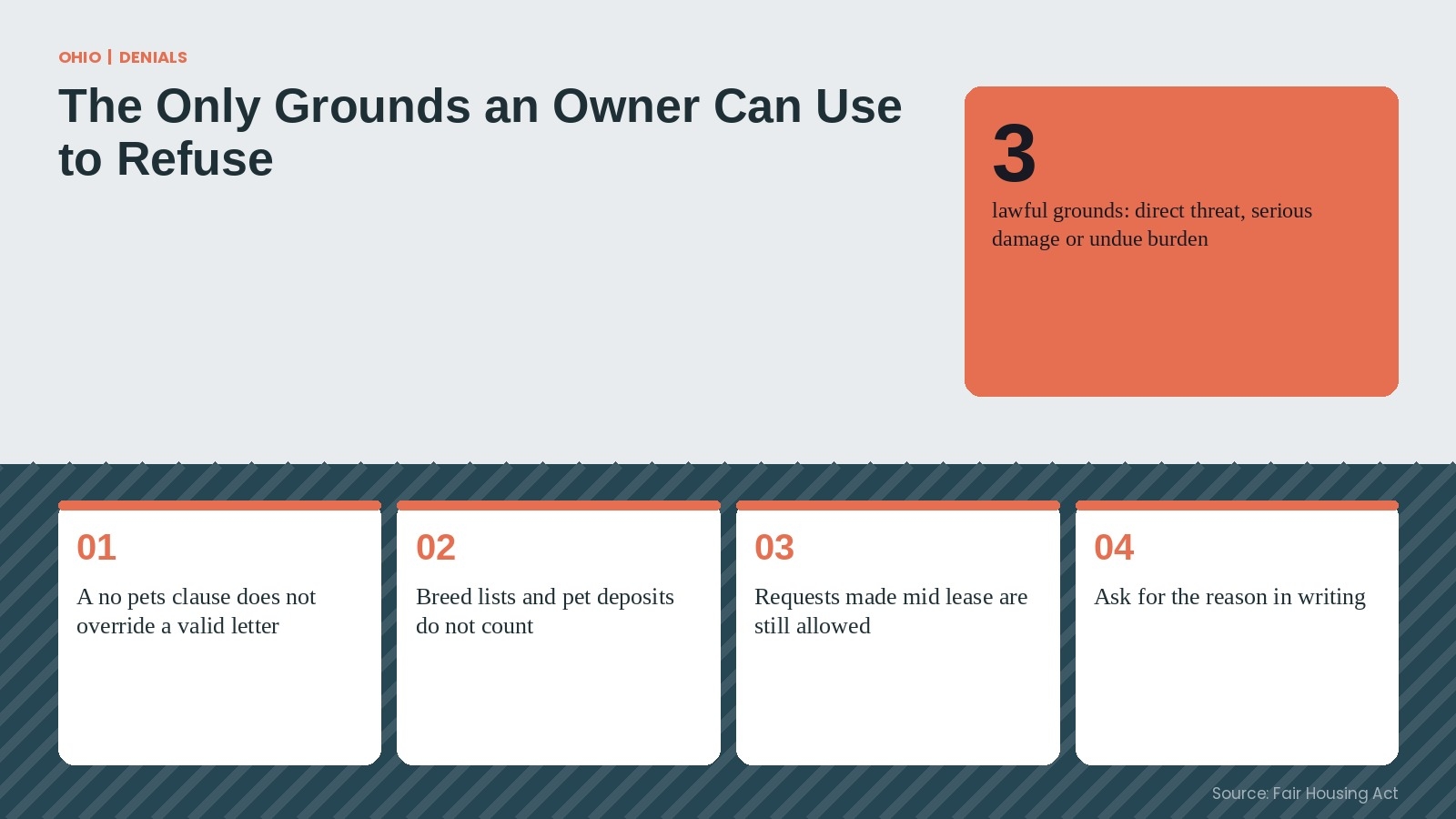
The recognized grounds fall into three groups:
The specific animal poses a direct threat to the health or safety of others.
The specific animal would cause serious damage to the property of others.
The accommodation would impose an undue financial or administrative burden.
Each one requires evidence. A landlord's preference, discomfort or worry about future complaints does not meet the standard.
What counts as a direct threat?
A direct threat is a documented safety risk from the particular animal, not its species or breed.
Objective proof carries the weight here. Examples include a prior bite, an attack on another animal or a recorded incident with animal control.
Generalizations fall short. A landlord who refuses a German shepherd because the breed "looks dangerous" has not shown that this dog has ever behaved dangerously.
Before refusing, providers are generally expected to ask whether conditions could reduce the risk. A leash rule in hallways or a muzzle during repair visits may solve the concern without denying the request.
When no reasonable measure would remove the threat, a refusal for that particular animal may be lawful. The tenant could still request an accommodation for a different animal.
When does property damage justify a refusal?
Only when the specific animal would cause serious damage that cannot be reasonably prevented.
The prediction must be grounded in the animal's history. A landlord cannot assume that a young dog will chew through walls simply because some puppies do.
Minor wear is part of renting with any animal. Scratches on a door frame or a stained carpet do not usually rise to the serious damage threshold.
Evidence of significant destruction is different. A documented history of chewed drywall or ruined flooring at a previous rental may support a landlord's concern.
Tenants remain financially responsible for damage their ESA causes. Landlords can deduct real repair costs from the security deposit, even though pet deposits and pet rent generally do not apply.
Offering a training plan or a reference from a previous landlord often settles worries before they become grounds for refusal.
What is an undue burden for an Ohio landlord?
An undue burden is a cost or administrative strain that is unreasonable for that particular provider.
This ground is applied case by case. A large management company with many units faces a different calculation than a small owner with one rental.
Insurance is the most common example raised. If a provider can show that its insurer would cancel coverage or impose a cost the business cannot reasonably absorb, the claim may carry weight.
Vague statements do not. A landlord should be able to point to specific facts, such as written notice from an insurer, rather than an assumption.
Requests for an unusual animal can also raise burden questions. Housing a large or exotic species may involve structural or safety issues that a dog or cat would not.
Which Ohio housing is outside Fair Housing Act coverage?
A few small or private arrangements are exempt from federal accommodation rules.
Federal law carves out certain situations. These include some owner occupied buildings with four or fewer units and some single family homes rented by the owner without a broker.
Housing run by certain religious organizations and private clubs may also be treated differently for their own members.
University residence halls are generally covered, but schools handle requests through their own disability or housing offices. Students should follow the school's process and submit paperwork well before the term begins.
State fair housing law can apply where federal law does not, so an exemption under one does not automatically mean no protection at all.
A plain explanation of Ohio ESA laws helps renters work out which rules cover their particular building before they assume a refusal is final.
What reasons are not lawful grounds for denial?
Blanket policies, fees and stereotypes do not justify refusing a valid request.
Ohio renters sometimes hear explanations that sound official but fail under fair housing rules. Common examples include:
"Our building has a strict no pets policy."
"We do not allow dogs over a certain weight."
"That breed is on our restricted list."
"You must pay a pet deposit first."
"Other tenants might complain."
Each of these treats the ESA as an ordinary pet. Once a valid letter is provided, the landlord must assess the request as an accommodation instead.
Ohio's own rules point the same way. A press release on Yahoo Finance covering Ohio ESA housing rules notes that Ohio Administrative Code Rule 4112-5-07 lets a person with a disability keep an animal assistant in covered housing without an extra charge, while staying responsible for any damage the animal causes.
A demand for diagnosis details is also off limits. The provider may verify the clinician's license but cannot require medical records.
Can a landlord refuse an ESA requested after move in?
No, timing alone is not a lawful reason to refuse.
A disability related need can arise at any point during a tenancy. A renter who signed a no pets lease last year may still request an accommodation today.
The landlord reviews a mid lease request the same way as one made at application. The letter, the animal and the property are what matter.
Bringing the animal home first and asking afterward can cause friction, though. Submitting the request before the animal arrives shows good faith and avoids a lease violation notice while the review is pending.
Do neighbor allergies or complaints justify a denial?
Not on their own, though landlords may need to balance competing needs.
A neighbor's allergy can itself be a disability. When two accommodation needs collide, a provider is generally expected to look for a workable solution rather than reject one tenant outright.
Options might include assigning units on different floors, adjusting cleaning schedules in shared spaces or using air filtration in common areas.
General complaints carry less weight. A neighbor who simply dislikes animals has not created a lawful reason for refusal.
Repeated, documented nuisance problems are another matter. Persistent barking or unsanitary conditions that breach the lease can still lead to enforcement against the tenant.
Can a landlord reject the letter itself?
Yes, if the letter is unreliable or cannot be verified.
A refusal based on documentation is different from a refusal based on the animal. Landlords may question letters that lack key details or come from unverifiable sources.
Weak documentation often includes:
No license number or an expired license.
A clinician not licensed in Ohio.
A registry certificate instead of a clinician's letter.
No issue date or no contact details.
No state runs an ESA registry, so registry cards do not count as ESA letters.
RealESALetter letters are written by clinicians licensed in Ohio, and the service liaises with the landlord if a letter is questioned. That support helps resolve documentation doubts before they turn into a denial.
How should Ohio renters respond to a refusal?
Ask for the reason in writing, answer that reason and keep records.
Request a written explanation
A clear statement of the reason shows whether the refusal targets the animal, the letter or the property. It also creates a record if the dispute escalates.
Address the specific concern
If the issue is safety, offer training records or conditions such as leashing. If it is documentation, provide the clinician's contact details for verification.
Seek outside help
A local fair housing organization can review the situation. Since HUD's May 22, 2026 enforcement memo, state enforcement is primary and HUD is secondary, so Ohio's state channels are the first stop for complaints.
Renters wanting more detail on each lawful ground can learn when a landlord can deny an ESA and how providers are expected to apply those limits.
Frequently asked questions
Can an Ohio landlord deny an ESA because of a no pets lease?
No. A no pets clause does not override a valid accommodation request in covered housing.
Can a landlord limit me to one emotional support animal?
Not automatically. Federal law sets no fixed number, but your letter must support the need for each animal.
Can I be evicted if my ESA bites someone?
Possibly. A documented attack can show a direct threat and justify removing that particular animal.
Do restaurants and stores in Ohio have to allow my ESA?
No. ESAs have no public access rights under the ADA, so businesses can generally refuse them.
Can a landlord ask me to get a different letter?
Only if the current one is unreliable. A valid letter from an Ohio licensed clinician should be accepted for review.