Dubai is becoming an exciting environment for businesses exploring innovative digital experiences. From real estate and hospitality to healthcare, education, retail, and manufacturing, organizations are looking for new ways to engage customers, train employees, and present complex information. Virtual reality (VR) offers an opportunity to create interactive digital environments where people can explore products, understand spaces, and experience simulated situations before making real-world decisions.
However, not every virtual reality solution delivers the same business value. A visually impressive experience may attract attention, but organizations also need reliable performance, intuitive navigation, relevant features, and a clear purpose behind the technology. Choosing the right development partner can make a significant difference in how effectively a VR application supports business objectives.
A capable virtual reality company combines technical expertise with creative thinking and an understanding of industry requirements. It identifies the challenges a business wants to solve, selects suitable technologies, and develops an experience that users can navigate comfortably. Understanding these qualities helps businesses in Dubai and across the UAE make informed decisions when exploring immersive technology.
Virtual Reality Innovation in Dubai: Beyond Visual Experiences
Virtual Reality Innovation in Dubai is not limited to creating realistic digital environments. It involves using immersive experiences to solve practical business challenges, improve communication, and help users understand information in more interactive ways. Businesses can use VR to present products, demonstrate processes, simulate environments, and offer experiences that traditional digital content may not communicate as effectively.
For example, a real estate developer can create a virtual walkthrough of a property before construction is complete. Potential buyers can explore room layouts, understand the available space, and visualize the design without needing to visit a physical location. Similarly, a hotel can use virtual tours to help customers explore selected rooms, facilities, or event spaces before making a reservation.
VR can also support employee training and product demonstrations. Organizations can introduce employees to simulated equipment or workplace scenarios, allowing them to become familiar with selected procedures in a controlled environment. In education, immersive experiences can help learners explore complex subjects through interactive visual demonstrations.
Businesses exploring VR innovation should focus on the following considerations:
Clear business objectives: Define whether the experience is intended to improve customer engagement, support training, explain products, or simplify planning.
User-focused design: Make navigation and interactions easy to understand, including for people who have never used a VR headset.
Relevant content: Build environments and scenarios that reflect the intended audience and real business requirements.
Reliable performance: Optimize the experience for suitable devices and maintain responsive interactions.
Measurable outcomes: Identify how the project will be evaluated after launch.
The strongest VR projects begin with a business need rather than a technology trend. When the purpose is clearly defined, developers can create experiences that are useful, practical, and relevant to the organization.
VR Technology Adoption in the UAE: What Businesses Should Consider
VR Technology Adoption in the UAE depends on more than the availability of advanced hardware. Organizations must consider their budgets, workforce readiness, technical infrastructure, user expectations, and the suitability of VR for their intended applications.
Some businesses may benefit from a comprehensive immersive environment, while others can begin with a focused application that addresses one specific challenge. A property developer might start with a virtual property tour, whereas a manufacturing company could test a simulation for equipment familiarization. Starting with a defined use case allows organizations to evaluate the experience before expanding the project.
Hardware selection is another important consideration. Some applications require dedicated VR headsets, while other immersive experiences may offer alternative ways to access digital environments. Businesses should evaluate device compatibility, user comfort, session duration, equipment management, and the practical conditions in which the application will be used.
Content localization can also influence adoption. Applications developed for audiences in Dubai and the wider UAE may require suitable language options, familiar environments, and content relevant to local customers or employees. An experience that is difficult to understand or navigate may struggle to gain acceptance, regardless of its technical sophistication.
Before investing in a VR project, businesses should assess:
The specific business problem the application will address.
The intended users and their familiarity with immersive technology.
The hardware, software, and infrastructure required for deployment.
The cost of development, testing, updates, and maintenance.
The availability of employee training and ongoing technical support.
The expected business outcomes and methods for measuring performance.
A structured evaluation helps organizations avoid unnecessary complexity and select a solution that fits their actual requirements. It also provides a foundation for improving the application as users become more familiar with the technology.
Business Applications of Virtual Reality Across Industries
The Business Applications of Virtual Reality extend across customer experiences, professional training, product visualization, and operational planning. The most suitable application depends on the industry's requirements and the specific outcome a business wants to achieve.
In real estate and architecture, VR allows potential buyers, investors, and project teams to explore digital representations of properties. In healthcare and education, immersive simulations can support selected learning activities and help users visualize complex concepts. Retailers and hospitality providers can use virtual environments to present products, venues, and facilities in an interactive format.
Industrial businesses can also explore VR for equipment familiarization, safety education, and procedural training. These experiences can provide a controlled setting for practice, although they should complement appropriate practical instruction and established safety procedures rather than automatically replace them.
Some common applications include:
Real Estate and Architecture: Virtual property tours, building walkthroughs, and design visualization before physical construction is complete.
Healthcare and Education: Interactive learning environments, professional training simulations, and visual explanations of complex subjects.
Retail and E-commerce: Virtual product demonstrations that help customers understand selected features before purchasing.
Hospitality and Tourism: Immersive hotel tours, venue previews, and destination experiences that support customer decision-making.
Manufacturing and Engineering: Simulated equipment familiarization, process visualization, and controlled training scenarios.
Corporate Training: Interactive learning experiences that help employees practice selected tasks in a simulated environment.
A strong VR development partner understands that each industry has different priorities. A real estate application may emphasize visual quality and spatial accuracy, while a training application may prioritize task completion, feedback, and learning outcomes.
By matching the experience to the intended use case, businesses can avoid developing features that look impressive but provide limited practical value.
Immersive Technology Capabilities That Set Strong Providers Apart
Immersive Technology Capabilities involve more than creating three-dimensional environments. A successful VR application requires software engineering, interaction design, content development, performance optimization, device compatibility, and ongoing support.
One of the most important capabilities is designing interactions that feel natural to users. People should be able to navigate the environment, select objects, access information, and complete tasks without unnecessary confusion. Clear instructions and consistent controls can make the experience more accessible, particularly for first-time users.
Technical performance is equally important. VR applications need responsive controls and smooth visual output to provide a comfortable experience. Complex environments, high-resolution assets, and demanding interactions must be optimized for the devices on which the application will run. Poor performance can interrupt the experience and reduce user confidence.
Integration capabilities also matter when businesses want VR to work alongside existing systems. Depending on the project, the application may need to connect with learning management platforms, product information systems, analytics tools, or other business applications. Planning these connections early can improve the usefulness and maintainability of the solution.
When evaluating a provider's technical capabilities, businesses should look for:
3D Environment Development: The ability to create appropriate digital spaces, objects, and interactive scenes.
User Experience Design: Clear navigation, understandable controls, and interactions designed around the intended audience.
Platform Compatibility: Development and testing for the VR devices and platforms required by the project.
Performance Optimization: Efficient rendering, responsive controls, and suitable loading performance.
System Integration: Connections with relevant business applications, databases, or learning platforms where required.
Quality Assurance: Testing of functionality, usability, device compatibility, and performance under expected conditions.
Maintenance and Updates: Ongoing support for content changes, technical issues, and evolving business requirements.
A provider that considers the entire application lifecycle is better positioned to deliver a solution that remains useful after its initial launch. This approach helps businesses evaluate VR as a long-term digital investment rather than a one-time visual project.
Factors Behind VR Industry Growth
Several Factors Behind VR Industry Growth are encouraging businesses to explore immersive technology. Improvements in hardware, more capable development tools, growing interest in interactive experiences, and the need for effective digital communication have created opportunities for new applications.
Traditional images, videos, and presentations remain useful, but they may not always provide the level of interaction needed to understand a product or environment. VR allows users to explore digital spaces, examine objects from different angles, and experience simulated situations. This can be particularly useful when spatial understanding or practical interaction is important.
Training requirements are another factor. Organizations that need employees to become familiar with equipment, processes, or selected workplace scenarios may find value in controlled simulations. These environments can support repeatable practice and allow trainers to evaluate specific activities, depending on how the application is designed.
More accessible development tools can also help businesses test ideas before committing to a larger project. A proof of concept can demonstrate whether the proposed experience is technically feasible, useful to its intended audience, and appropriate for the available budget.
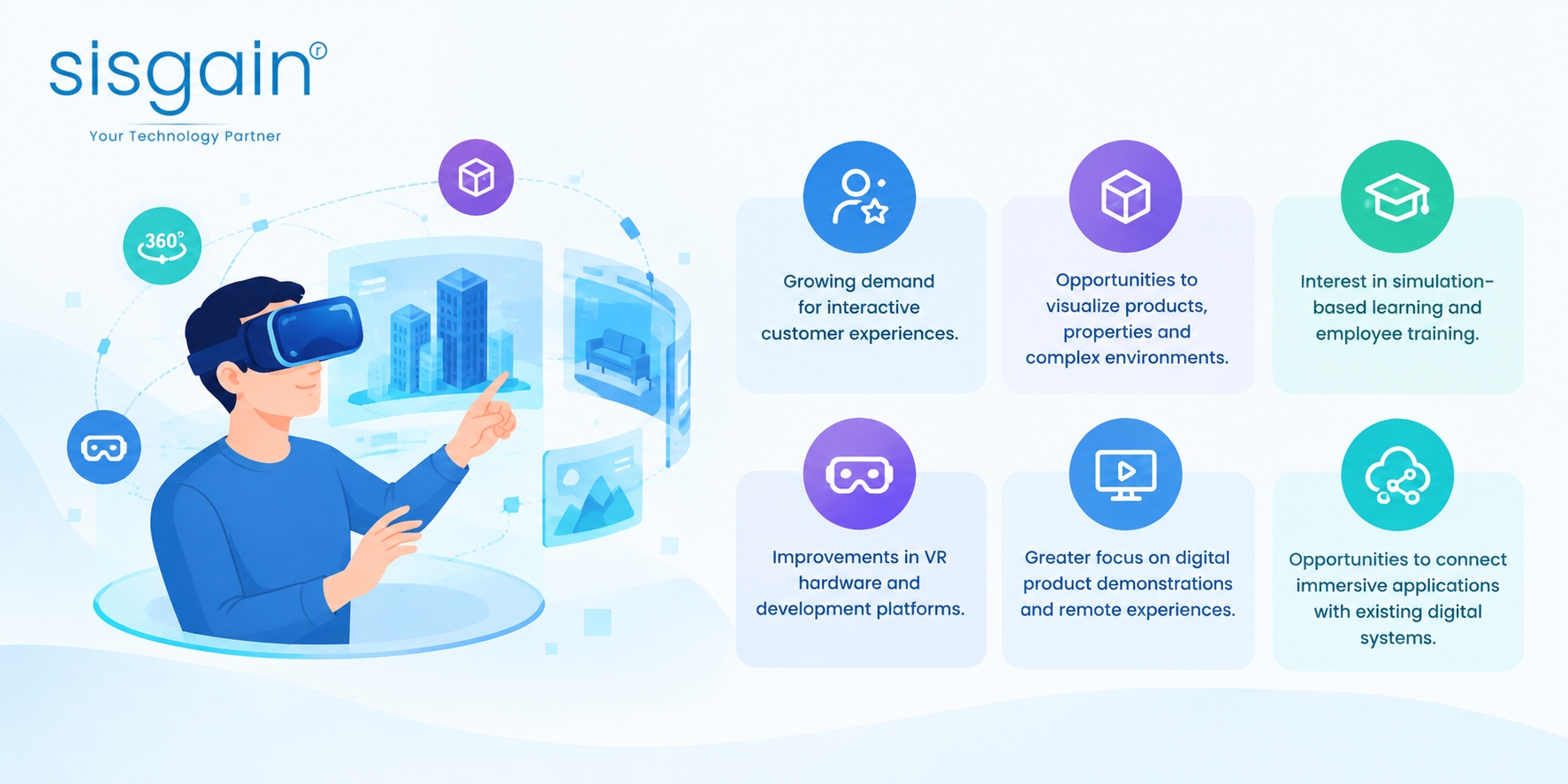
Key factors influencing business interest in VR include:
Growing demand for interactive customer experiences.
Opportunities to visualize products, properties, and complex environments.
Interest in simulation-based learning and employee training.
Improvements in VR hardware and development platforms.
Greater focus on digital product demonstrations and remote experiences.
Opportunities to connect immersive applications with existing digital systems.
Despite these opportunities, VR is not the right choice for every business challenge. Development costs, device availability, user comfort, content maintenance, and employee adoption can influence the overall value of a project.
Businesses should therefore evaluate potential benefits against the full cost of implementation. A carefully selected use case with clear objectives can be more valuable than a large immersive project without a defined purpose.
How to Choose the Right Virtual Reality Development Partner
Choosing a VR development partner requires more than reviewing visual demonstrations or promotional claims. Businesses should assess whether a provider can understand their requirements, deliver a reliable application, communicate clearly, and support the solution over time.
Relevant experience is a useful starting point. Reviewing previous projects can help organizations understand how a provider approaches user interaction, technical performance, content development, and deployment. Experience with a similar industry or use case may be especially valuable when the project involves specialized workflows or complex requirements.
The discovery process is another important indicator. A capable provider should ask about the target audience, business objectives, device requirements, integration needs, and expected outcomes before recommending a solution. This helps ensure that the proposed application is based on actual business requirements instead of unnecessary features.
Businesses should evaluate potential providers using the following criteria:
Industry Experience: Review relevant projects and examples of work that demonstrate an understanding of the intended use case.
Technical Expertise: Assess capabilities in VR development, 3D design, interaction development, and performance optimization.
Business Understanding: Look for a partner that connects technical decisions with specific business objectives.
Transparent Project Planning: Confirm that the scope, deliverables, milestones, and responsibilities are clearly explained.
Testing Procedures: Ask how the application will be tested across supported devices and user scenarios.
Security and Data Handling: Understand how information is stored, accessed, and protected where the application collects or processes data.
Post-Launch Support: Clarify the approach to updates, troubleshooting, maintenance, and future enhancements.
Scalability: Determine whether the solution can accommodate additional content, users, or integrations when business needs change.
When comparing the best virtual reality company in dubai for a specific project, businesses should focus on demonstrated capabilities, relevant experience, and the provider's ability to explain how the proposed solution will deliver value. The right partner should also be transparent about technical limitations, implementation requirements, and ongoing costs.
A careful selection process helps organizations establish realistic expectations and creates a stronger foundation for successful development.
Measuring the Business Value of a VR Solution
A virtual reality application should be evaluated according to its intended purpose. Without clear performance indicators, businesses may find it difficult to determine whether the experience has improved customer engagement, supported learning, or contributed to operational goals.
For customer-facing projects, organizations may track experience completion rates, user feedback, product inquiries, and relevant booking or purchase activity. These measures can help determine whether the experience provides useful information and supports customer decision-making. However, high engagement alone does not automatically demonstrate a financial return.
Training applications require different measures. Businesses may evaluate task completion, knowledge retention, performance during follow-up assessments, and employee feedback. Results should be interpreted carefully and alongside other training methods to understand the application's contribution.
Operational projects may focus on the time required to complete selected tasks, the effectiveness of planning activities, or improvements in training delivery. Financial evaluation should also account for development, hardware, integration, content updates, and maintenance expenses.
Businesses can assess a VR project using several indicators:
User Engagement: Track experience completion, interaction patterns, and relevant user feedback.
Customer Experience: Review customer satisfaction and the effect on selected product inquiries or booking decisions.
Training Outcomes: Measure learning performance, task completion, and knowledge retention where appropriate.
Operational Improvements: Evaluate whether the application supports more effective training, planning, or communication.
Technical Reliability: Monitor performance, compatibility issues, and application errors.
Total Cost of Ownership: Include development, hardware, integration, maintenance, and support costs.
The most useful measurement plan is created before development begins. Establishing a baseline allows organizations to compare results over time and identify where further improvements are needed.
Regular evaluation also helps businesses decide whether to expand the application, introduce additional features, or refine the existing experience. This keeps technology investment aligned with business priorities.
Building Practical Immersive Experiences with SISGAIN
Developing a valuable VR solution requires technical planning, user-focused design, and a clear understanding of business requirements. SISGAIN supports organizations exploring digital solutions that align with their operational objectives and customer needs. For businesses considering immersive technology, a structured approach can help identify suitable use cases, define essential features, and address integration, usability, and maintenance requirements. Careful planning also helps organizations evaluate performance and refine the experience as their needs evolve. The focus should remain on developing technology that solves a genuine business challenge and delivers practical value rather than pursuing immersion for its own sake.
Conclusion
A virtual reality company stands out when it combines technical expertise with a practical understanding of business needs. Strong providers develop intuitive experiences, optimize performance, plan reliable integrations, and consider the long-term requirements of deployment and support. For businesses in Dubai and across the UAE, the right VR project begins with a clear objective and a realistic assessment of its potential value. By evaluating industry experience, technical capabilities, usability, and measurable outcomes, organizations can make informed decisions and explore immersive technology with greater confidence.





