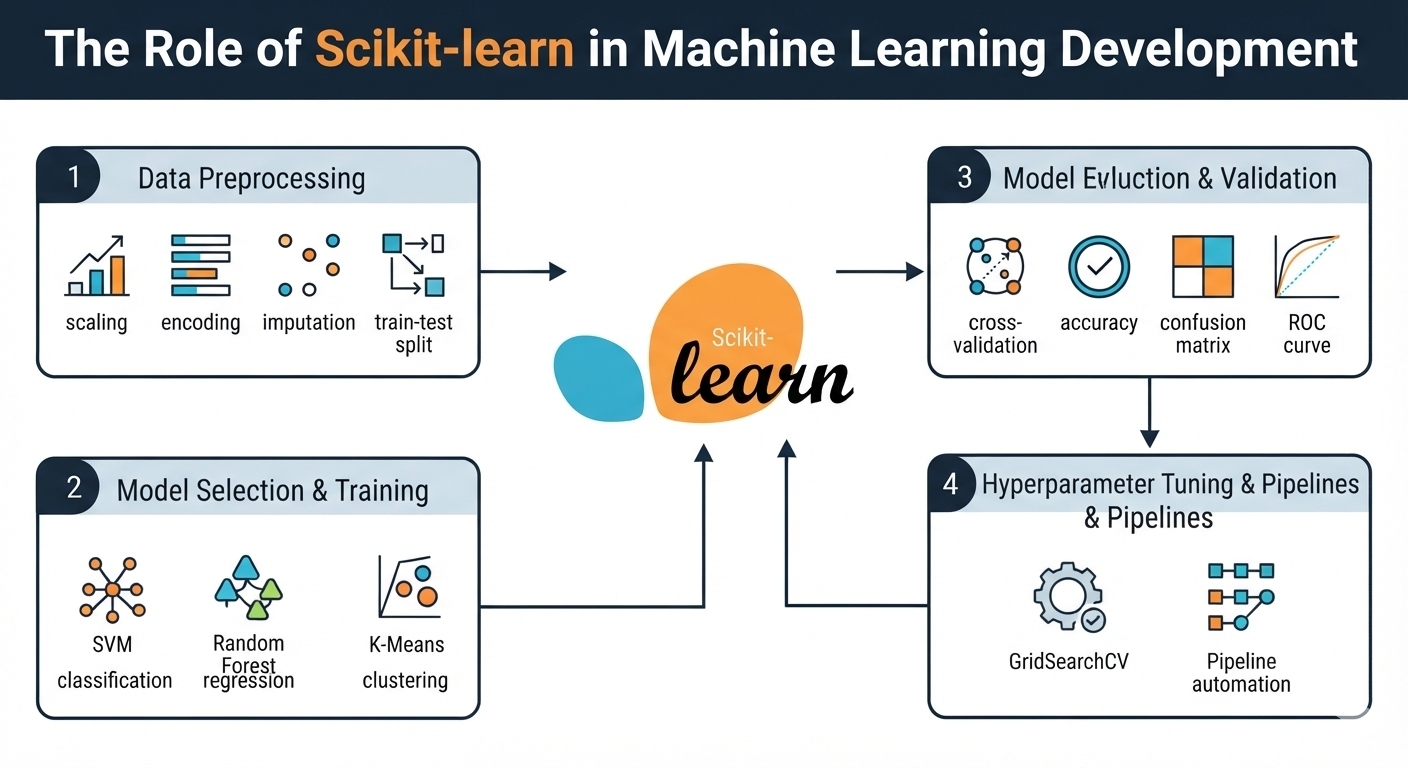
Machines are learning and changing the way we live today. Algorithms can make your work easier. Whether it's related to the procedure of getting a ticket or a job. If you’re not doing machine learning, it’s really hard to create a predictive model. You don't want to get caught up in the math. The filthy data needs to be cleaned, the right methods need to be selected, the models need to be trained, and the results need to be tested. This is where the Python libraries live. Scikit-learn is the perfect toolbox for developers and data scientists everywhere. It’s so simple to begin with, yet it still has a lot of capability. If you want to enhance your skills with Scikit-learn then you should enroll in the Machine Learning Online Course and train yourself while you are working.
What Is Scikit-learn?
Scikit-learn is a free software machine learning library for the computer language Python. It was first launched in 2007. Has since become one of the most trusted and commonly used tools within the discipline of data science. Built on top of Python libraries like NumPy, SciPy and Matplotlib, Scikit-learn gives you clean, consistent and straightforward tools for evaluating predictive data. Scikit-learn includes tools that programmers can use to classify data, group related items, make correct predictions and assess how well a model works without having to create difficult mathematical formulas from scratch. It links data to sophisticated software systems.
Core Features and Capabilities of Scikit-learn
With scikit-learn you get the whole toolkit that practically covers every step of a typical machine learning pipeline. With Machine Learning Certification Course you can learn about it and gain practical hands-on experience with the advantage of certification. It’s a must-have for developers because to five key features:
Preprocessing of Data and Cleaning: In the real world, data is typically untidy with missing values and scale mismatches. Scikit-learn has good tools for normalising numbers, handling missing entries and converting text categories to numerical values that algorithms can readily analyse.
Supervised Learning Algorithms: Scikit-learn includes a large collection of classification and regression algorithms which can be used with a few lines of clean code to implement models such as Linear Regression, Decision Trees, Support Vector Machines (SVM) and Random Forests.
Unsupervised Learning Models: Work with your unlabeled data to uncover hidden, structured information within it via clustering and dimensionality reduction using models such as K-Means, and PCA.
Model Validation and Evaluation: But building a model is only half the battle, the other half is model validity and evaluation. You will also need to test it on new data to see how well it works. Scikit-learn has certain built-in methods to accurately test the models depending on their performance. These include an accuracy score, a mean squared error and cross-validation.
Hyperparameter Tuning and Grid Search: You can spend hours guessing the best configuration values for a model. This is known as hyperparameter tuning and grid search . Scikit-learn automates this procedure by using Grid Search and Randomised Search. It tries out a lot of various parameter combinations to build the most accurate model possible.
Why do developers and data scientists love Scikit-learn?
There are tons of machine learning frameworks available today. However, Scikit-learn is still the ideal choice for beginners and experienced experts alike for several good reasons:
Consistent and Easy to Learn API | All Scikit-learn functions have the same structure. Once you learn how to use .fit() and .predict() for one model, you know how to use them for nearly every model in the library. |
Seamless Integration with Python Ecosystem | It fits nicely with the rest of the Python data science stack and is straightforward to integrate with the Python ecosystem. Scikit-learn can take data from Pandas DataFrames and NumPy arrays directly.You can plot your results using matplotlib or seaborn. |
Complete Documentation and Community Support | Scikit-learn is famous for its user-friendly documentation, user guides, and examples which are easy to follow and use for beginners. If you feel stuck you can go online and get answers to similar issues other writers have asked already. |
High Performance for Standard Datasets | Deep learning frameworks require strong GPU hardware, but Scikit-learn is designed to run efficiently on standard CPU hardware. This makes it lightning fast for everyday business challenges and table based data sets. |
Production-Ready and Reliable Codebase | The code inside scikit-learn is stable, robust and trusted by organisations across the world for production-level machine learning applications. It has been tested extensively by the community for years and actively maintained. |
The demand for the developers with machine learning skills is increasing in Delhi. And if you are the developer who wants to learn ML then join the Machine Learning Course in Delhi.
The bottom line
Today, in the domain of machine learning, the use of Scikit-learn is significant as it helps to speed up, simplify and organise the complex examination of data. It has extensive preprocessing features, comprehensive application programming interfaces (APIs) and reliable algorithms. It is easy to start constructing simple mathematical applications. Working with Scikit-learn is a huge advantage for anyone, from the student building their first classification model to the business person designing solutions that can predict the future. If you want to be a writer, or a data scientist, one of the most useful things you can do is learn how to utilize this fundamental Python package. Artificial intelligence is still shaping the future of technology.