
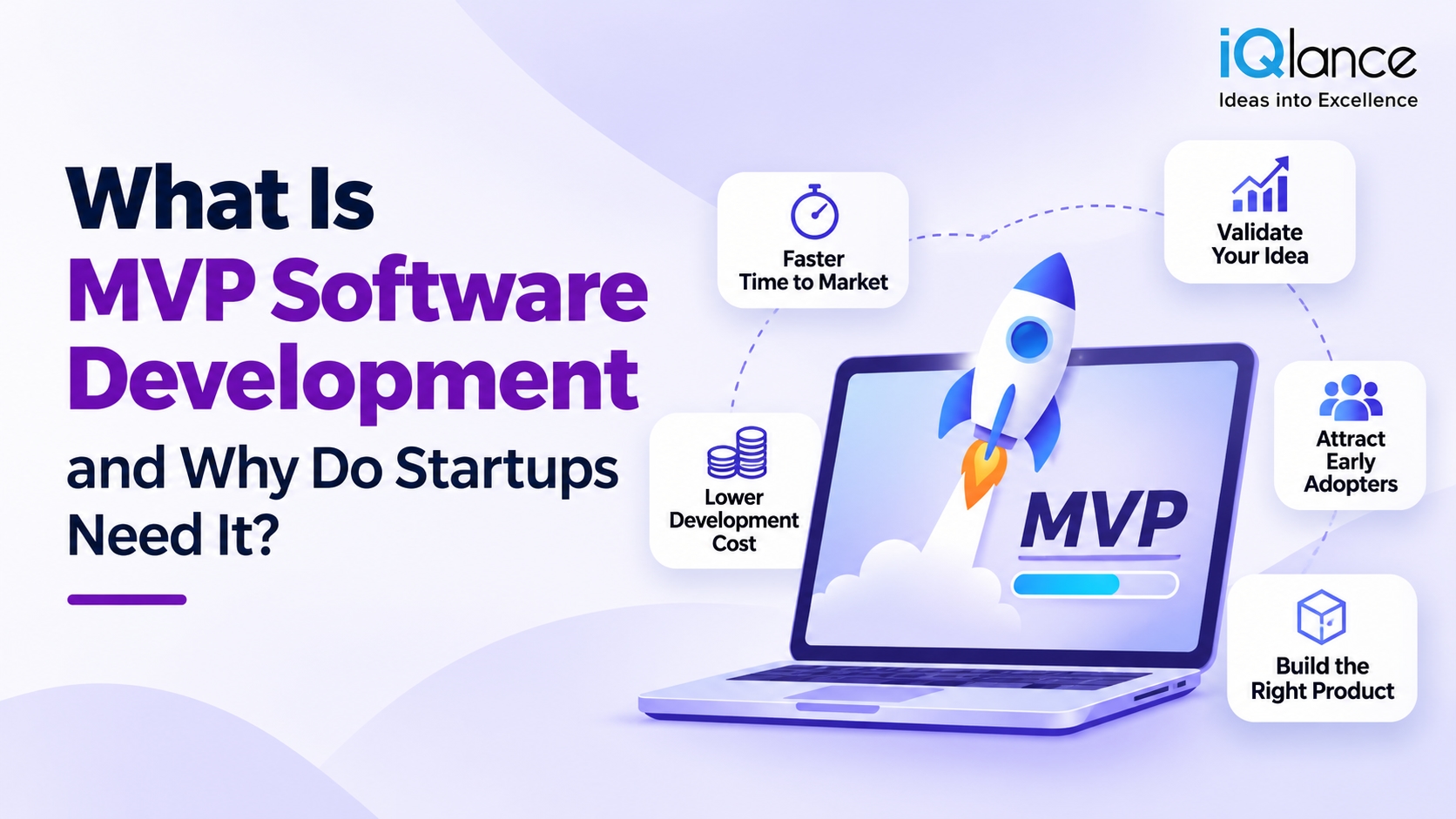
Starting a new business often begins with an innovative idea, but turning that idea into a successful software product requires careful planning, investment, and market research. Many startups make the mistake of developing a complete software product before understanding whether customers actually need it. This approach can increase development costs, delay product launches, and create unnecessary business risks.
This is where Minimum Viable Product (MVP) software development becomes valuable. It allows startups to transform their ideas into functional software products with essential features, launch them in the market, and collect feedback from real users before investing in full-scale development.
Instead of spending months building a feature-rich application, startups can focus on developing a simplified version that solves their target audience's primary problem. This approach helps businesses validate their ideas, understand customer expectations, and make informed decisions about future development.
In this article, we will explore what MVP software development means, how it works, its benefits for startups, and why it is an effective approach for launching new software products.
What Is MVP Software Development?
MVP software development is the process of creating a Minimum Viable Product with only the essential features required to solve a specific user problem and deliver initial value. It is an early version of a software product designed to test a business idea with real users before developing the complete solution.
The primary objective is not to create an incomplete or low-quality application. Instead, it is to build a functional product that focuses on the most important requirements while avoiding unnecessary features during the initial development stage.
For example, imagine a startup wants to develop an online food delivery application. Rather than immediately building advanced features such as AI-based recommendations, loyalty programs, multiple payment integrations, and real-time analytics, the startup can begin with essential functionalities.
These may include:
User registration and login.
Restaurant listings and menus.
Food ordering functionality.
Basic payment integration.
Order tracking.
Customer notifications.
Once the application is launched, the startup can observe how customers interact with it, identify missing features, and understand which improvements should be prioritized.
This makes MVP development a practical approach for startups looking to enter competitive markets without committing their entire budget to an untested idea.
How Does the MVP Software Development Process Work?
Developing an MVP requires a structured approach that connects business objectives with user expectations. Each development stage focuses on building a product that can be tested, evaluated, and improved.
1. Identify the Business Problem
Every successful software product begins with a problem worth solving. Before starting development, startups need to identify their target audience, understand their challenges, and define the primary purpose of the product.
Market research, competitor analysis, customer interviews, and surveys can help businesses understand whether their proposed solution addresses a genuine market requirement.
2. Define Essential Features
Once the business problem is identified, the next step is determining which features are necessary for the initial product launch.
Startups should separate essential functionalities from additional features that can be introduced later. Prioritizing features helps control development costs and keeps the initial product focused.
For example, an MVP for a healthcare appointment application may initially include patient registration, doctor profiles, appointment scheduling, and booking notifications.
3. Design the User Experience
A simple and intuitive user experience is important for an MVP. Users should be able to understand the application and complete essential activities without unnecessary complexity.
During this stage, development teams create wireframes, prototypes, user flows, and interface designs to establish how the product will look and function.
4. Develop the MVP
After finalizing the design and technical requirements, developers begin building the application. This includes selecting the appropriate technology stack, developing the backend, implementing frontend functionality, and integrating essential third-party services.
Working with an experienced MVP software development agency can help startups establish a suitable development architecture while maintaining a clear focus on their initial business objectives.
5. Test and Launch
Before releasing the product, developers conduct functional, usability, performance, and security testing.
Once the essential features are working correctly, the MVP can be launched to a selected group of users or introduced to the wider target market.
6. Collect Feedback and Improve
The development process does not end after launch. Startups need to monitor user behavior, collect feedback, analyze performance, and identify areas requiring improvement.
Based on these findings, businesses can introduce additional features, improve existing functionality, and gradually transform the MVP into a more comprehensive software product.
Why Do Startups Need MVP Software Development?
For startups, every investment matters. Building a complete software application without validating its market demand can create unnecessary financial and operational challenges.
Here are some important reasons why developing an MVP can benefit early-stage businesses.
1. Reduce Initial Development Costs
Developing a full-featured application requires significant investment in design, development, testing, infrastructure, and ongoing maintenance.
An MVP focuses on essential functionalities, helping startups avoid spending money on features that may not provide immediate value.
By starting with a smaller product, businesses can manage their initial development budget more effectively and allocate resources toward future improvements based on actual user requirements.
2. Validate Business Ideas Before Investing More
A business idea may look promising during the planning stage, but its actual market demand can only be understood by testing it with real customers.
An MVP provides an opportunity to introduce the product to potential users and evaluate their response.
Startups can discover whether customers are interested in the solution, which features they prefer, and whether they are willing to pay for the product.
This validation helps founders make better decisions before committing to larger development investments.
3. Launch Products Faster
Speed is important for startups entering competitive industries. Spending several months developing a complete application can delay market entry and give competitors an advantage.
MVP development allows businesses to prioritize core features and release an initial product within a shorter development cycle.
An early launch also creates opportunities to attract initial customers, establish market presence, and begin building brand awareness.
4. Understand Real Customer Requirements
Customer expectations are not always the same as business assumptions. Features that founders consider important may not be useful to actual users.
By releasing an MVP, startups can collect feedback directly from their target audience.
This information helps businesses understand customer preferences, identify usability problems, and prioritize improvements that deliver meaningful value.
5. Attract Investors and Business Partners
Investors often look for evidence that a startup's idea has market potential. A business plan alone may not demonstrate how customers will respond to a proposed solution.
A working MVP provides something tangible that founders can demonstrate during investor presentations.
It can showcase the product concept, core functionality, user experience, and early market validation. Depending on its traction and business potential, an MVP may help startups build investor confidence and explore funding opportunities.
6. Minimize Business Risks
Developing a complete application without testing its concept can expose startups to financial and operational risks.
An MVP reduces initial commitment by allowing businesses to test their assumptions before expanding the product.
If the initial approach does not meet customer expectations, startups can make changes without rebuilding an extensive application.
This flexibility makes it easier to adjust product direction and respond to changing market requirements.
7. Build a Scalable Product Gradually
An MVP should be developed with future expansion in mind. Although the initial version includes limited functionalities, its architecture should support additional features and increasing user demand.
Startups can gradually introduce advanced capabilities such as AI-powered automation, analytics dashboards, third-party integrations, subscription management, and personalized user experiences.
This approach supports continuous product development without requiring businesses to introduce every feature from the beginning.
MVP vs Full Product: What Is the Difference?
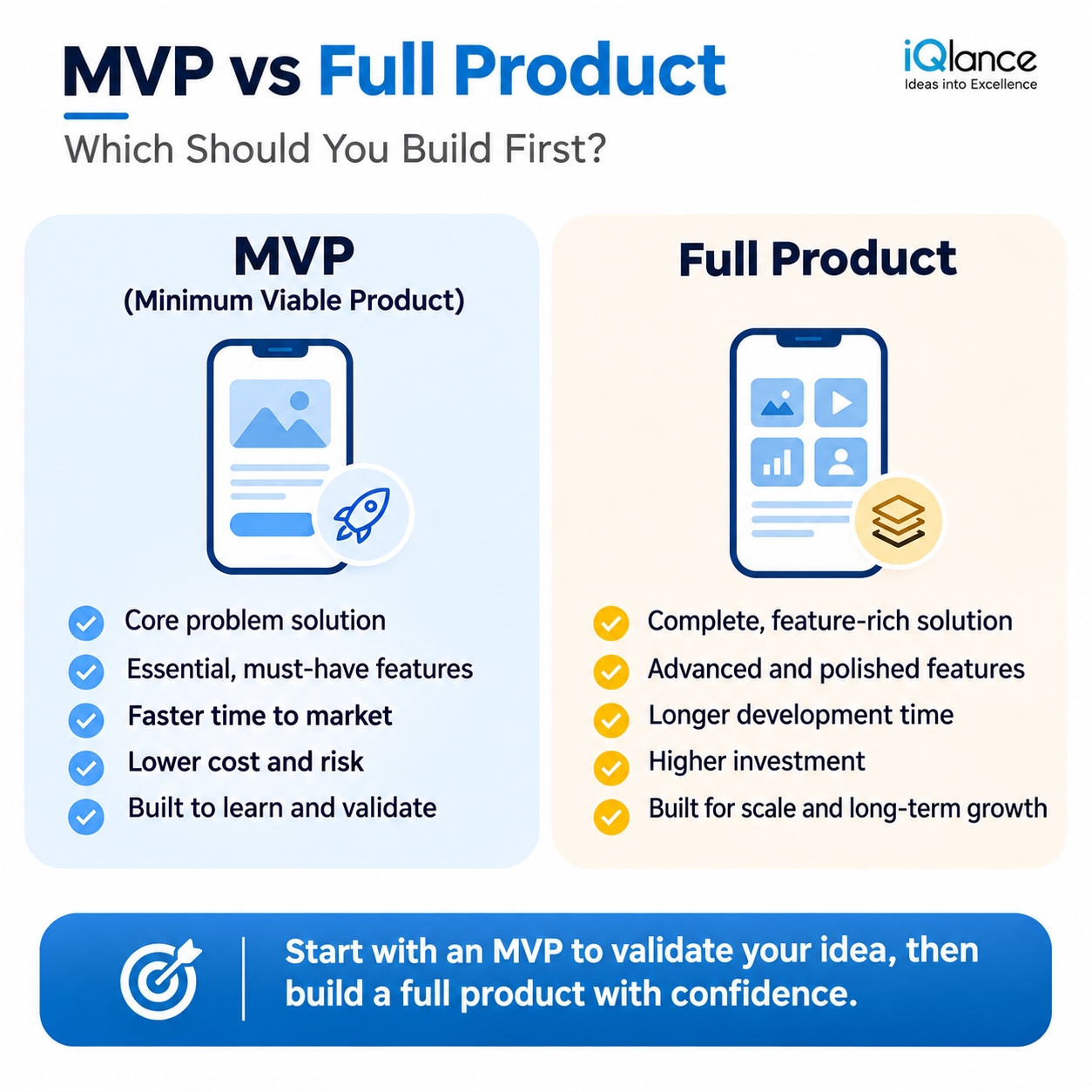
An MVP and a full product serve different purposes in the software development lifecycle. While an MVP focuses on validating an idea with essential functionalities, a full product is designed to provide a more comprehensive experience with advanced features and capabilities.
1. Development Scope
An MVP includes only the essential features required to solve the primary user problem. A full product includes additional functionalities, advanced integrations, and more comprehensive user experiences.
2. Development Cost
An MVP generally requires a smaller initial investment because the development scope is limited. A full product requires more resources for advanced functionality, testing, infrastructure, and implementation.
3. Development Time
An MVP can typically be developed and introduced to the market faster because the team concentrates on essential features. A complete product generally requires a longer development cycle.
4. Primary Objective
The main objective of an MVP is to validate the business concept, test market demand, and understand customer expectations. A full product focuses on delivering a comprehensive solution to a broader audience.
5. Feature Availability
An MVP provides the basic functionalities needed to deliver initial value. A full product offers more advanced features, integrations, automation, and customization options.
6. Future Improvements
An MVP evolves through customer feedback and market research. A full product continues to receive updates, feature enhancements, performance improvements, and new capabilities.
For example, a startup developing a project management application can initially launch an MVP with task creation, team management, and basic progress tracking.
After understanding customer requirements, the company can expand the product with advanced reporting, workflow automation, integrations, and AI-powered task management.
The right approach depends on business objectives, available resources, market expectations, and product complexity.
Industries That Can Benefit from MVP Development
MVP development is suitable for businesses across different industries that want to test new software ideas before investing in complete solutions.
Some common examples include:
1. Healthcare
Startups can develop appointment booking platforms, telemedicine applications, patient management systems, and digital health solutions. An initial product can focus on essential patient and provider interactions before introducing advanced healthcare integrations.
2. FinTech
Businesses can test digital payment platforms, expense management applications, budgeting tools, and financial dashboards. Early user feedback helps determine which financial features should be prioritized.
3. E-commerce
New businesses can launch online marketplaces with product listings, shopping carts, checkout functionality, and order management. Additional capabilities can be introduced after understanding customer purchasing behavior.
4. Logistics
Startups can validate fleet management platforms, shipment tracking applications, delivery management systems, and logistics automation solutions.
5. Education
Entrepreneurs can introduce online learning platforms, course management applications, student portals, and virtual classroom solutions.
6. SaaS
Businesses can test subscription-based software products with essential user management, dashboards, reporting, and account management functionalities.
How to Choose the Right MVP Development Partner?
Selecting the right technology partner is an important decision for startups because the development team's technical expertise and planning approach can influence the product's future direction.
When evaluating potential development partners, consider the following factors:
Technical Expertise: Look for developers with experience in relevant programming languages, frameworks, databases, and cloud technologies.
Industry Experience: Choose a team that understands your business requirements and target market.
Development Methodology: Ensure the team follows an organized development process with clear milestones and regular communication.
UI/UX Capabilities: Evaluate its ability to create user-friendly interfaces and practical application experiences.
Scalability Planning: Make sure the proposed architecture can support future product expansion.
Post-Launch Support: Check whether the team provides maintenance, technical support, updates, and feature enhancements.
Choosing the right partner helps startups maintain development quality while keeping their product aligned with business goals.
Build Your Startup Idea with iQlance Solutions
Turning an innovative idea into a functional software product requires the right combination of business planning, technical expertise, and development strategy.
iQlance Solutions is a software development company in texas helping startups and businesses transform their ideas into customized digital solutions. Our team focuses on understanding business requirements, identifying essential product features, and developing software solutions aligned with specific business objectives.
We provide an end-to-end MVP software development service covering product discovery, UI/UX design, frontend and backend development, quality testing, deployment, and ongoing support.
Whether you are planning a SaaS platform, healthcare application, logistics management system, or custom business software, we help you establish a practical development roadmap and bring your initial product vision to life.
Working with experienced MVP software development agencies can help startups approach product development strategically, validate ideas, and prepare for future growth.
Ready to Turn Your Software Idea into Reality?
Connect with iQlance Solutions to discuss your MVP requirements and explore how we can help turn your concept into a functional software product.
Website: https://www.iqlance.com/mvp-software-development-company/
Address: 17250 Dallas Pkwy, Dallas, Texas 75248, United States
Phone: 469-793-9837